
How to Improve Vocabulary Effortlessly
Learn how to improve vocabulary with 11 effective techniques
Knowing how to improve vocabulary works a lot like a gym membership bought in January. Full of promise on day one. Then a slow fade by week three. Why is that? Well, the problem is less often motivation. It’s likely due to a lack of a learning strategy.
We can’t build a working vocabulary by occasionally looking up a word and moving on. Words need to be met, used, wrestled with, and revisited. Similar to the way we learn a route through a new city. Walk it once, and it vanishes. Walk it five times, and it becomes muscle memory.
Thus, let’s think about what a rich vocabulary actually gives you in real life. Is it really about sounding impressive at dinner parties? Or is it about having options on how to express yourself in any kind of situation?
When you know thirty words for angry, you can choose between irritated, incensed, livid, indignant, and exasperated, for example. Each one paints a slightly different picture, each one landing differently on the person reading or hearing it.
Precision, color, nuance. That’s what strong vocabulary building delivers. And vocabulary learning, done right, is less about memorizing lists (luckily) and more about expanding the palette you reach for without thinking.
This guide covers 11 techniques to genuinely improve your vocabulary. It covers every practical angle of how to improve vocabulary across different goals and learning styles and is grounded in how the brain acquires and retains language.
Whether you’re expanding professional fluency in English, preparing for academic exams, navigating a second language, or simply wanting to read and write with more confidence, the principles are the same. Words stick when you meet them in context, revisit them at the right moment, and use them deliberately.
What you’ll take away: A practical, research-backed system for improving your vocabulary — with tools, AI tips and techniques to learn new words faster and make them stick.
Let’s look at 11 techniques that will teach you how to improve vocabulary across different domains.
1. Start With a Goal, Not a Wish

Specificity separates the people who build strong vocabularies from those who carry good intentions around for years without acting on them. Wanting to “learn more words” is not a goal. It’s a wish.
A comfortable B2-level reader in English — someone who handles novels and professional documents without strain — has working access to roughly 8,000–10,000 word families.
A C2 speaker moves past 20,000. Knowing where you currently sit changes everything about how you approach vocabulary learning, plan your strategies, and decide which words to prioritize first.
Before anything else, decide what you’re building toward. Professional vocabulary for your field? Academic word lists for GRE or IELTS? Casual conversational fluency in a second language? Each path requires a different starting point, a different word list, a different tempo.
Your action
Write down three specific vocabulary goals. Make each one measurable.
“Learn 15 new vocabulary words per week in my professional field” is a goal. “Learn more legal vocabulary” is not.
One distinction worth establishing early:
active vocabulary versus passive vocabulary.
Passive vocabulary is what you recognize when you see or hear a word.
Active vocabulary is what you reach for when you speak or write.
The two overlap, but they are not the same territory. A word can sit in your passive vocabulary for years — recognized every time, used never. Getting words across into active use takes a separate, deliberate step: conversation, writing, and speaking practice. This guide covers both sides.
Setting the goal clearly now also determines which techniques below you should prioritize. If improving active vocabulary is your target, lean harder on Sections 7 and 9. If passive recognition for reading is the goal, Sections 3 and 5 are your fastest return.
2. Use a Dictionary Like an Explorer, Not a Rescue Tool

Now that you have a clear target, a dictionary becomes your first and most underrated tool. Well, provided you treat it as something to explore rather than something to consult in a crisis.
A dictionary is the least glamorous vocabulary tool in existence. It is also still one of the most reliable.
The shift worth making is moving from reactive to proactive use. Reaching for a dictionary only when you’re confused is the minimum.
The better habit is to use it to explore:
- Look up a word you already know,
- Read its etymology,
- Work through the example sentences,
- Then follow the synonyms in the thesaurus to understand the shades of difference in register and tone.
For online dictionaries, Merriam-Webster and Oxford Learner’s Dictionaries are the most authoritative free options. Power Thesaurus offers a strong alternative to Thesaurus.com, with community-rated synonyms that reflect current usage well.
Merriam-Webster’s Word of the Day is a small habit with a large cumulative effect — one word properly absorbed each day is 365 new vocabulary words added to your active range per year — a quiet, consistent way to improve vocabulary daily without dedicated study blocks.
AI tip — contextual thesaurus on demand:
- Paste any sentence containing a word you want to replace into ChatGPT.
- Ask: “What does [word] mean in this context? Give me three synonyms and tell me which is most formal.”
- You receive context-sensitive alternatives immediately — not a generic synonym list.
Tip: QuillBot is an AI writing tool that also helps to improve vocabulary. Read our QuillBot review here.
The dictionary and thesaurus are your first line of defense in building passive vocabulary. But passive recognition alone won’t carry you far. The next vocabulary technique — strategic reading — is where word retention really starts to compound.
3. Read More — and Read Strategically

Reading is the single most researched pathway to vocabulary acquisition. What receives less attention is how the type of reading matters as much as the volume.
Research in second-language acquisition draws a useful line between two reading modes. Extensive reading means reading large volumes of accessible text for pleasure and flow. Intensive reading means slowing down deliberately — looking up unfamiliar words, examining how sentences are constructed.
Both build lexical knowledge. Extensive reading develops contextual learning fluency. Intensive reading builds precision.
Use both: read widely at a comfortable level to expand your vocabulary naturally, and occasionally take on something harder with full attention.
Your reading choices matter
To improve vocabulary across different use cases, your reading choices matter:
- Academic vocabulary: long-form journalism (The Atlantic, The New Yorker), research summaries, quality non-fiction — dense, precise, register-conscious
- Professional vocabulary: industry publications, well-edited business writing, case studies in your field
- Casual and conversational vocabulary: contemporary fiction, personal essays, podcasts with transcripts
- Language learning: graded readers in your target language first, then native-level content as fluency grows
Start small and aim higher gradually. Classic novels are a consistently strong choice. The writing tends to be precise, varied, and register-rich. For free novels to read online, ReadAnyBook.com carries thousands of titles across genres.
If reading print isn’t always practical, audiobooks are equally effective for passive vocabulary exposure. Open Culture and Loyal Books both offer extensive free audiobook libraries weighted toward classic literature. This means rich, well-crafted vocabulary from page one.
A word encountered in context is far more memorable than a word pulled from a list. That is contextual vocabulary learning at work. It is also the same principle behind the best vocabulary apps, which you’ll see in Section 6.
Build a small habit alongside your reading: carry a vocabulary journal or use a notes app. When a word stops you, write it down with its full sentence. Over time, you return to a word bank built from your own reading. That is more useful than any preset list someone else compiled.
Both extensive and intensive reading build lexical knowledge. Extensive reading develops contextual learning fluency. Intensive reading builds precision. Thus, read widely at a comfortable level to expand your vocabulary naturally, and occasionally take on something harder with full attention.
AI tip — vocabulary capture while reading:
- When you encounter an unfamiliar word, open ChatGPT.
- Type: “I just read [word] in this sentence: [paste sentence]. Explain the meaning, give me two words from the same word family, and one example sentence in a professional context.”
- Save the response in your vocabulary journal.
For deeper reading comprehension strategies that complement vocabulary work, see our guide. On the other hand, Readwise Reader captures vocabulary automatically as you highlight. It covers how to use it effectively.
Reading fills your passive vocabulary rapidly. The next step is making sure those words actually stay. And that requires giving them somewhere vivid to live in your memory.
4. Attach Words to Images That Won’t Fade

To improve vocabulary systematically, think of vocabulary learning as building a filing system. A word with no image attached is a loose piece of paper with no folder. It gets lost. A word linked to a vivid mental picture has somewhere to live — and something to pull it back to the surface when you need it.
The visualization technique works because episodic memory — the system that stores personal experiences and sensory images — is substantially more durable than the rote memory used for lists.
Thus, attach a word to an image, a scene, a physical sensation, and you create a retrieval path that resists fading far longer than repetition alone.
This is what mnemonic devices exploit. Word association is the simplest form: link a new word to something you already know that sounds or looks similar.
Melancholy sounds like melon and collie. Picture a sad dog eating a melon in the rain. Absurd? Completely. Forgettable? Surprisingly not.
Games exploit the same mechanism. The Camping Trip game is a classic memory exercise: one player starts with “I’m going on a camping trip, and I’m bringing [word],” and each player must recall all previous items before adding their own.
If played with vocabulary targets, it turns word retention into a social challenge. The mild pressure of recall in front of others makes the memory stick harder, more fun.
For more structured systems, the method of loci — the memory palace — applies the same principle at scale. Words get placed inside a familiar mental space: your home, your commute route. Each location becomes an anchor. Walk through the space mentally, and the words surface with it.
AI tip — instant image anchors for abstract words:
- Pick any abstract word you’re struggling to retain.
- AI Prompt: “Describe a vivid, surreal image that represents the word [word] and its meaning. Make it memorable and slightly absurd.”
- Hold that image in mind for ten seconds before moving on. The absurdity is the point. It creates the hook.
For a full guide to memory systems and their vocabulary applications, see memory techniques and how to build a memory palace.
Imagery anchors words in long-term memory. Games and flashcards, covered next, do something complementary. They force you to retrieve those words under pressure, which is what actually cements them.
5. Learn Through Games and Flashcards

Vocabulary games work not because they make learning enjoyable (though they do) but because they force active retrieval. Every time you reach for a word under mild pressure, you strengthen the neural pathway that leads to it. Games are retrieval practice wearing a friendlier face.
Classics like Scrabble, Boggle, and crossword puzzles remain genuinely effective here. You cannot win by recognizing words. You have to produce them. That shift from recognition to production is precisely where active vocabulary develops.
For digital vocabulary games, ManyThings.org offers free vocabulary quizzes in multiple formats, including vocabulary matching and word recall exercises.
Flashcards deserve particular attention because they form the foundation of the most research-supported vocabulary method available: spaced repetition.
If you want to improve your vocabulary daily without engineering a separate study routine, spaced repetition is the closest thing to a system that runs itself. You can think of it like watering a plant. Water it too early, and you waste the effort. Leave it too long, and it wilts.
Spaced repetition finds the exact right moment — rescheduling each vocabulary flashcard to reappear precisely when it’s about to fade from memory. The reinforcement hits at maximum efficiency.
Anki is the most widely used spaced repetition app, free and open-source. It supports custom card decks with audio and image fields, across any language and any domain.
For a more guided approach with prebuilt vocabulary sets, Quizlet offers a freemium model with AI-generated quiz formats and collaborative deck sharing.
A personal note: I use Anki flashcards myself for vocabulary learning in Spanish. The consistency of the review schedule does something that willpower alone never managed. It keeps words in rotation long enough for them to actually cross from passive recognition into active use.
AI tip — domain-specific flashcard generation:
- Open ChatGPT: “Generate 20 flashcards for [your field: legal / medical / business] English vocabulary. Format as: FRONT: [word], BACK: [definition + one example sentence].”
- Export the output into Anki or Quizlet.
- Your deck now reflects your actual vocabulary needs — not a generic word list designed for no one in particular.
Games and flashcards cover the retrieval side of vocabulary learning. For the tools that automate and scale the whole process, the next section covers what’s actually worth your time.
6. Use Software to Improve Vocabulary

There is no shortage of vocabulary apps. There is, however, a shortage of good ones. The real test is whether an app simply presents vocabulary words or actively adapts to how well you are retaining them — and that distinction matters enormously for long-term word retention.
Here is an honest breakdown of the tools worth your time:
| Tool | Best For | Language Support | Key Strength |
|---|---|---|---|
| Wordela | Serious English vocabulary building | English only | 146,000-word database with AutoLearn AI scheduling |
| Anki | Custom decks, all domains, all levels | 50+ languages | Free, open-source, research-backed spaced repetition |
| Quizlet | Students, quick review, collaborative sets | Wide multilingual support | AI-generated quizzes, broad word list library |
| Vocabulary.com | Adaptive English learning, all levels | English | Adaptive difficulty, real contextual sentences |
| Clozemaster | Intermediate–advanced vocabulary in context | 50+ languages | Cloze exercises using real sentence corpora |
| LingQ | Improve vocabulary through reading | 60+ languages | In-context word capture, personal word tracking |
Wordela by eReflect (visit website) is the most comprehensive dedicated program currently available to teach you how to improve vocabulary. Its database contains over 146K+ words drawn from a 520-million-word linguistic corpus, meaning that every definition and example sentence comes from documented real-world language use.
Its AutoLearn AI technology continuously tracks your comprehension and schedules a review at the precise moment a word is at risk of being forgotten. Spaced repetition is built into the software itself, with no manual scheduling required.
The platform runs across Mac, PC, Linux, iOS, and Android with cloud sync, and includes 639 curated word lists developed by published academics — covering SAT, GRE, TOEFL, GMAT, business English, and K–12 curriculum.
Tip: Read our Wordela review and our list of the best vocabulary apps for a full comparison.
Where Such Tools Fail to Improve Vocabulary
No app replaces the full vocabulary-building cycle on its own. Apps build strong passive recognition. Active vocabulary — words you use fluently in speech and writing — only develops through practice outside the app: conversation, deliberate writing, and real use under pressure.
Wordela is English-only. Multilingual learners building vocabulary in other languages need Anki, Clozemaster, or LingQ for non-English work. Anki’s blank-canvas interface requires real setup time before it pays off — new users often abandon it before experiencing its benefits. Quizlet’s AI quiz features are improving, but remain inconsistent across different word sets.
Pick one app as your primary spaced repetition engine. Treat everything else in this guide as the surrounding system. No single tool is sufficient on its own.
Ok, deep breath. You are doing well. So, apps are powerful for systematic review. Writing, covered next, is where you discover whether any of that review has actually taken hold.
7. Write More, Write Deliberately

Writing is where passive vocabulary becomes active. It is also the step many learners skip — and the reason their vocabulary stays exactly where it is.
It is also one of the most underused vocabulary learning strategies for people trying to build and improve vocabulary that actually transfers to real speech and writing, and not just recognition.
Reading a word feels like knowing it. Writing with it tells a different story. Sit down to use laconic in a sentence, and you’ll quickly discover whether you actually own it or merely recognize it. That distance between recognition and ownership is what deliberate writing practice closes, one word at a time.
Practical approaches to improve vocabulary:
- Keep a vocabulary journal. Each week, take five new words and write a short paragraph — not a definition list — using all five naturally in context. Force the words into sentences that could exist in real life.
- Blog or write essays on topics that genuinely interest you. The vocabulary you reach for when engaged is the vocabulary you retain. Boredom produces forgettable writing and forgettable learning.
- Try poetry. Sites like Poem of Quotes offer prompts and a community for short-form writing. A poem forces word precision in ways prose rarely does — every word choice is visible, and there’s nowhere to hide behind a long sentence.
- Mind maps for conceptual vocabulary: take one abstract word and map its associations, synonyms, antonyms, and related concepts. Miro works well digitally; pen and paper are just as effective.
- Vocabulary worksheets suit structured learners who prefer guided, fill-in-the-blank practice — particularly useful for academic vocabulary targets like GRE or IELTS preparation.
AI tip — live vocabulary coaching while you draft:
- Write anything: a paragraph, an email, a short essay.
- Paste it into ChatGPT: “List every word I’ve repeated more than twice and suggest one stronger or more varied alternative for each. Flag any vague or overused words too. For this text: [your text here]“
- Review the suggestions critically — accept what sharpens clarity, ignore what doesn’t fit your voice.
For note-taking strategies that support vocabulary retention alongside writing practice, see how to take notes.
Writing pushes vocabulary into active use. Knowing why words are shaped the way they are — their roots, their history — gives you a structural shortcut for learning entire clusters at once. That’s what word origins offer.
8. Learn Words Through Their Origins
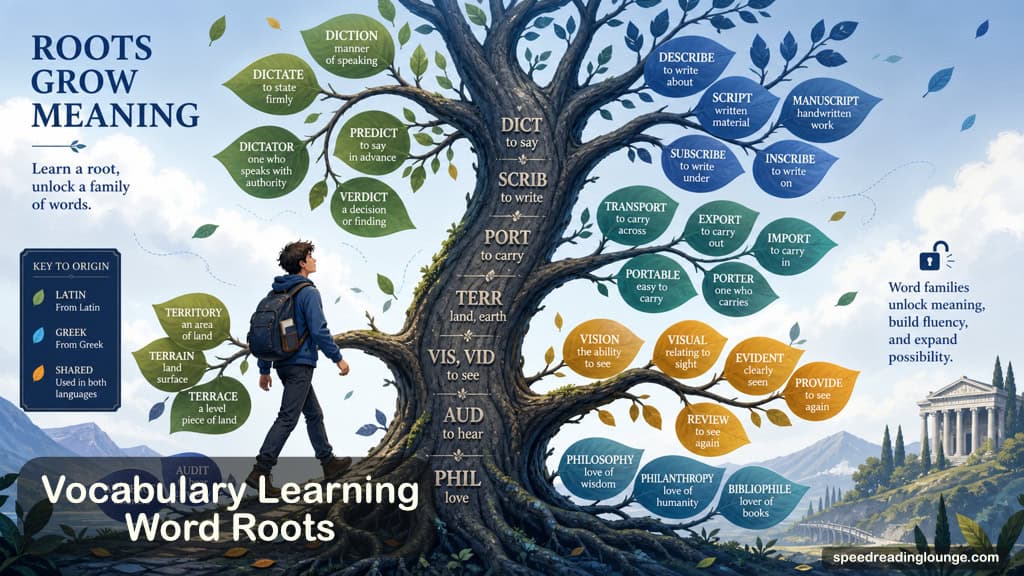
Latin and Greek roots are the infrastructure beneath English vocabulary. Once you understand them, you stop learning words one at a time and start acquiring them in clusters.
The prefix bene- (good) gives you benefit, benevolent, benefactor, and benediction in one move. One root. Four words. Same cognitive effort as learning one.
Linguists call this a word-family strategy — learning the morphological relationships among words rather than their isolated definitions. It is especially powerful for academic and professional vocabulary, where Latin and Greek roots are densely concentrated.
Alongside roots, prefixes, and suffixes are worth mastering as dedicated tools. Understanding that -tion converts a verb to a noun, or that un- reverses meaning, or that -ous signals an adjective.
These patterns let you decode unfamiliar words on first encounter without stopping to look them up. A comprehensive list of the most common English prefixes and suffixes makes an effective companion reference for this section.
Remember 10 Word Roots to Improve Vocabulary
Ten roots that unlock a disproportionate share of English vocabulary:
| Root | Meaning | Examples |
|---|---|---|
| port (Latin) | carry | transport, export, portable, import |
| rupt (Latin) | break | interrupt, erupt, disrupt, corrupt |
| dict (Latin) | say/speak | predict, dictate, contradict, verdict |
| scrib/script (Latin) | write | describe, manuscript, prescribe, inscription |
| spec/spect (Latin) | see/look | inspect, spectator, perspective, specimen |
| bene (Latin) | good | benefit, benevolent, benefactor, benediction |
| mal (Latin) | bad | malfunction, malice, malevolent, malign |
| graph/gram (Greek) | write/record | photograph, telegram, biography, diagram |
| phon (Greek) | sound | telephone, microphone, symphony, phonics |
| log/logy (Greek) | word/study | biology, dialogue, monologue, chronological |
One more underused technique: link words across languages that sound alike (cognates). Rose in English, rose in French, rosa in Italian, rosa in Spanish — the same root, the same core meaning, instantly recognizable across four languages.
When you spot a shared root between your native language and a language you’re learning, note it. These cross-language bridges significantly reduce the cognitive load of vocabulary acquisition in a second or third language.
This pays off differently depending on your goal. Academic learners targeting GRE vocabulary will find that roots unlock enormous swaths of the word list at once.
Language learners discover that many Latin roots reappear across Romance languages — know “port” in English, and you recognize “porter” in French, “portare” in Italian, and “portar” in Spanish. One root, multiple languages. The word family strategy you’ve built in English carries directly into your next language.
AI tip — word family building on demand:
- Pick any unfamiliar word.
- AI Prompt: “Give me the Latin or Greek root of [word], five related words from the same root, a brief meaning for each, and a one-sentence memory hook.”
- One new word becomes a vocabulary cluster of six.
Roots give you structure. Conversation gives you speed. Knowing a word intellectually and being able to use it under the pressure of real speech are two very different skills — which is why the next section matters more than most learners expect.
9. Speak New Words Before You Feel Ready
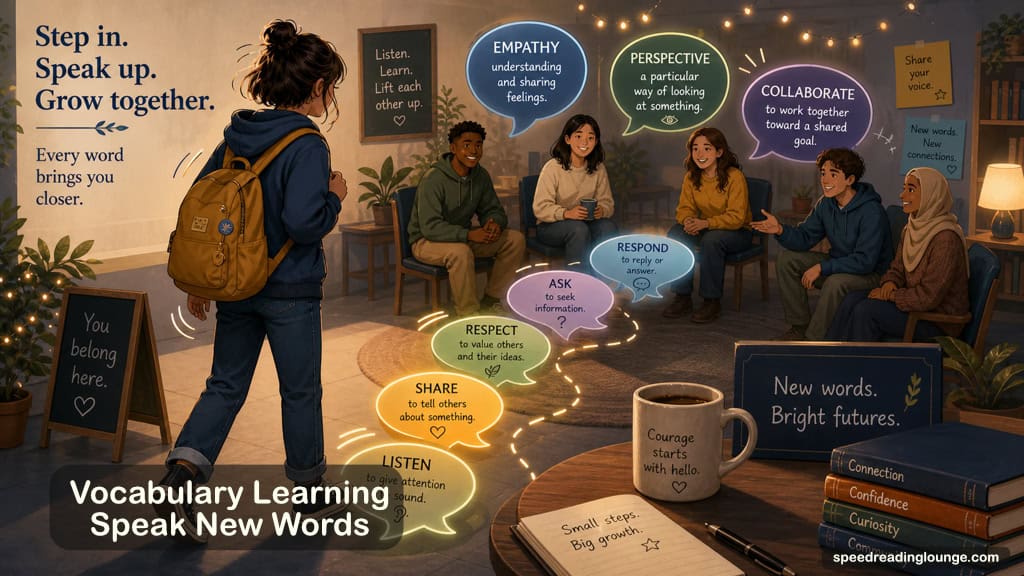
You can read every vocabulary resource in existence and still stumble when someone asks you to use a word out loud. Speaking is a different cognitive task from reading. It runs faster, with less tolerance for hesitation, and it demands active retrieval — not passive recognition.
The method is simple and uncomfortable in equal measure: use new words before you feel entirely ready. The feeling of slight overreach — reaching for a word at the edge of your active vocabulary — is the sensation of growth. Avoiding it keeps your vocabulary exactly where it is.
Practical conversation strategies:
- Set a weekly target: use three specific new words in real conversations
- Join language exchange platforms like Tandem or HelloTalk for low-stakes practice with native speakers
- Use online communities — language-focused subreddits and Discord servers — for written conversation practice that still demands active vocabulary improvement, development, and production.
- Written exchanges offer something face-to-face conversation doesn’t: a few seconds of planning time before you commit to a word. That buffer makes it easier to reach for something new rather than defaulting to familiar phrasing
AI tip — low-stakes conversation practice:
- Open ChatGPT and say: “I want to practice using these words: [list 5 words]. Have a short conversation with me and correct me only if I use one clearly incorrectly — not for style, only for meaning errors.”
- Use it as a practice space: no judgment, no awkwardness, available at any hour, infinitely patient.
Vocabulary Learning Across Languages
Every technique in this guide applies directly to vocabulary learning in languages other than English. Spaced repetition, contextual learning, word family strategies, and conversation practice work identically whether you are learning Spanish, German, Mandarin, or Arabic. The brain’s acquisition mechanics don’t change with the language.
A few language-specific notes:
- Anki and Clozemaster support 50+ languages and offer the most flexibility for non-English vocabulary work
- LingQ covers over 60 languages and integrates vocabulary capture directly into reading practice
- Wordela is English-only; multilingual learners building and improving vocabulary in other languages will need alternative tools for that work
- Research from the University of Wisconsin-Madison found that interleaving two languages within a single study session — rather than keeping them strictly separate — can improve retention for bilingual learners. Worth experimenting with if you are actively working on two languages simultaneously
For a full guide to language learning apps across multiple languages, see best language learning apps.
Conversation pushes words into active use. Testing — the final practice step before retention becomes permanent — confirms whether that use has actually created lasting memory.
10. Test Yourself — That’s Where Memory Forms
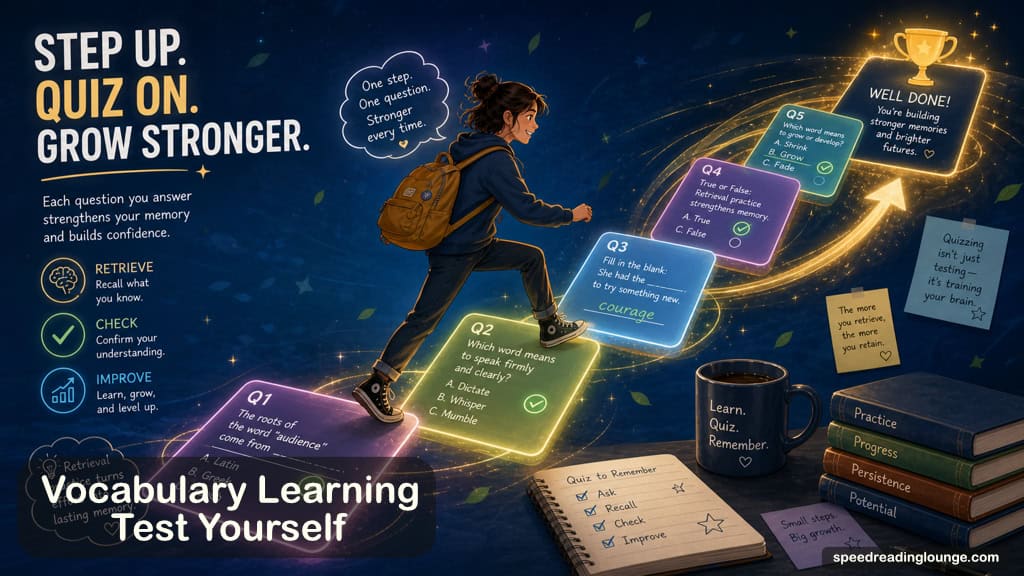
Cognitive psychology has a well-documented concept called the testing effect, also known as retrieval practice. The core finding: attempting to recall information strengthens memory more effectively than re-reading or re-studying the same material.
Looking at your vocabulary flashcards does less than being tested on them. The moment of effortful retrieval — searching for the word, sometimes failing, then seeing the correct answer — is when memory consolidates.
That discomfort is the mechanism, and less a side effect. And this is why spaced repetition, which you first encountered in Section 5, is also not just a scheduling convenience. Think of it more as a retrieval practice on a timer.
Apps like Anki and Wordela are structurally aligned with how memory works. They force retrieval at calibrated intervals. They make you reach for the word every single time.
Beyond flashcard apps, Vocabulary.com uses an adaptive vocabulary quiz format that adjusts difficulty in real time based on your accuracy. Answer consistently, and it moves you forward. Struggle with a word, and it returns more frequently until the pattern changes.
AI tip — custom vocabulary quiz on any word list:
- Compile a list of words you are currently learning.
- AI Prompt: “Quiz me on these 10 words: [paste list]. Give me one sentence with a blank where the word belongs. Wait for my answer before continuing. Tell me if I’m right.”
- Run this test once a week. Track which words you consistently miss — those are your priority for the next review cycle.
The science behind testing and long-term vocabulary retention connects directly to spaced repetition — the full SPL guide covers the mechanism in depth.
Testing is the final step in the vocabulary cycle. What you may not expect is how directly that cycle connects to something most people treat as entirely separate: how fast and fluidly you read.
11. Vocabulary and Speed Reading — The Connection
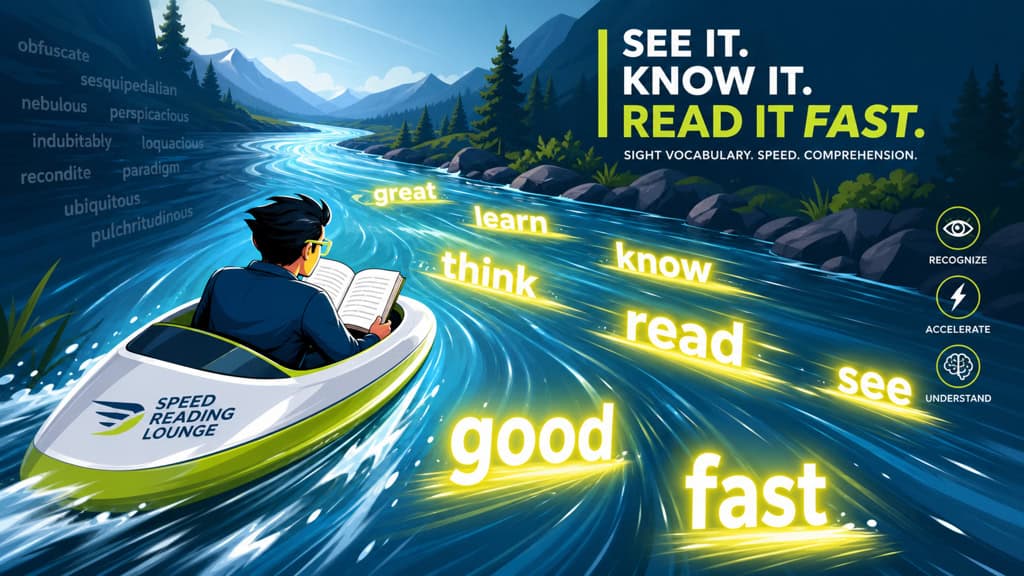
It’s quite simple: words you know instantly read faster than words you have to decode. That sounds like a minor difference word by word. Across a full page, it compounds into a measurable drag on both speed and comprehension.
When you encounter a familiar word, your brain processes it in a single visual fixation — no pause, no friction. An unfamiliar word causes your eyes to stall.
You decode it letter by letter, cross-reference it against partial memory, and sometimes backtrack. Multiply that stall across every unknown word in a document, and reading becomes effortful rather than fluid.
Researchers describe this as the sight vocabulary threshold. Above it, reading flows. Below it, reading feels like work. Building vocabulary is, in significant part, building the size of your sight vocabulary — the set of words your brain handles without conscious processing effort.
And, this is where lexical knowledge and reading speed become the same conversation.
The practical implication runs throughout this guide. A stronger vocabulary reduces cognitive load per line. Lower cognitive load allows faster processing. Faster processing improves comprehension retention because working memory is freed from decoding and becomes available for meaning-making.
The goal-setting you did in Section 1, the contextual reading in Section 3, the spaced repetition in Sections 5 and 6 — all of it feeds this threshold directly.
AI reading tools further strengthen this connection. Reading with a tool that highlights or defines unfamiliar words in real time builds and improves vocabulary through contextual exposure, the highest-retention learning mechanism.
Tip: See our bionic reading guide for how visual text enhancement reduces reading friction around unfamiliar words.
For readers building both skills simultaneously, the AI speed reading guide shows how to stack vocabulary tools with reading techniques into a single integrated workflow. The foundational technique is covered in the how to speed read guide.
How to Improve Vocabulary: A Final Word
You may have wondered why a speed reading site is publishing a guide on how to improve vocabulary. The answer is straightforward: Speed Reading Lounge is dedicated to helping you read smarter and faster.
The more words you recognize instantly, the faster you process text — and the more you retain of what you’ve read. Mastering both is a natural combination, and each feeds the other in ways that make the combined return greater than either skill alone.
Part of what makes how to improve vocabulary such a rich topic is that there are so many ways into it. Each technique suits a different kind of learner, a different kind of day, a different kind of goal. There is no single correct path, though. Every approach here lets you learn at your own pace and at your own level.
How to Improve Vocabulary – 10 Techniques
- Start with a goal, not a wish — define active vs. passive targets, make them measurable
- Use a dictionary like an explorer — explore, don’t just look up
- Read extensively and intensively — volume for fluency, precision for depth
- Attach words to images — vivid mental anchors resist fading
- Learn through games and flashcards — retrieval practice in every form
- Use vocabulary apps — Wordela, Anki, Quizlet, Vocabulary.com, Clozemaster
- Write deliberately — close the distance between passive and active vocabulary
- Learn word origins — one root unlocks an entire word family
- Speak new words before you feel ready — discomfort is the growth signal
- Test yourself — effortful retrieval is where memory forms
- Connect vocabulary to speed reading — sight vocabulary reduces reading friction
One caution worth holding onto: a word used incorrectly causes more damage than not knowing it. When you add a word to your active vocabulary, take time to understand its full register.
Eschew is a perfectly valid word — and sounds stiff in casual conversation. Livid and irritated both describe anger, but they denote different intensities, social registers, and moments.
Therefore, vocabulary building is not just about quantity. Ideally, you aim to know exactly where each word belongs and choose accordingly.
For exam preparation, the Top 100 SAT Words is a strong starting point for high-frequency academic vocabulary targets.
FAQs Vocabulary Learning
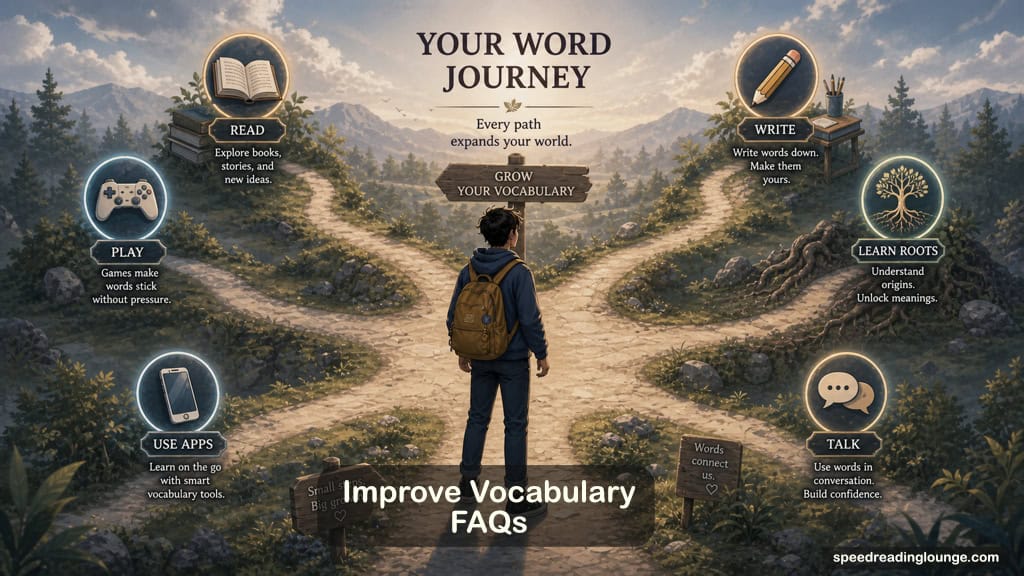
What is the fastest way to improve vocabulary?
Spaced repetition combined with contextual reading is the most research-supported combination. Apps like Anki and Wordela automate the scheduling. Reading widely — especially in your area of interest — provides contextual exposure that makes new words stick faster than memorizing lists.
How long does it take to noticeably improve vocabulary?
With consistent daily practice — even 15 minutes — recognition vocabulary tends to grow before active use catches up. Active vocabulary use in speech and writing takes longer and depends heavily on how many real contexts you use new words in. There is no fixed timeline; consistency matters more than intensity.
What is the difference between active and passive vocabulary?
Passive vocabulary is every word you recognize when you read or hear it. Active vocabulary is every word you can produce naturally when speaking or writing. Passive vocabulary is almost always larger. Moving words from passive into active use requires deliberate writing practice, conversation, and regular retrieval — not just reading.
Can you improve vocabulary in a second language the same way?
Yes. The core vocabulary learning strategies — spaced repetition, contextual learning, word family analysis, and conversation practice — work across all languages. Tools like Anki and Clozemaster support 50+ languages. The main difference is that second-language learners benefit from graded input early on: start with accessible texts before moving to native-level material.
Is it better to learn vocabulary from lists or in context?
Context produces significantly better long-term word retention than isolated list memorization. A word encountered inside a real sentence — with meaning partially inferable from surrounding words — creates richer memory encoding. Lists are useful for review and testing, but contextual learning should be the primary method of acquisition.
What are the best free tools to build vocabulary?
Anki (free, open-source spaced repetition), ManyThings.org (free vocabulary quizzes), Merriam-Webster’s Word of the Day (free), and Quizlet’s free tier are all strong starting points. For AI-assisted vocabulary practice, ChatGPT works well as a contextual thesaurus, etymology explainer, and quiz partner.
How do I improve vocabulary for professional or academic writing?
Focus on word family strategies using Latin and Greek roots — these unlock academic and professional vocabulary in clusters. Build flashcard decks specific to your field using Anki or ChatGPT-generated cards. Read widely in your domain and write regularly using new vocabulary in real contexts. For exam-specific vocabulary (GRE, IELTS, TOEFL), Wordela’s curated academic word lists cover the most tested terms.
Does reading improve vocabulary automatically?
Extensive reading contributes to passive vocabulary growth over time. Active vocabulary growth — the ability to use new words fluently — requires deliberate attention: noting unfamiliar words, looking them up, revisiting them through spaced repetition, and using them in writing or conversation. Reading alone is a strong foundation, not a complete system.
How does vocabulary affect reading speed?
Every unfamiliar word slows reading down. Your eyes stall on unknown words, breaking reading flow and increasing cognitive load. A larger sight vocabulary — words your brain recognizes instantly — allows faster, more fluid reading. Improving vocabulary and improving reading speed are genuinely complementary goals. See the how to speed read guide for more on the connection.
Can AI help with vocabulary learning?
Directly and practically. ChatGPT, Claude, Gemini or Perplexity work well as a contextual thesaurus, etymology explainer, word family generator, conversation partner, and custom quiz builder. Anki and Quizlet integrate AI to generate and adapt flashcard sets. AI reading tools like Readwise Reader highlight and define unfamiliar words in context while you read. The most effective approach uses AI as a layer on top of proven vocabulary learning strategies — not as a replacement for them.
Credits and Further Reading
- Spacing effect and long-term memory retention — foundational overview
“Spacing Repetitions Over Long Timescales: A Review and a Consolidated Theory” — PMC / National Institutes of Health - Spacing effect demonstrated across 200+ studies — UC San Diego
“Spaced Practice” — Department of Psychology, University of California San Diego - Testing effect and retrieval practice as a memory mechanism
“The Testing Effect” — EBSCO Research Starters, Library and Information Science - Retrieval practice in applied learning contexts — NIH review
“The Use of Retrieval Practice in the Health Professions” — PMC / National Institutes of Health - Contextual richness in vocabulary learning: retention and recall study
“Contextual Richness and Word Learning: Context Enhances Comprehension, but Retrieval Enhances Recall” — Language Learning, Wiley Online Library - Ranked analysis of vocabulary acquisition variables — L2 research
“What Really Matters in Vocabulary Acquisition? A Ranked Analysis of Key Influencing Factors” — Gianfranco Conti, Language Acquisition Research - Ten essential vocabulary instruction findings for language teachers
“Ten Essential Research Findings About Vocabulary Instruction” — Gianfranco Conti, Language Acquisition Research - Active versus passive vocabulary — distinction and production training
“Active vs Passive Vocabulary: Why You Understand More Than You Can Say” — Clozemaster Blog - Morphological instruction and vocabulary building through word families
“How Building Students’ Vocabulary Through Morphology Improves Reading Comprehension” — NWEA Research - Morphemic knowledge and novel word learning — PMC study
“The Role of Morphemic Knowledge During Novel Word Learning” — PMC / National Institutes of Health - Interleaving two languages in a single study session — UW-Madison 2025
“New Research Suggests Mixing Languages During Study Session Might Be a More Effective Learning Method” — Waisman Center, University of Wisconsin-Madison - Effects of interleaving and rest on L2 vocabulary learning — peer-reviewed
“The Effects of Interleaving and Rest on L2 Vocabulary Learning” — Language Teaching Research, SAGE Journals - Sight word recognition and reading fluency — foundational research
“Effective Sight Word Methods for Young Readers” — St. Cloud State University Repository - Vocabulary breadth, text coverage, and reading comprehension threshold
“Vocabulary, Text Coverage, Word Frequency and the Lexical Threshold” — TU Dortmund University - Word reading speed and its contribution to reading comprehension
“Contribution of Word Reading Speed to Reading Comprehension in Adults” — PMC / National Institutes of Health
Final tip: Be aware that people might not understand rarely used or highly specialized words. Keep it real when talking to children, friends, and family. You may want to impress, but you don’t want to sound off-key in your everyday, casual conversations.
If you wish to help spread the word, please share our “How to improve vocabulary” tutorial on your favorite social media network.
Disclosure: This post contains affiliate links to some partners. Speed Reading Lounge may receive a commission for purchases made through these links. It does not add any extra costs. All reviews, opinions, descriptions, and comparisons expressed here are our own.