
What Is Spaced Repetition – A Guide
How to use the spaced repetition system for effective learning.
Kids learn by playing. College students cram before exams. Adults juggle work deadlines with skill updates. Learning never stops, yet we keep forgetting what matters most. Spaced repetition solves that problem.
The technique trains your brain to remember information longer by reviewing it at specific intervals. Simple concept, powerful results. Language apps use it. Medical students swear by it. Now, with AI tools making spaced repetition easier to track and automate, the method has become more practical than ever.
Our brain is a powerful machine with one frustrating limitation: it forgets. Spaced repetition works with that reality, not against it. This guide shows you how the technique works, why it outperforms cramming, and how to build your own system using modern tools and apps.
Spaced Repetition – Overview
The concept sounds modern, yet humans have understood it for over a century. Remember the fable of the rabbit and the turtle? Slow and steady wins the race. Speed matters less than consistency.
Herman Ebbinghaus, a German psychologist, first studied spaced repetition systematically in the 1880s. His work on learning and forgetting curves laid the foundation for everything we know about memory retention today.
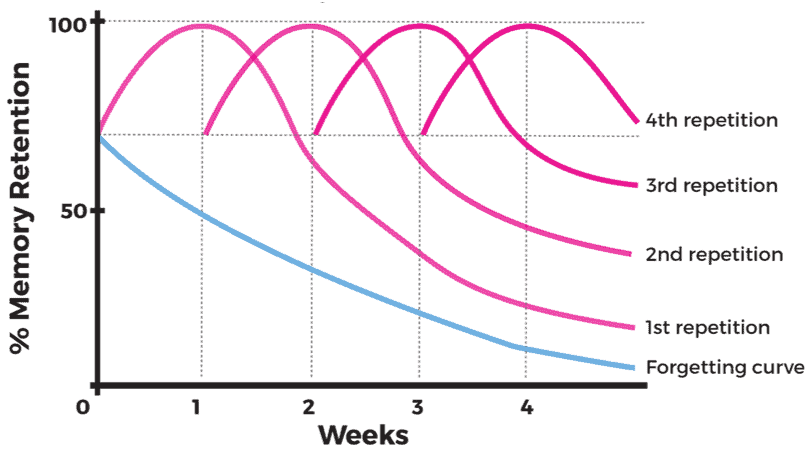
The mechanism: Spaced repetition means reviewing information at increasing intervals rather than cramming it all at once. Your brain naturally forgets what it doesn’t use. The technique exploits this by timing reviews right before you’d forget, strengthening the memory each time.
“The technique exploits this by timing reviews right before you’d forget, strengthening the memory each time.”
The process moves information from short-term memory into long-term storage through strategic repetition. Students use it to ace exams. Language learners rely on it to build vocabulary. Medical professionals apply it to retain vast amounts of information.
It’s also used to improve long-term memory and support individuals with memory disorders. Now, AI-powered apps can automatically calculate optimal review intervals, making the technique accessible to anyone with a smartphone.
How Does Spaced Repetition Work?
The human brain is a muscle just like any other in the body. When we utilize it for longer periods, it gets tired and requires a time-out. Stretching too far or putting too much pressure on the muscle can have negative consequences.
The workout analogy: Suppose you wanted bigger and stronger biceps and decided to start working out. If you have never lifted weights before, you won’t start with a hundred pounds. Professionals recommend starting small, like five pounds.
Starting with five pounds gives your body time to relax, then you proceed to seven pounds, and so on. By working your way up in weight with each session, you’ll be able to handle more weight. You can apply that principle to any sport, too.
Our brain works similarly. Instead of heavier weights, information is repeated over extended periods to help it be remembered. The repetition continues until the old information is stored in long-term memory. Learning software takes advantage of that.
Tools – Educational products that use spaced repetition as a learning technique include typing software, speed reading courses, or language courses. AI-powered apps now automate the timing, tracking your progress and adjusting review intervals based on your performance.
Herman Ebbinghaus’s Forgetting Curve
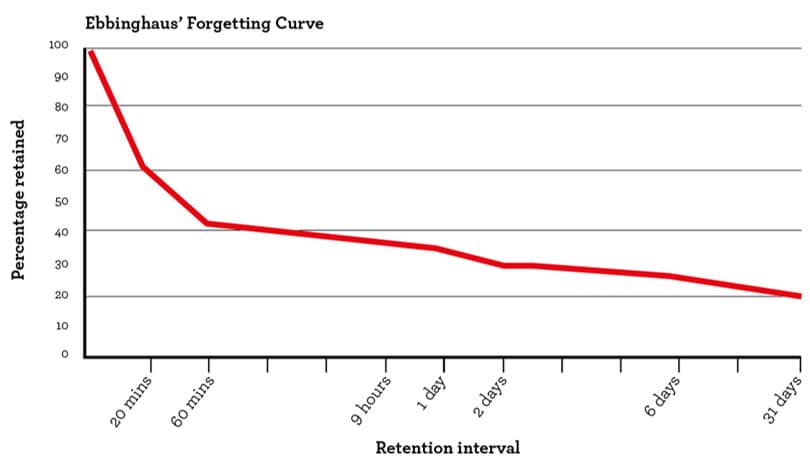
As mentioned earlier, Herman Ebbinghaus focused on the forgetting curve. The memory model shows how retention declines over time unless we take preventive measures. The fastest drop occurs after 20 minutes, and the curve almost levels out within a day.
The experiment: Ebbinghaus was the first psychologist to systematically study memory. He spent years memorizing made-up syllables and recording the results.
The data: He tracked how many times he studied each list, the time intervals between sessions, and how much information he retained.
This meticulous work allowed him to chart the rate of memory decay over time on the forgetting curve. The pattern he discovered still holds true today, which is why modern learning apps and AI tools use his findings to calculate optimal review timing.
Understanding this curve helps you work with your brain’s natural rhythm, not against it. The next section explores the spacing effect and how it turns forgetting into a learning advantage.
How the Spacing Effect Works
When it comes to reality, things are more complicated than they seem on paper. Why do you remember the name of an old school friend you haven’t seen in years? Street numbers, random conversations—why does our brain bother storing such mundane information?
How our brain stores memories
In our brains, memories and information are stored in various locations, not just in a single place. That’s why we don’t forget entire concepts or experiences, just small details.
Often, a musical note brings up a long-forgotten memory, or the smell of fresh cake takes you right back to your childhood. This suggests that even though we think we forgot something, we haven’t.
Herman Ebbinghaus discovered that our brains store small pieces of information in our subconscious minds, even when it seems forgotten. He called these pieces savings. While savings cannot be consciously brought back to your mind, they do speed up the process of relearning.
Forgetting and remembering are linked together
When you’re on the verge of forgetting something, your brain reinforces the memory while adding new details. That’s why teaching others, quizzes, and practice papers help. They highlight what has been almost forgotten.
Memories don’t stay the same
In our brain, not only is new information stored every day, but it also changes the way we think and see things. It’s rightly said that no person ever reads the same book twice.
“It’s rightly said that no person ever reads the same book twice.”
Retrieving memories is better than revisiting memories
Since we talk so much about repetition, one may think it’s the best way to learn. On the contrary, the best way to remember is by recalling the information.
Trying to remember something puts strain on your brain and makes it easier to remember information in the future. This is why practice tests are a better way to learn than re-reading highlights from your textbook.
Our brain prioritizes recurring information
When we encounter some information daily, it becomes easier to recall it without even trying. That’s why we never forget mundane information such as an important PIN code, directions to work, and our signatures.
Implementing the Spaced Repetition System
Over time, spaced repetition, like everything else, has evolved. There are two popular ways to implement spaced repetition for effective learning: manually and via apps.
1. Manual Spaced Repetition Technique
Starting with the old-school way of using the spaced repetition technique. Our day-to-day lives are full of things we can’t control, but when life gives you a lemon, make lemonade. Suppose you’re standing in a long queue and know that it will be a while before your turn.
You will naturally be annoyed, take out your phone, and start browsing. There’s a more efficient way to use this time—learn something new with spaced repetition.
Manual spaced repetition may involve reading and learning from a notebook or using flashcards. The simplest way to implement flashcard studying is via the Leitner system. It’s a method proposed by Sebastian Leitner, a German science journalist, that involves reviewing flashcards in increasing intervals.
How the Leitner system works:
- Start by creating flashcards.
- Label three to five boxes with study time intervals.
- The boxes should be labeled as follows:
| Box Number | Time Interval |
|---|---|
| Box 1 | Every day |
| Box 2 | Every two days |
| Box 3 | Once a week |
| Box 4 | Once, every two weeks |
| Box 5 | Retired (to be repeated sometime in the future) |
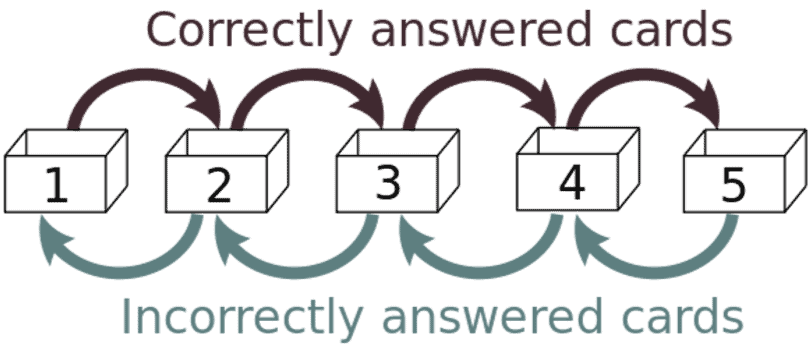
In the Leitner system, every flashcard starts at box 1 and moves to box 2 when you answer a flashcard correctly. If you don’t, it goes right back to box 1 for a fresh start. The same method is followed for each flashcard in box 2, and so on.
After some time, you’ll start to see a pattern where some cards are more difficult and require frequent repetition, while other cards easily move from one box to the other.
The method for moving between boxes applies to every card in box 1. It graduates to the next box if you answer correctly, and stays in the same box if you answer incorrectly. Depending on your specific study schedule and the interval boxes, you’ll end up studying just one or even multiple topics each day.
2. Spaced Repetition via Apps
Smartphones and apps have changed the way we learn. Now, people find an app to learn something instead of heading to the library.
There’s an app for everything, and that includes spaced repetition, e.g., speed reading apps or vocabulary apps.
In the following table, we list additional Windows, OS X, Linux, iPhone, and Android apps for spaced repetition learning.
| App | Pricing | Availability |
|---|---|---|
| Spreeder | VIP Version (view) | Web, Mobile, Browser |
| Wordela | Pro version (view) | Web, Mobile, Browser |
| Anki | Free (except iOS) | Android, iOS, Linux, Mac, Windows, Web |
| Brainscape | Free + Pro version | Android, iOS, Web |
| Quizlet | Free + Pro version | Android, iOS, Web |
| Cram | Free + Pro version | Android, iOS, Web |
| IDoRecall | Free + Pro version | Web |
Apps offer an advantage over traditional learning, as it may be difficult to take a book or flashcards along, but we take our mobile phones everywhere.
Remember that spaced learning is about technique, not apps. You need to create effective flashcards and make sure you don’t go over your schedule.
Spaced Repetition – 3 Steps
Now that you understand how spaced repetition works and ways to implement it, let’s discuss how to make the most out of the technique. This three-step approach, also known as distributed practice, helps you build lasting knowledge.
Step 1: Encode Information
The foundation: Before you can remember something, you need to understand it first. Encoding means processing new information in a way your brain can store and retrieve later.
Reading a textbook chapter once isn’t encoding. Taking notes in your own words, creating visual diagrams, or explaining concepts to someone else—that’s encoding. The more actively you engage with the material, the stronger the initial memory trace.
Think about learning a new language. Simply reading vocabulary lists won’t help much. But if you write sentences using new words, practice pronunciation, and connect them to images or emotions, you’re encoding effectively. The same principle applies to any subject.
Step 2: Recall Information
The challenge: This is where active recall makes the difference. Instead of re-reading your notes, force yourself to retrieve information from memory without looking.
Close your book. Write down everything you remember about the topic. Use flashcards that show questions, not answers. Test yourself before you feel ready. This struggle to remember—even when you fail—strengthens neural pathways more than passive review ever could.
“That uncomfortable feeling when you can’t quite remember? That’s your brain doing the hard work.”
That uncomfortable feeling when you can’t quite remember? That’s your brain doing the hard work. Reading comprehension strategies often incorporate this principle, pushing you to engage rather than passively consume.
Step 3: Review at Intervals
The timing: This is where the science of spaced repetition comes into play. Review material right before you’re about to forget it.
Start with short intervals—review after one day, then three days, then a week, then two weeks, and so on. Each successful recall session pushes the next review further into the future. The pattern adapts to how well you know the material.
Manual systems like the Leitner method work perfectly for this. Digital apps handle the scheduling automatically, tracking which concepts need reinforcement and which have moved into long-term retention. Either way, consistency beats intensity. Fifteen minutes daily outperforms three-hour weekend cramming sessions every time.
Reading tip: Spaced repetition is part of a comprehensive speed reading system. Start with a fundamentals guide on how to speed read, then move into practical lessons on skimming and scanning, and reading word chunks. If you want AI to be part of it, then read our AI speed reading guide.
Benefits of Spaced Repetition

The spaced repetition technique offers clear advantages over traditional cramming. Understanding these benefits helps you commit to the method, even when motivation dips.
Better long-term retention
Information reviewed at intervals sticks longer than material crammed in one session. Your brain builds stronger neural pathways each time you successfully recall something. This means less time spent relearning forgotten concepts months or years later.
Efficient use of study time
Instead of constantly reviewing everything, you focus on what you’re about to forget. Strong memories need less attention. Weak ones get more practice. This targeted approach saves hours compared to blanket review sessions.
Reduced cognitive load
Spreading learning across days prevents mental exhaustion. Your brain processes and consolidates information during rest periods between sessions. You avoid the fatigue and frustration that come from marathon study sessions.
Improved confidence
Watching yourself recall information weeks after first learning it builds trust in your memory. You stop second-guessing whether you truly know the material. This confidence translates to better performance during exams or real-world applications.
Applicable across subjects
Whether you’re learning languages, memorizing medical terminology, mastering programming concepts, or studying history, spaced repetition works. The technique adapts to any field that requires retention of factual information.
AI-enhanced personalization
Modern learning platforms now analyze your individual forgetting patterns and automatically adjust review schedules. This removes guesswork and optimizes timing based on your actual performance, making the spaced repetition technique more effective than ever.
AI and Spaced Repetition

Let’s assume this situation: You spent three hours handwriting flashcards from a textbook chapter. Your hand aches. The stack looks impressive, but tomorrow you’ll spend another hour sorting them into review boxes. Most of us have been there.
AI doesn’t make spaced repetition work—the science still does that. What AI does is remove the tedious parts:
- card creation,
- interval tracking,
- and schedule management.
You can think of it as hiring an assistant for the boring work while you focus on actual learning.
When AI Actually Helps
Turning notes into flashcards
Imagine finishing a two-hour lecture. Your notebook overflows with diagrams, definitions, and examples. Normally, you’d spend an hour converting those notes into flashcards manually.
With AI, you upload the notes. The software generates question-answer pairs automatically. You review them, fix those that lack context, and delete weak questions. Fifteen minutes instead of an hour.
Tip: Note taking itself is heavily influenced by AI, too. Here’s the guide.
Adjusting to your memory
Traditional spaced repetition treats everyone the same—one day, three days, a week. AI watches how YOU actually forget. Biology terms slip away after five days, but history dates stick for two weeks? The algorithm adjusts each subject differently.
No more manually moving cards between boxes. The app tracks performance and automatically schedules reviews. Anki’s FSRS system reduced unnecessary reviews by 20-30% by stopping cards from being shown again once you’ve mastered them.
Reading and retention together
We’ve all highlighted passages in books, only to abandon them forever.
Spreeder combines speed-reading practice with spaced repetition—train reading speed and review key concepts at intervals. Readwise syncs highlights from Kindle and articles, then surfaces them again days later. Your highlights become review material instead of digital clutter.
A Simple Starting Point
For notes from PDFs or lectures:
StudyGlen and RemNote handle scanned documents and images. Upload your material, generate cards, edit the weak ones, and import to your study app.
For highlights while reading:
Readwise syncs automatically from Kindle, Instapaper, and most reading apps. Daily review emails bring your highlights back.
For speed reading and retention:
Spreeder builds both into one workflow. Practice reading faster while reviewing content at spaced intervals.
Time saved: Creating 50 flashcards manually takes about ninety minutes. AI generation plus editing takes twenty.
What AI Can’t Replace
To be frank, AI doesn’t know what matters for your exam. A textbook chapter might contain a hundred concepts, but only twelve appear on your test. You still decide which ideas deserve flashcards.
AI-generated cards also lack depth. A textbook explains photosynthesis across three pages with diagrams and examples.
AI condenses it to: “Question: What is photosynthesis? Answer: Process plants use to convert light into energy.”
Technically accurate, practically useless for real understanding.
You’ll still need to choose what’s worth remembering, add context AI misses, and verify accuracy—AI makes up definitions occasionally.
The practical reality: AI handles logistics so you can focus on learning. It speeds up card creation and manages review schedules. But it can’t determine what’s important or whether you actually understand the material. That part still requires human judgment.
Try AI-generated cards for one subject. Please see whether the time savings justify the editing work. If you spend more time fixing AI mistakes than creating cards manually, the old way might serve you better. The technique matters more than the tools.
Drawbacks of Spaced Repetition

No learning technique is perfect. Spaced repetition comes with limitations you should understand before committing to the method.
Requires consistent commitment
The spaced repetition technique only works if you stick to the schedule. Missing review sessions breaks the spacing pattern and weakens retention. If you struggle with consistency, you’ll find this frustrating. The system demands discipline over weeks and months, not just days.
Initial time investment
Creating effective spaced repetition materials takes time up front. Please break down complex topics, formulate clear questions, and organize information properly. Poorly designed flashcards undermine the entire process. This preparation phase can feel overwhelming when you’re already busy.
Not ideal for conceptual understanding
Spaced repetition excels at memorizing facts, vocabulary, formulas, and procedures. It’s less effective for developing deep conceptual understanding or creative problem-solving skills. You still need other learning methods—discussions, practice problems, projects—to truly master a subject.
Spaced repetition can feel mechanical
Reviewing flashcards repeatedly through spaced repetition schedules can become tedious. The process lacks the engagement that comes from reading a compelling textbook chapter or having a stimulating conversation about ideas. Some learners find the repetitive nature demotivating over time.
Spaced repetition is difficult to track without tools
Manual spaced repetition systems, like the Leitner method, work but require organization and record-keeping. If you forget which box a card belongs in or when to review, it defeats the purpose. Digital apps solve this problem but introduce dependency on technology and potential distraction.
Risk of shallow learning
Focusing too heavily on spaced repetition can lead to memorization without comprehension. You might recall a definition perfectly but fail to apply the concept in context. Balance matters. The technique supplements learning; it doesn’t replace understanding.
“The technique supplements learning; it doesn’t replace understanding.”
Spaced Repetition – Summary & Conclusion

Spaced repetition transforms how we retain information by working with the brain’s natural forgetting patterns rather than fighting them. The technique isn’t new—Herman Ebbinghaus discovered the forgetting curve over a century ago—but modern tools have made it more accessible and effective than ever.
There’s a simple formula.
The three-step process remains simple: encode information meaningfully, practice active recall, and review at increasing intervals.
Whether you use physical flashcards with the Leitner system or AI-powered apps that automatically calculate optimal timing, the underlying principle remains the same. Strategic repetition moves knowledge from short-term memory into long-term storage.
The benefits are also clear.
Better retention, efficient use of study time, reduced cognitive load, and improved confidence all come from consistent practice. Students ace exams. Language learners build vocabulary that sticks. Medical professionals retain vast amounts of technical information. The technique adapts to nearly any field requiring factual knowledge.
It’s good to know the reality.
Yes, spaced repetition has limitations. It demands consistency, requires upfront preparation, and works best for memorization rather than conceptual understanding.
The repetitive nature can feel mechanical. You still need traditional study methods, discussions, and hands-on practice to truly master complex subjects. Balance matters.
“The spacing effect turns forgetting into an advantage.”
The technique supplements learning; it doesn’t replace thinking. Use spaced repetition to remember what you’ve learned, then apply that knowledge through problem-solving, writing, and real-world application. Combine both approaches for complete mastery.
Getting started
Starting feels daunting. Creating flashcards takes time. Sticking to review schedules requires discipline. But the compound effect of daily practice becomes obvious within weeks. Information you studied months ago surfaces effortlessly when you need it. That confidence—knowing your memory works—changes how you approach learning permanently.
The spacing effect turns forgetting into an advantage. Each successful recall after an interval strengthens neural pathways more than constant review ever could. Your brain adapts. Knowledge consolidates. Learning becomes sustainable rather than exhausting.
Whether you’re preparing for certification exams, learning new languages, or building expertise in your field, spaced repetition offers a proven path forward. The science works. The tools exist. Consistency delivers results.
Your next step
Start small. Create five flashcards today. Review them tomorrow, then three days later, then a week after that. Watch the pattern emerge. Trust the process. Your future self will thank you for the investment.
FAQs Spaced Repetition

Common questions about implementing and optimizing spaced repetition for effective learning.
What is the best spaced repetition app?
The best app depends on your specific needs. Anki remains the gold standard for customization and flexibility, with robust spaced repetition algorithms and cross-platform support. Brainscape offers a more polished interface with pre-made decks. Quizlet provides social features and collaborative learning options.
For language learning specifically, apps like Memrise and Duolingo integrate spaced repetition into gamified experiences. For professionals who memorize technical information, RemNote and Obsidian now include spaced repetition plugins that work with your existing notes.
The right choice balances ease of use, content availability, and how well the spaced repetition intervals match your learning pace. Try several before committing.
How long should I study using spaced repetition?
Quality matters more than quantity. Fifteen to thirty minutes of focused spaced repetition practice daily outperforms sporadic three-hour sessions. Your brain needs time between reviews to consolidate memories—cramming defeats the purpose.
Most learners see optimal results with 20-minute sessions, one or two times per day. This prevents mental fatigue while maintaining consistency. The key is showing up regularly, not burning yourself out with marathon reviews.
Can spaced repetition replace traditional studying?
No. Spaced repetition excels at retention but doesn’t replace initial learning or deep understanding. Use it to remember what you’ve already learned through lectures, reading, or practice.
Think of it as maintenance rather than construction. You build knowledge through traditional study methods, then use spaced repetition to prevent that knowledge from decaying. Combine both approaches for the best results.
Is spaced repetition effective for all subjects?
Spaced repetition works brilliantly for fact-based subjects: languages, medical terminology, historical dates, scientific classifications, legal concepts, and programming syntax. Any field requiring memorization benefits significantly.
It’s less effective for subjects demanding creative synthesis, critical analysis, or hands-on skill development. You can’t learn to write compelling essays or debug complex code solely through flashcards. The technique supports these skills but doesn’t replace deliberate practice and feedback.
How do I create effective flashcards for spaced repetition?
Keep cards atomic—one concept per card. Ask specific questions rather than vague prompts. “What enzyme breaks down lactose?” works better than “Tell me about lactose.”
Include context when necessary. “In glycolysis, what is the first committed step?” provides enough information to answer meaningfully. Use images, diagrams, or mnemonic devices when they clarify concepts.
Avoid recognition-only cards like “Is this statement true or false?” Force yourself to recall actively. The struggle to retrieve information strengthens memory more than simply recognizing correct answers.
When should I start using spaced repetition?
Start immediately after learning new material. Create flashcards as you study, not weeks later when you’ve already forgotten. The technique works best when you encode information properly from the beginning.
For exam preparation, begin spaced repetition at least four to six weeks before the test date. Last-minute cramming contradicts the entire spacing principle. Early start, consistent practice, gradual review expansion—that’s the formula.
Sources
- Spaced repetition and memory retention – Psychological Science Journal
- Forgetting Curve Research – Herman Ebbinghaus Archive
- Active recall and spaced repetition effectiveness – Recallify Research
- Spaced repetition science explained – Voovo Study Blog
- FSRS algorithm research – Open Spaced Repetition Project
- Distributed practice vs massed practice – PMC Meta-Analysis
- Leitner System Methodology – Learning Scientists
- AI flashcard generation effectiveness – Educational Technology Research
- AI cognitive offloading in learning – PMC Psychology
- Spacing effect cognitive science – Cognitive Psychology Quarterly
Disclosure: This post contains affiliate links to some partners. Speed Reading Lounge may receive a commission for purchases made through these links. It does not add any extra costs. All reviews, opinions, descriptions, and comparisons expressed here are our own.