
Subvocalization – 6 Drills to Stop It
Subvocalization: How to stop the little voice in your head (with AI)

There is a narrator in your head.
You are likely hearing him right now. As your eyes scan these pixels, a faint, familiar voice is reading aloud in the back of your mind. It is a comforting presence. It feels like thinking. It feels like understanding.
But this voice is also a straitjacket.
In cognitive science, this phenomenon is called subvocalization. It is the single biggest bottleneck preventing you from becoming a speed reader. Why? Because that little voice can only speak as fast as you can talk—typically around 150 to 250 words per minute (wpm).
If you want to read at the speed of thought (500, 600, or even 800 wpm), you cannot wait for the narrator to catch up. You have to leave him behind.
This guide will teach you how to stop subvocalization. We will look at the classic “analog” drills used for decades to silence the inner voice, and then introduce a new paradigm: Digital Pacing.
The latter uses modern AI tools to force your brain into a visual-only processing state—essentially “overclocking” your reading speed until the voice simply gives up.
But don’t worry, we are not aiming to silence the voice forever. It is more about learning to shift gears. So, keep reading.
What Is Subvocalization?
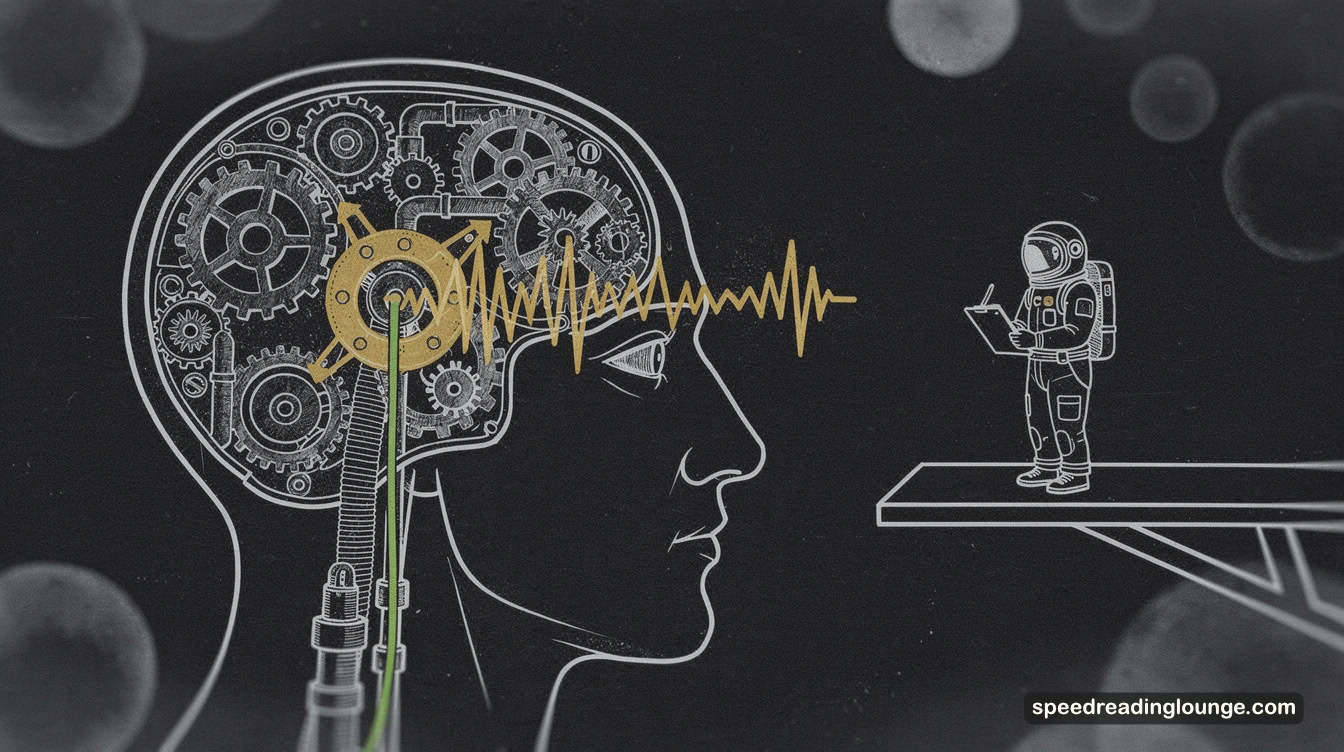
The Science of Silent Speech.
To learn how to stop subvocalization, we first have to understand why we do it. It is not a “bad reading habit” you picked up in school; it is a fundamental part of how your brain’s working memory is wired.
Psychologists call this the Phonological Loop.
Proposed by Alan Baddeley in his model of working memory, the phonological loop is a temporary storage system for speech-based information.
When you learned to read as a child, you read out loud. You connected the visual shape of the letter “A” to the sound “Ayy.” Over time, you stopped moving your lips, but the connection remained. You simply internalized the sound.
This creates a processing chain:
- See the word (Visual Cortex)
- Say the word (Motor/Auditory Cortex)
- Understand the word (Wernicke’s Area)
This “Say” step is the bottleneck. It effectively caps your reading speed at your speaking speed. Even if your eyes can snap a picture of a whole sentence in 100 milliseconds, your brain waits for the inner voice to “pronounce” it before moving on.
The Two Types of Subvocalization
It is helpful to distinguish between two levels of this habit:
- Motor Subvocalization: This is when your lips, tongue, or vocal cords actually move slightly while reading. You might not notice it, but a sensitive microphone placed against your throat (an electromyogram) could pick up the muscle twitching.
- Auditory Subvocalization: This is the “mental voice.” Your body is perfectly still, but your brain is simulating the sound of the words.
Our goal is to eliminate the first entirely and significantly reduce the second. We want to rewire the chain to a cleaner, faster signal:
See -> Understand.
Common Myths About Subvocalization
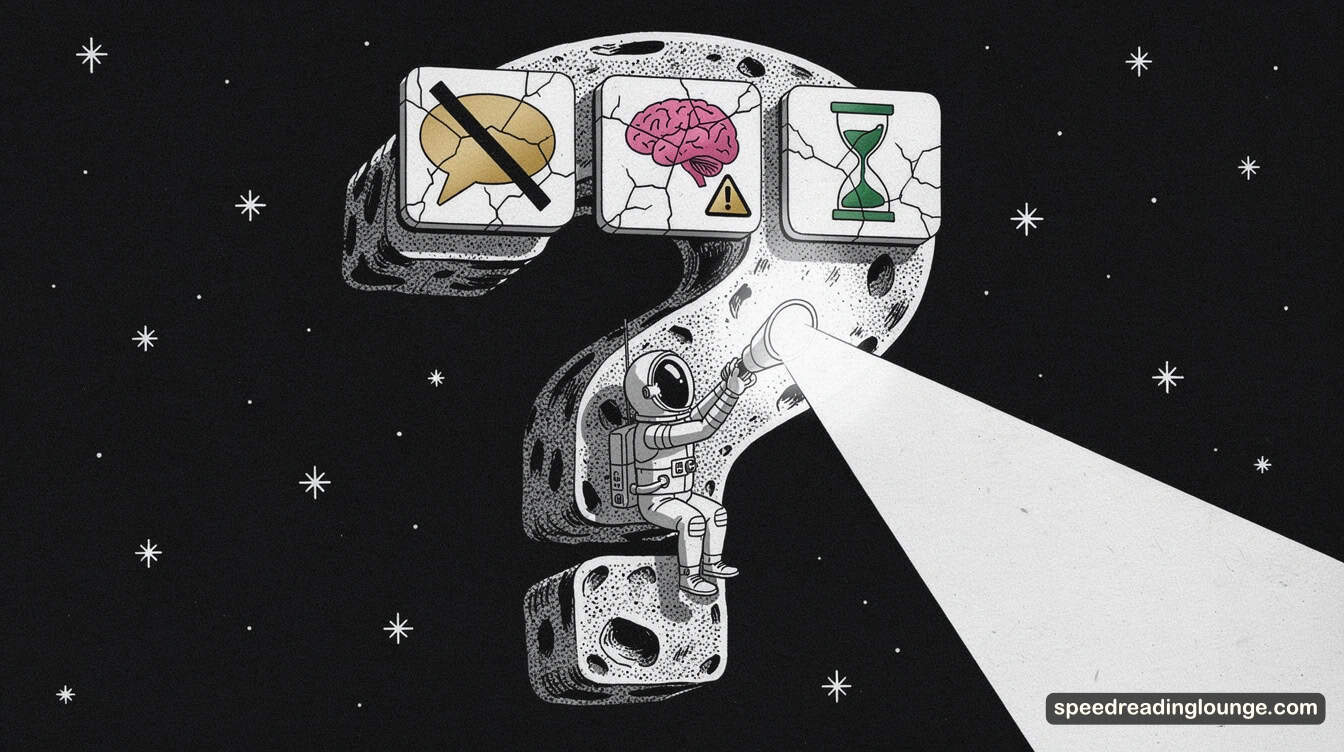
Before we get to the drills, we need to clear up some confusion. The internet is full of bad advice on this topic.
Myth 1: You Must Eliminate It Completely
This is the most dangerous myth. You cannot stop subvocalization 100%. Even the world’s fastest speed readers have a faint “shadow” of a voice in their heads. If you try to force total silence, you will stress your brain out and your comprehension will crash. The goal is to turn the volume down, not mute it.
Myth 2: Subvocalization Is Always Bad
Your inner voice is a quality control tool. When you read a difficult textbook, a legal contract, or a poem, you need the phonological loop to hold complex sentences in your working memory. Subvocalization becomes a problem only when you use it for everything—like reading a simple email or a news article.
Myth 3: You Can Fix It In A Day
Rewiring a neural pathway you have used since age five takes time. Expect this to feel awkward for the first two weeks. Your brain will panic and say, “I don’t understand this!” just because it didn’t “hear” it. Trust the process. Your visual cortex is faster than you think.
3 Analog Drills To Stop Subvocalization
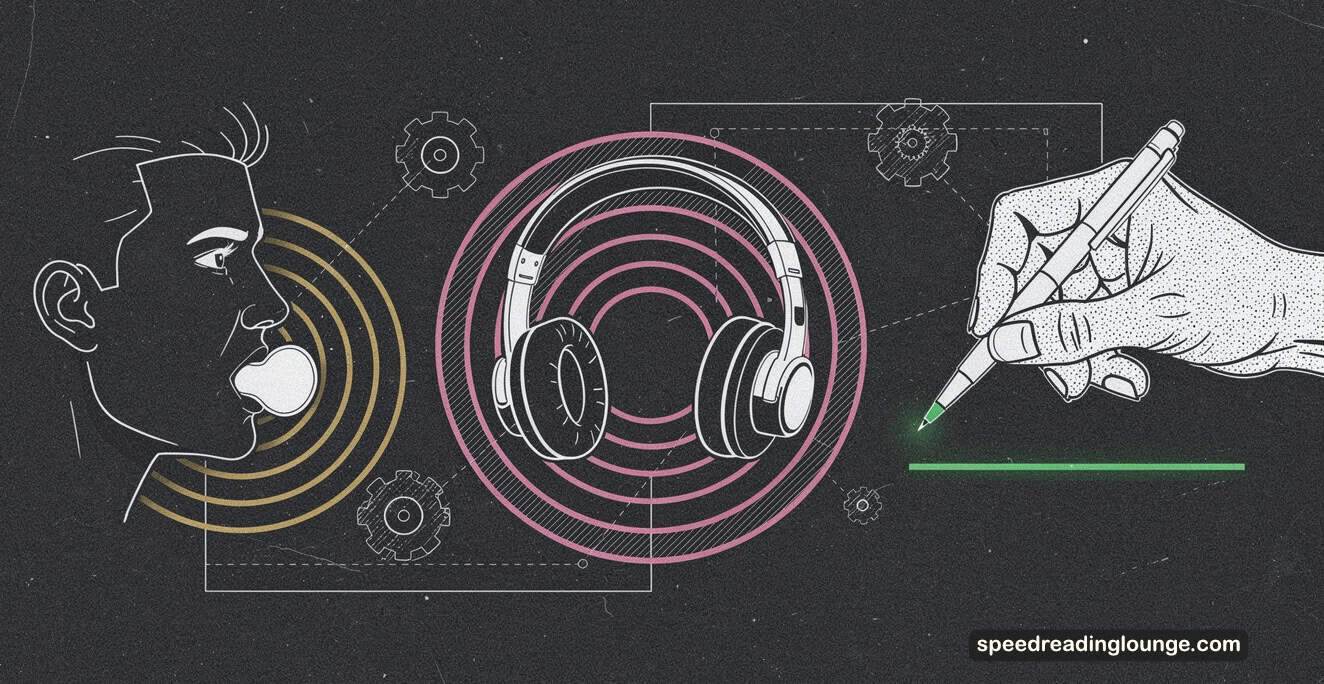
We start with the basics. These are “manual” interventions designed to occupy or distract the phonological loop so your visual cortex can take over.
1. The “Chewing Gum” Hack
Subvocalization is closely tied to the brain’s speech center. By physically engaging the muscles used for speech—your jaw and tongue—you create “noise” in the motor control center.
The Drill:
- Get a piece of gum.
- Chew it rhythmically while you read.
- Alternatively, you can tap your finger on the table or even lightly hum a monotone drone.
The logic is similar to trying to pat your head and rub your stomach. Your brain struggles to send “speak the word” signals to your vocal cords because those channels are already busy chewing. This forces the brain to rely more heavily on the visual input.
2. The “Music” Jammer
If chewing gum distracts the motor cortex, music distracts the auditory cortex.
The key here is instrumental music. If you listen to a song with lyrics, your phonological loop will try to process those words and the words you are reading, leading to a traffic jam.
The Drill:
- Put on headphones and listen to classical, lo-fi, or ambient electronic music.
- Keep the volume moderate.
- The Goal: The music occupies the “sound buffer” in your brain. With the auditory channel flooded with melody, the inner voice becomes faint. You stop listening to it and start just looking at the text.
3. Hand Pacing (The Finger Method)
This is the oldest trick in the speed reading book, championed by Evelyn Wood in the 1950s. It remains effective because it forces your eyes to move smoothly, rather than jumping back and forth (saccades).
The Drill:
- Place your index finger under the first word of a line.
- Move your finger steadily across the line, slightly faster than feels comfortable.
- Do not stop. Even if you miss a word, keep going.
By forcing your eyes to keep up with your finger, you eliminate the micro-pauses where the inner voice usually chimes in. You are essentially outrunning the narrator.
For a deeper dive into this specific technique, read our guide on Hand Pacing.
3 Digital AI Drills To Stop Subvocalization

Manual drills require willpower. You have to consciously push yourself to read faster.
Technology offers a different path: the Treadmill Effect. Just as a treadmill forces you to run at 6mph regardless of how you feel, these tools force your brain to process text at 400+ wpm. At this speed, subvocalization becomes physically impossible. The inner voice simply breaks up and fades away.
Here is how to use technology to stop subvocalization.
Technique A: Audio Overclocking (TTS)
Most people use Text-to-Speech (TTS) apps to listen passively. But if you use them actively—listening while reading along—you can use the speed of the audio to pull your eyes forward.
The Setup:
- Open an article in a TTS tool (like Speechify or your browser’s “Read Aloud” mode).
- Set the speed to 2.0x or 2.5x (roughly 350-400 wpm).
- Read along with your eyes as the voice speaks.
Why it works:
The AI voice is speaking faster than your internal narrator can. Your brain naturally syncs with the external audio, suppressing your internal subvocalization.
It effectively “replaces” your slow inner voice with a fast, synthetic one. After 10 minutes of this, pause the audio and keep reading. You will often find that your visual reading speed stays elevated.
Technique B: Brute Force Visuals (RSVP)
Rapid Serial Visual Presentation (RSVP) is the nuclear option for killing subvocalization.
Tools like Spreeder or SwiftRead take a block of text and flash it one word at a time in the center of the screen. You can set the speed to whatever you want—300, 500, even 1000 wpm.
The Drill:
- Set the tool to 400 wpm.
- Stare at the center point.
- Let the words wash over you.
Because your eyes don’t have to move (no saccades) and the words appear faster than you can pronounce them, the phonological loop is bypassed entirely.
This is pure See -> Understand processing.
It feels chaotic at first, but it is the fastest way to prove to your brain that it can comprehend text without hearing it.
Note: For a full breakdown of these tools, see our guide to the Speed Reading Apps.
Technique C: Visual Guiderails (Bionic Reading)
You may have seen “Bionic Reading” fonts where the first few letters of every word are bolded.
- Standard: Subvocalization is a bottleneck.
- Bionic: Subvocalization is a bottleneck.
Does it stop subvocalization?
Not directly. However, it acts as a visual anchor. By highlighting the start of the word, it helps the eye snap to the target faster (reducing fixation time). Less time on the word means less time for the voice to start speaking. It smooths the visual track, making it easier to build momentum.
I’m Still Subvocalizing! Troubleshooting Tips

Even with these drills, the voice can be stubborn. Here are common reasons why subvocalization persists and how to fix them.
Problem 1: The “Back-Skipping” Reflex
The Symptom: You read a sentence, feel like you missed a word, and immediately look back to re-read it.
The Fix: This is a confidence issue, not a vision issue. Your brain did see the word, it just didn’t “hear” it, so it assumes it missed it. You must train yourself to trust your eyes. Use a card to cover the lines you have just read. Physically prevent yourself from looking back.
Problem 2: The “Comprehension Dip”
The Symptom: You successfully stop the voice, but you have no idea what you just read.
The Fix: This is normal. You have switched from auditory processing to visual processing, and your visual cortex is out of shape. Start with easier material (like a biography or a blog post). Do not start with quantum physics. Give your brain “easy wins” to build the visual-to-meaning connection.
Problem 3: The “Lip Reader”
The Symptom: Your throat gets sore after reading for a long time.
The Fix: This is severe motor subvocalization. You need the “Chewing Gum Hack” immediately. You can also try holding a pencil between your lips (lightly). If the pencil moves, you are moving your lips.
The Hybrid Protocol: The 3-Step AI Method
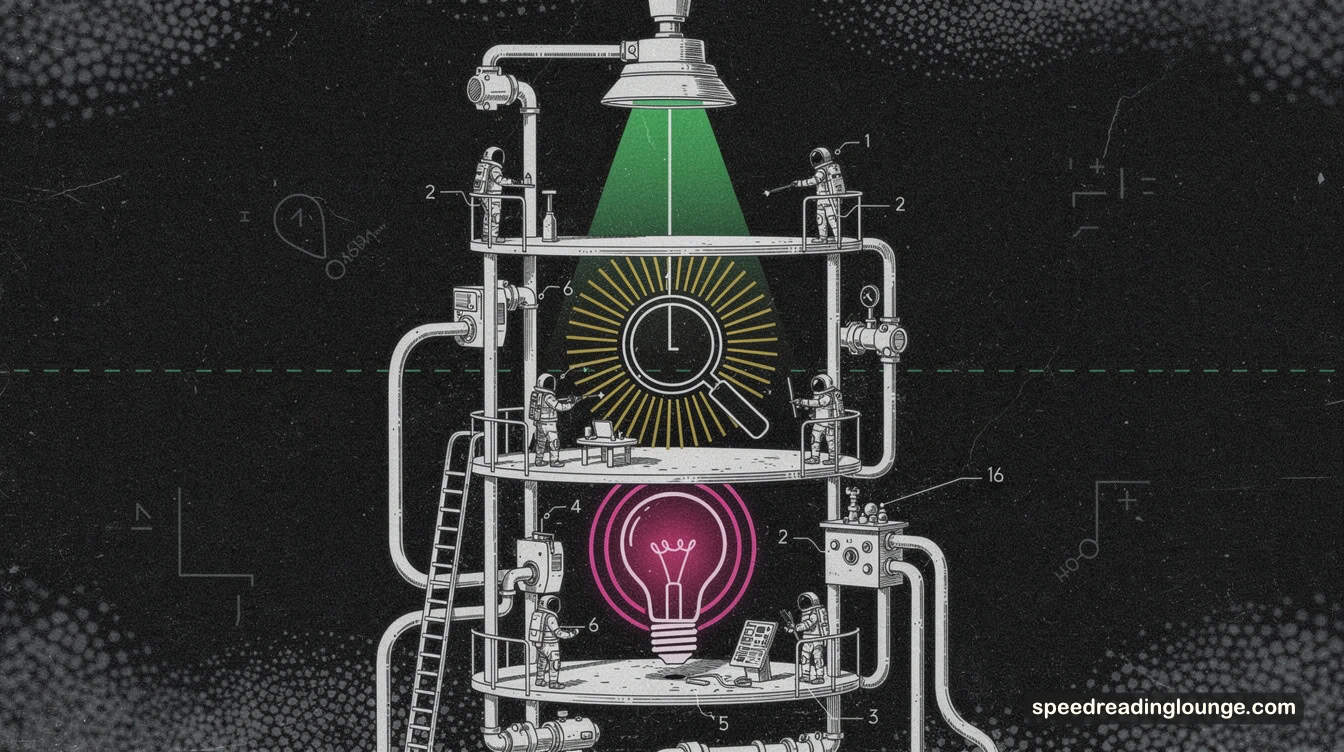
We do not want to stop subvocalization 100% of the time. The inner voice is actually useful for deep analysis, poetry, or complex legal documents where every nuance matters. The goal is control.
Here is how to apply these drills using our signature 3-Step AI Reading Method:
Step 1: The Visual Scan (No Voice)
- Tool: Use [Hand Pacing] or an RSVP tool at 450+ wpm.
- Goal: Identify the structure, main arguments, and key terms.
- Voice: Silenced by speed. You are looking for shapes, not sounds.
Step 2: The Deep Dive (Controlled Voice)
- Tool: Slow down to 250 wpm or use “Audio Overclocking” at 2x speed.
- Goal: Comprehend the nuanced sections you identified in Pass 1.
- Voice: Allowed, but guided. Use the inner voice to “test” the logic of the argument.
Step 3: The Review (Synthesize)
- Tool: Glance back over your highlights.
- Goal: Lock the information into long-term memory.
This is how expert readers operate. They don’t read a whole book at one speed; they shift gears constantly. They treat the inner voice like a tool—picking it up when they need precision, and putting it down when they need speed.
For a complete breakdown of this workflow, see our AI Speed Reading Guide.
Optional step: The Morning “Warm-Up”
Just as an athlete stretches before a race, a reader should warm up the visual cortex.
- Spend 5 minutes each morning using an RSVP tool at a speed slightly too fast for comfort (e.g., 450 wpm).
- This “primes” your brain to look for visual patterns rather than auditory sounds.
- When you switch to normal reading, your baseline speed will naturally sit higher, and your subvocalization will be quieter.
Tip: The Role of Scanning and Skimming
Another powerful way to reduce the reliance on the inner voice and to stop subvocalization is to change how you look at the page.
When you read linearly (left to right, line by line), you are following the exact path of speech. This invites the inner voice to join in.
Scanning, on the other hand, is a non-linear process. You are moving your eyes down the middle of the page, looking for specific shapes (keywords) or structures (bullet points). Because the eye movement doesn’t track with the sentence structure, the phonological loop gets confused and stays silent.
Learn more about these techniques in our article on Skimming and Scanning. Alternatively, explore AI summarization tools to try new AI reading strategies that can help reduce or stop subvocalization habits.
Subvocalization – Summary and Conclusion

Simply put: Silence is not the goal.
We all subvocalize, and while there is much we can do to minimize it, we cannot completely eliminate it. You will want to stop subvocalization because it slows your pace without providing any compensating benefits, such as better comprehension.
Thus, if you take one thing away from this guide, let it be this: Do not fight the voice.
Trying to forcefully “silence” your mind usually backfires (the “don’t think of a white elephant” effect). Instead, focus on speed. Focus on the visual flow. Focus on outrunning the narrator.
When you push your reading speed past 350 wpm—whether by using your finger, a music jammer, or an AI pacer—the voice doesn’t die. It just gets left behind. And in that quiet space, you finally find the flow.
Ready to take the next step? Check out our comprehensive AI Speed Reading Guide for advanced workflows on combining these manual drills with the latest AI technology.
How To Stop Subvocalization – 6 Tips
- Chew gum or tap your fingers while reading
- Use hand pacing to push eyes faster than the voice
- Play instrumental music to occupy your auditory cortex
- Train peripheral vision to recognize word chunks instantly
- Preview the material structure before diving into deep reading
- Use RSVP tools flashing words at 400+ wpm
- Apply text-to-speech audio overclocking at 2x-2.5x speed
- Prevent visible mouth and throat movement while reading
- Use bionic reading fonts to reduce eye fixation time
- Master the 3-Step AI Method for strategic reading control
FAQs Subvocalization
Can You Permanently Stop Subvocalization Completely?
No. You cannot permanently stop subvocalization 100%, and you shouldn’t try. Even elite speed readers—those who claim to read at 800+ wpm—still subvocalize at a reduced level. Research by cognitive scientists Carver and Rayner has shown that subvocalization is detectable in all readers via throat EMG (electromyography), even among those who believe they have eliminated it entirely.
What is possible is to manage subvocalization rather than eliminate it. You can reduce its intensity to a level where it no longer slows you down. Think of it like turning down the volume on a radio, not unplugging it entirely. When you stop subvocalization for specific types of reading (like skimming news articles), you retain the ability to toggle it back on when you need depth (like reading a legal contract).
The key insight: Your brain uses subvocalization as a quality-control mechanism. Completely silencing it would actually hurt your comprehension of complex material. The goal is control, not elimination.
Does Reducing Subvocalization Hurt Comprehension?
It depends on how you reduce subvocalization. This is where most people get it wrong.
If you simply force yourself to stop the inner voice through sheer willpower, yes, comprehension will crash. Your brain panics because the familiar “soundtrack” is gone. But if you use the right techniques—hand pacing, RSVP tools, or audio overclocking—your comprehension remains stable or even improves.
Here’s why: Subvocalization forces you to process words sequentially (one at a time), like listening to a podcast. Your visual cortex, by contrast, can process chunks of information simultaneously. When you stop subvocalization using digital drills, you switch from serial (word-by-word) processing to parallel (chunk-based) processing. This is actually faster and more efficient.
Research shows that readers who successfully reduce motor subvocalization (the lip movements) maintain 70-85% comprehension at speeds of 400-600 wpm, compared to the typical 200-250 wpm baseline. The trade-off occurs only if you abandon the technique too quickly, without letting your visual cortex adapt.
Is Subvocalization Worse for People With ADHD or Dyslexia?
Subvocalization shows up differently in neurodivergent readers, and it’s not always a problem—sometimes it’s a coping mechanism.
For dyslexia: Many dyslexic readers subvocalize more intensely because it helps them decode unfamiliar letter patterns. Trying to force them to stop subvocalization can actually backfire. Instead, the goal is to refine it: use music to occupy the auditory cortex, or switch to tools like BeeLine Reader that reduce eye-tracking strain (which is often the real bottleneck for dyslexic readers, not the inner voice).
For ADHD: Some ADHD readers hyperfocus on individual words, which makes subvocalization feel like a drag. Others find that subvocalizing helps them maintain focus. The solution is to test both approaches: try hand pacing (manual distraction) and RSVP (forced speed). One of these two will likely “click” for ADHD brains because they introduce the external structure that ADHD brains crave.
The key: Don’t try to stop subvocalization for neurodivergent readers. Instead, help them work with it by using the right complementary tools.
Does Subvocalization Affect Foreign Language Reading Speed?
Yes, subvocalization affects foreign-language reading even more than it affects native-language reading. But here’s the paradox: you need subvocalization to learn the foreign language in the first place.
When learning a new language, subvocalization helps you internalize pronunciation and grammar patterns. The phonological loop (the memory system for sound-based info) is essential for vocabulary retention. Studies by Gathercole and Baddeley show that readers with stronger phonological memory acquire foreign words more efficiently.
However, once you’ve reached intermediate or advanced proficiency (B1+ level in the CEFR), you can start to reduce subvocalization using the same techniques: hand pacing, music, and RSVP tools. This allows you to read authentic foreign language content at near-native speed.
The practical approach: In the early stages (A1-A2), embrace subvocalization—it’s helping you build the phonological representation you need. At intermediate+ levels (B1 and above), use digital drills to stop subvocalization so you can read fluently without translating into your native language.
Does Subvocalization Improve Memory and Retention?
Yes, subvocalization does improve memory and retention—when used intentionally. This is the critical nuance that most speed reading guides miss.
When you subvocalize (engage your inner voice), you activate both the visual and auditory cortex. This “dual encoding” creates stronger memory traces. Research consistently shows that readers who subvocalize retain 75-85% of complex material, while those who try to bypass the inner voice entirely retain only 40-50% on the first pass.
But here’s where the 3-Pass AI Method comes in: You don’t read everything at one speed. You use Pass 1 (visual scanning at 450+ wpm) to identify structure, Pass 2 (controlled subvocalization at 250 wpm) to absorb meaning, and Pass 3 (review with the inner voice) to cement memory.
By strategically choosing where to use subvocalization, you get the best of both worlds: speed on lightweight material (news, summaries, overviews) and retention on heavy material (textbooks, research, important documents).
The takeaway: Stop subvocalization when reading for breadth. Allow subvocalization when reading for depth.
What’s the Difference Between Reducing Subvocalization and Losing Focus?
Many readers who successfully stop subvocalization panic because the experience feels wrong. Without the familiar “voice,” the reading experience feels empty or dreamlike. This is not failure—it’s adaptation.
Here’s how to tell the difference:
Successful Reduction of Subvocalization:
- The inner voice is quiet or barely present.
- Your eyes move smoothly down the page (no back-skipping).
- You can summarize what you read immediately after.
- You feel like you’re “scanning for meaning” rather than “hearing words.”
Failed Reduction (Loss of Focus):
- You read an entire page and have no idea what it said.
- Your eyes jump around randomly.
- You constantly re-read the same line.
- Your mind feels blank or “disconnected” from the text.
If you experience the second scenario, slow down. Use “Audio Overclocking” (TTS at 2x speed) instead of manual pacing—this gives your brain an external structure to lock onto. Or return to the “Music Jammer” drill to occupy your auditory cortex before attempting to stop subvocalization.
The key: Subvocalization is not the enemy of focus. When done right, reducing it improves focus because you stop getting distracted by the sound of individual words.
What is the difference between vocalization and subvocalization?
When you vocalize, you will move your lips and use your real voice to pronounce words. When you subvocalize, you hear an inner voice as you read a text.
When do we not subvocalize?
There are some interesting examples I found on the web and know from my own experiences. Think of walking the streets, looking at labels, signs, or advertisements. Whether you see brand names, numbers, or signs with one-word instructions, you likely see and understand that information without subvocalizing the words in your head. Another example is country names, i.e., the United States of America or New York City. You see and understand those terms immediately without pronouncing them silently.
Can chewing gum help reduce or stop subvocalizing?
I came across this method when talking to a colleague who was constantly trying to better control his inner voice. It works in a similar way to the ‘hum a melody’ trick. The question is how heavily you will need to move your jaws to achieve an effect. Simply try it out yourself.
Interesting reading
Wikipedia | Forum Discussion on Topic
Sources and credits
- Working Memory & Phonological Loop – ScienceDirect / Alan Baddeley
- Speed Reading vs. Comprehension Science – Association for Psychological Science
- Peripheral Vision in Reading Process – National Institutes of Health (NIH)
- Eye Movements and Reading Mechanics – Rayner Eye Tracking Lab
- Subvocalization via Electromyography (EMG) – NASA Technical Reports
- Processing Speed of Visual Cortex – MIT Brain & Cognitive Sciences