
QuickReader App Review for iOS, iPad
QuickReader – eBook Reader with accelerated reading function

QuickReader arrived with a genuine promise. Inkstone Software built it around a specific, disciplined idea: that guided highlighting and adjustable reading speeds could transform how someone moves through a book.
For a narrow window, that idea was enough. Then the updates stopped, the iOS ecosystem kept moving, and QuickReader stayed exactly where it was.
What you find today is an iOS-only speed reading app with real depth and real age. It handles DRM-free ePub files and connects to catalogs like the Internet Archive and Feedbooks. On paper, it does a lot. In practice, I’m looking at a tool that’s been untouched for over a decade — running on hardware it was never designed for.
It sits firmly in the legacy category. A specialist ePub speed reader with bones worth admiring, and a development history worth questioning.
Who QuickReader Was Built For (and not)
Primary audience.
QuickReader made genuine sense for a specific kind of reader. Someone importing Calibre libraries, drilling public-domain ePubs from the Internet Archive, and wanting granular control over reading speed and visual presentation.
Law students working through dense case files — or hobbyists building reading habits around free ebook catalogs — would have found real value here.
Secondary audience.
Anyone with a legacy iOS device who already knows this app and hasn’t run into any compatibility issues. If it still runs cleanly for you, the core experience remains intact.
Who should look elsewhere.
Android users have no option here at all. Anyone wanting AI-assisted reading, cross-platform sync, PDF support, or web article processing will find nothing useful. iOS users using the latest iPhones may face compatibility risks that no official update has addressed.
QuickReader – Highlights
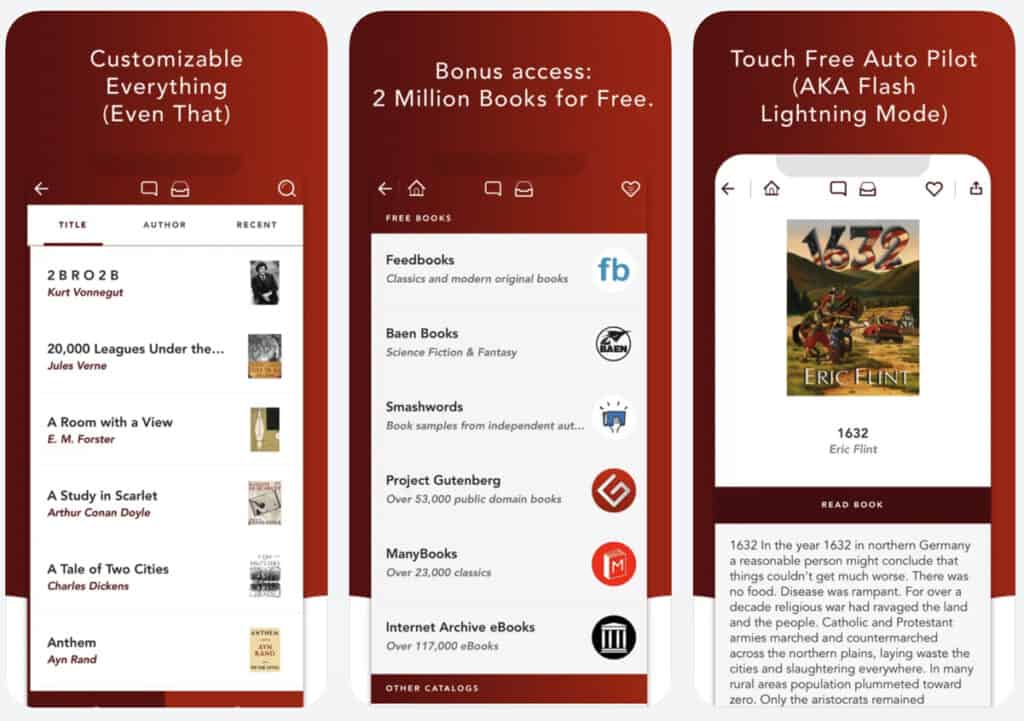
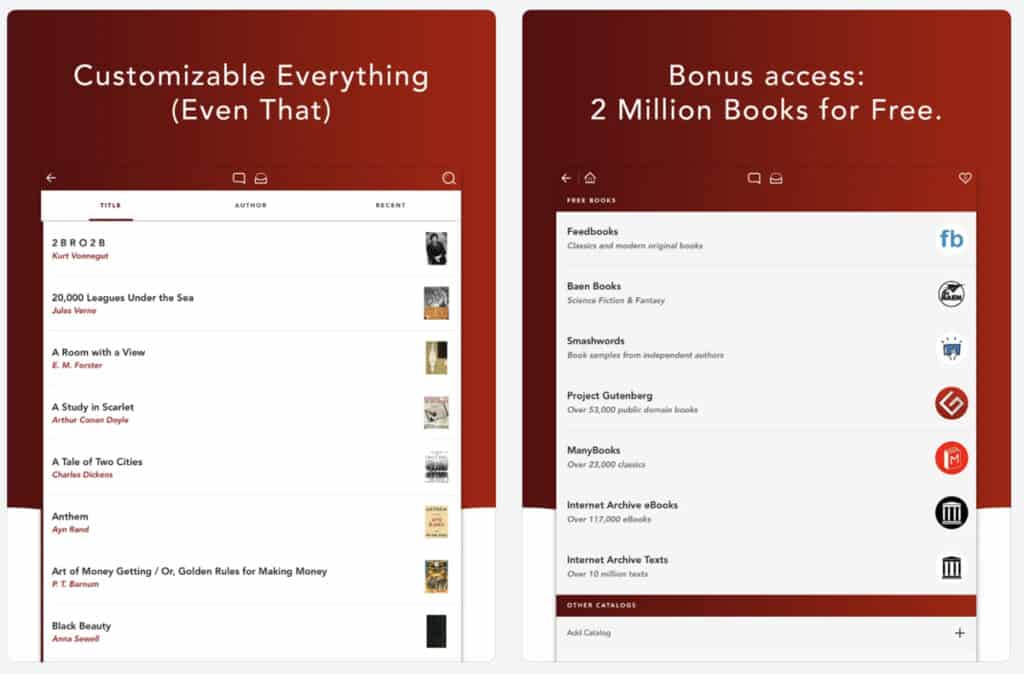
- eBooks – Install QuickReader and get access to over 2 million free books on your device. This will essentially give you a lifetime’s worth of books for just $4.99.
- Skills – Use proven techniques to reduce distractions and improve focus when learning new skills. Improve pace and use tests to assess yourself.
- Customization – Customize QuickReader to suit your needs and preferences, from colors and font styles to words-per-minute settings, up to 4,000 wpm.
Reading tip: Tools and apps are useful, but most lasting gains come from a few solid tutorials you revisit. If you suspect habits, not software, are holding you back, do this. Start with a fundamentals guide on how to speed read, then move into practical lessons on skimming and scanning, and reading word chunks.
QuickReader – Features and Highlights
1. Speed Control and Reading Mechanics
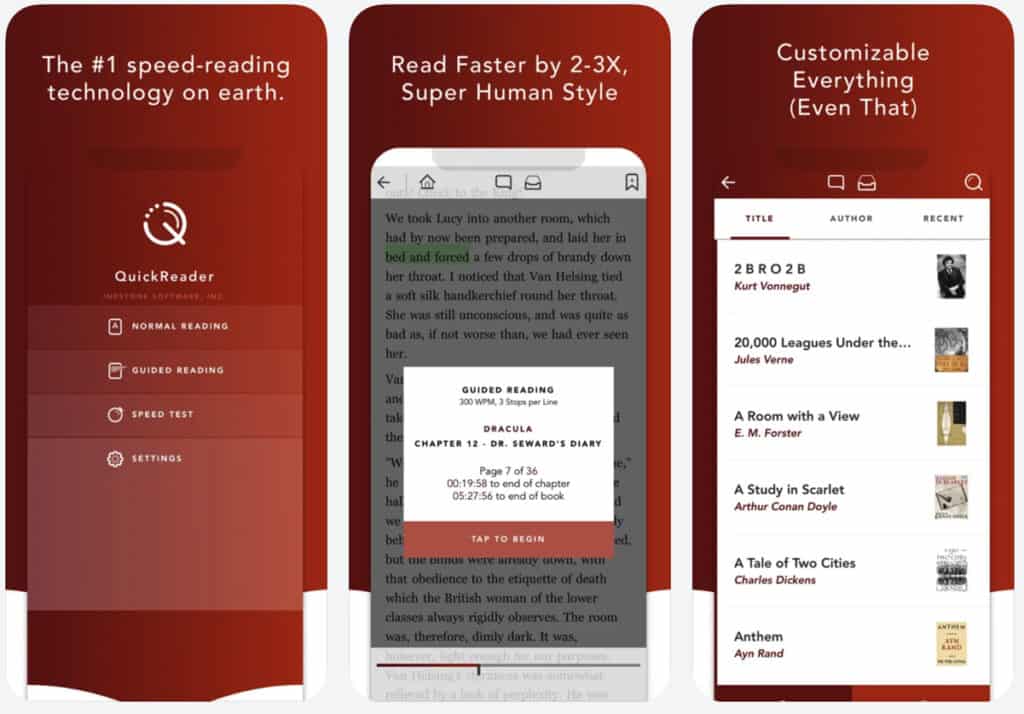
The headline capability is an adjustable reading speed from 10 to 4,000 words per minute. That range is unusually wide, and I mean that as genuine praise — not filler. At the low end, it accommodates deliberate, focused reading. At the upper end, it delivers the kind of high-velocity guided reading that speed training is built on.
Control is handled through tap zones. Tap to accelerate, tap to slow down, press and hold to pause. There’s also a normal reading mode for when guided highlighting feels like too much.
The technique resembles RSVP but retains the full line of text on screen, using a moving highlight rather than single-word flashing — a meaningful distinction for readers who find isolated-word presentation disorienting.
In a nutshell
- Speed range of 10–4,000 wpm offers genuine flexibility for readers at any level
- Touch-zone controls are intuitive once learned
- Press-and-hold pause is practical for readers who annotate while reading
2. Great Customization Depth
Customization is where QuickReader clearly differentiated itself, and I think it’s still the most honest argument for the app. Named color schemes — Amber Light, Green Tea, Morning Fog, Purple Haze, Rose Tinted, Clear — go beyond cosmetic choice.
Extended reading sessions genuinely benefit from thoughtful contrast and warm settings. Margin controls, font size, additional font options, and a hide-status-bar mode round out a display toolkit that was ahead of its time for an iOS reader.
Word grouping and highlighting style are also adjustable. Reading in chunks of two or three words reinforces natural phrasing and reduces subvocalization pressure — something that matters more than it sounds when you’re training at speed.
In a nutshell
- Six named color schemes designed for extended reading comfort
- Word grouping controls support phrase-based reading practice
- Font and margin adjustments go well beyond most competitor apps of its era
3. ePub Catalog Integration
The catalog reach is real and still technically available: over 1.8 million books through Internet Archive, 6,500-plus through Feedbooks, and OPDS/Stanza-format catalog support. Books can be pulled from the web, email, or directly from catalogs. Integration with Instapaper, iBookshelf, and MyLibrary further extends reach.
For DRM-free public-domain reading, matching the library’s depth is difficult. A reader focused on classic literature, historical documents, or open-license nonfiction has essentially unlimited material — and none of it comes with a paywall beyond the app’s cost.
In a nutshell
- Internet Archive integration provides access to 1.8 million DRM-free books
- OPDS/Stanza compatibility makes this usable with Calibre-managed libraries
- Email and web import offer flexible delivery for personal ePub collections
4. Navigation and Time Estimates
A book position slider allows fast jumping through chapters. Time-to-end estimates, which are calculated from your actual reading speed test, are a quietly excellent feature.
Knowing you have 47 minutes left in a chapter changes how you settle into a session. Bookmark saving and library sorting by title, author, or recent activity are standard, but they work without friction.
Reading tip: If you want AI to actually save reading time, start with a focused overview instead of scattered tips. The main AI speed reading guide walks you through my 3‑Step AI Speed Reading Method and shows where tools, AI summaries, and listening apps realistically help.
From there, you can dive into tutorials on AI‑supported reading workflows such as our ChatGPT for speed reading guide — and compare carefully selected AI speed reading apps and text-to-speech apps or AI summarization tools before committing to any subscription.
Where QuickReader Gets It Right – Pros
The depth of customization is the honest answer here, and I keep returning to it. A reviewer in the app’s active years described it plainly: the QuickReader app gives you “so many options — colors, font size, means of highlighting words, grouping of words, margins, and of course speed.”
That observation still holds structurally. No competing app from this era matched that level of visual and behavioral control for ePub speed reading.
The Internet Archive integration also holds up as a genuine strength. For readers whose practice centers on public domain material — Project Gutenberg titles, historical documents, classic literature — the catalog access is substantial. The content itself costs nothing; only the QuickReader does.
Multi-language support is a quiet differentiator worth naming. Reading in Chinese, Dutch, Spanish, French, or German, with the same speed control and customization that English readers get, is not something every speed-reading app has ever offered.
That it exists here, in an app this old, tells you something about the original build’s ambition.
QuickReader’s Problems Are Structural, Not Cosmetic
Here is where I’d ask you to pause before purchasing.
The update problem.
Development notes stop at the last documented build, which was optimized for iOS 6. A newer version is listed in the App Store. But what changed between then and now, and whether it addresses modern iOS compatibility, isn’t documented in any of the available sources, or at least very hard to find.
Running an undocumented update on iOS 18-era hardware is a reasonable concern. I wouldn’t call it a minor caveat. I’d call it the central question this app cannot answer.
No AI integration.
In 2026, this matters in a way it simply didn’t a decade ago. The most effective reading workflows now combine speed training with AI-powered comprehension tools, such as AI summarizers, concept extractors, and comprehension checks.
QuickReader has none of this. It operates entirely on manual technique, which was once the standard and now feels like a structural absence.
Platform isolation.
iOS only. No Android, no web app, no desktop. If your reading life spans multiple devices (and most people’s do), QuickReader creates a silo with no exit. There’s no cross-platform sync, no shared progress, no flexibility built for how people actually move through their days.
Transparency gaps.
Current pricing isn’t confirmed in the available data. Ratings and review counts aren’t verifiable. Inkstone Software’s support responsiveness is unknown. Buying an app with this many open questions requires a tolerance for uncertainty that most readers shouldn’t have to accept.
- Development appears stagnant
- No AI features exist; a manual-only technique in an AI-native reading landscape
- iOS exclusivity eliminates QuickReader for Android users entirely
- Pricing, current compatibility, and active support are all unverified
QuickReader Pricing
The pricing for the QuickReader remains stable at $4.99. But it seems the App Store listing indicates a paid app, and older catalog integrations appear to carry no additional paywalls beyond it.
However, whether a free tier, trial period, or in-app purchase structure is in place cannot be verified without direct access to the App Store at the time of purchase.
In my opinion, paying for an app whose maintenance status is unclear, whose current device compatibility is undocumented, and whose developer has gone quiet for years is a gamble — not a purchase. Small as the cost may be, the uncertainty is the real price.
QuickReader and Modern AI Reading Workflows
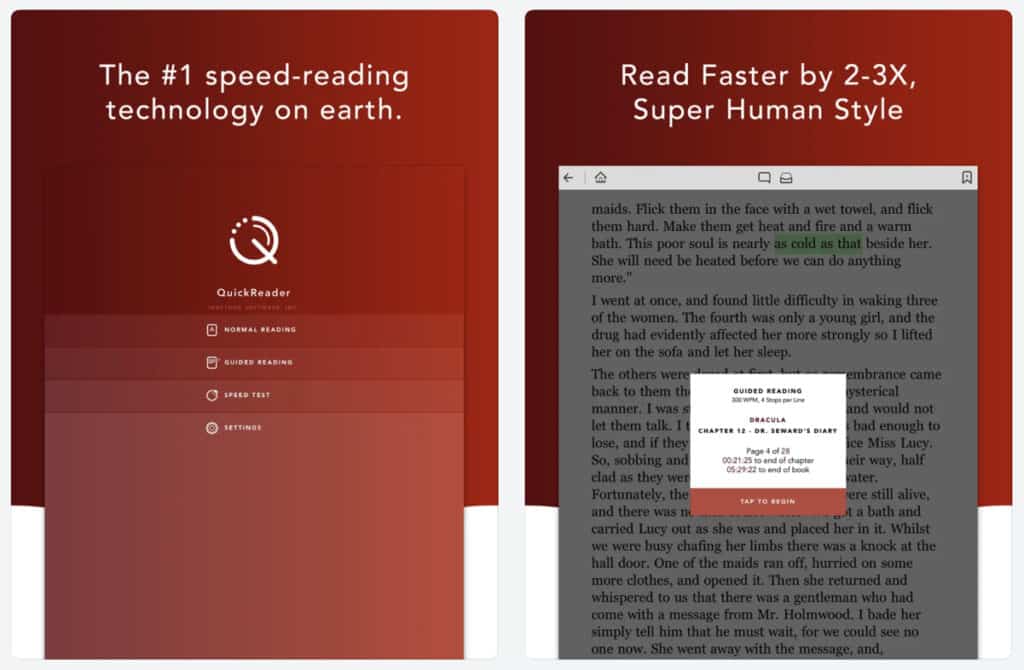
Look at the screenshot of QuickReader above. Bold claims. It was great back then. But honestly? With AI getting into EduTech heavily, I don’t think the app in it current state fits well into a modern AI reading workflow as outlined in our guide.
Our 3-Step AI Speed Reading Method involves using AI tools to pre-process material before reading, then applying speed techniques during reading, and then using AI again to consolidate comprehension afterward.
QuickReader handles only the middle step: the actual reading phase, with speed control and guided highlighting. That’s at least something. But it’s also not enough.
Without Step 1 or Step 3 capability, and without integration with any AI tool, it functions as an isolated reading environment.
- QuickReader can’t accept AI-generated summaries as inputs.
- It can’t export highlights or notes to a language model for post-reading analysis.
- QuickReader handles ePubs — not the PDFs, web articles, and research papers that dominate how most people read now.
For readers who want to explore how AI tools enhance the reading process, the our speed reading tools section offers a broader overview.
For those specifically working with ePub-format books and willing to handle AI steps separately in other apps, QuickReader could still serve as a dedicated speed-training environment — provided it runs on your device.
QuickReader Review: Final Verdict
Our review score for QuickReader is 4/10. And here is why.
There was once a version of QuickReader that deserves an 8. In its active years, the combination of deep customization, a wide speed range, a broad catalog, and thoughtful reading mechanics certainly made it a genuinely serious tool for ePub speed training.
I can still see what it was trying to be. The bones of a good app are visible here, and that’s not a small thing to acknowledge. But the bones are all that remain.
Because there have been no confirmed updates for a few years now, no AI integration, iOS-only availability, undocumented compatibility with current devices, and no transparency around pricing or active support, I can’t recommend QuickReader in 2026. Nostalgia isn’t a reason to buy an app. Neither is potential.
Thus, download it only if you’re on an older iOS device, your reading practice is exclusively ePub-based, and you’re willing to verify compatibility before committing. That’s a narrow window — and whether it’s still open at all is something only your own App Store can confirm.
Who should try QuickReader:
Legacy iOS users with established ePub libraries and a tolerance for an outdated interface.
Who should look elsewhere:
Everyone using a current iPhone, all Android users, and anyone whose reading workflow involves PDFs, web content, or AI tools.
Better alternatives to QuickReader:
- Spreeder — cross-platform RSVP reader for Windows, Mac, iOS, and Android. Includes expert-guided speed training courses, cloud sync, and a lifetime VIP license at a one-time cost.
- Speechify (visit website) — text-to-speech focused rather than traditional speed reading. Supports PDFs, web articles, Google Drive, and 60+ languages. AI summaries and comprehension tools are built in.
- Outread — actively maintained, science-backed RSVP techniques, modern iOS and Android support
- Quickify — AI-driven reading with ChatGPT integration, PDF support, and Android availability
QuickReader — Quick Reference
| Detail | Info |
|---|
| App Name | QuickReader |
| Developer | Inkstone Software, Inc. |
| Platforms | iOS only (iPhone, iPad) |
| iOS Compatibility | Optimized for iOS 4.0–iOS 6; current iOS 18 compatibility unverified |
| Android | Not available |
| Web / Desktop | Not available |
| Reading Speed Range | 10–4,000 words per minute |
| Content Support | DRM-free ePub; no PDF or web article support confirmed |
| Catalog Access | 1.8M+ books (Internet Archive); 6,500+ (Feedbooks) |
| AI Features | None |
| Pricing | Paid app. From $4.99. |
| Android users, AI workflow users, modern iOS, with no compatibility testing | Not currently verifiable |
| Best For | Legacy iOS ePub readers; public domain book speed training |
| Not For | Android users, AI workflow users, modern iOS with no compatibility testing |
| Official Links | App Store · quickreader.net |
| SPL Rating | 4/10 |
Quickreader Lite

What I haven’t mentioned so far is that there is also a lite version with limited access to (now outdated) features, the catalog, and settings.
This is great if you want to try it out first, if you still want to at all. The other highlights mentioned above remain intact, such as touch-free learning and customization to organize the way you access and process your material.
Keep in mind that ads may be displayed and data privacy may be less secure than with a premium plan.
Other solutions include the Outread or the ReadMe! app.
QuickReader – Other Incstone titles
eBook Search – Incstone is the company behind QuickReader. They have a range of other tools available. One of the best ones is the eBook Search. It contains access to the same library, and once you have chosen a title, you can simply download it to your favorite reader, i.e., Kindle, Nook, or iBooks.
Audiobooks HQ – If you are more of an audio person, then Audiobooks HQ might be worth a try. While not everything is free, you get free access to at least 12,000 titles. The library contains a total of 320,000 premium audiobooks.
MegaReader – If you don’t need the features of QuickReader, you may consider MegaReader. It provides access to the library but without the learning effects.
Interesting sources:
If you like to see what the evidence actually says about speed reading and reading tech, it’s worth dipping into original research rather than app marketing. These non‑commercial sources on RSVP reading, bionic reading, eye movements, regressions, comprehension, and retention are a solid starting point:
Curious what science says about RSVP, bionic reading, eye fixations, and regressions? These original studies and reviews are a good starting point:
- Modern Speed‑Reading Apps Do Not Foster Reading Comprehension (Rayner et al., 2016):
https://pubmed.ncbi.nlm.nih.gov/29461715/ - Perceptual Learning in an RSVP Reading Task (Chung, 2014):
https://pmc.ncbi.nlm.nih.gov/articles/PMC4274879/ - Guiding the Gaze: How Bionic Reading Influences Eye Movements (2025):
https://pmc.ncbi.nlm.nih.gov/articles/PMC12565662/ - Eye Movements and Fixation‑Related Potentials in Reading – Review (Schuster et al., 2020):
https://pmc.ncbi.nlm.nih.gov/articles/PMC7157570/ - A Cognitive Model of Regressive Eye Movements During Reading (von der Malsburg & Vasishth, 2020):
https://pmc.ncbi.nlm.nih.gov/articles/PMC7888242/
Disclosure: This post contains affiliate links to some partners. Speed Reading Lounge may receive a commission for purchases made through these links. It does not add any extra costs. All reviews, opinions, descriptions, and comparisons expressed here are our own.