
Outread App Review
Outread: An AI RSVP reader for ebooks, websites & reading lists
Outread is a well-made iOS speed reading app to quickly go through your digital reading lists by using numerous tried-and-tested accelerated reading strategies.
But in late 2025, version 2.5 arrived, also adding Apple Intelligence features to an already capable foundation. The current Outread app is already beyond version 2.6.
For an indie app built by a single developer in Warsaw, that’s a signal worth paying attention to.
This Outread review examines what the app delivers, where the subscription model creates friction, and whether the new AI layer adds genuine value. By the end, you’ll know exactly whether this belongs on your iPhone — or stays off it.
What Outread Is, and Where It Comes From
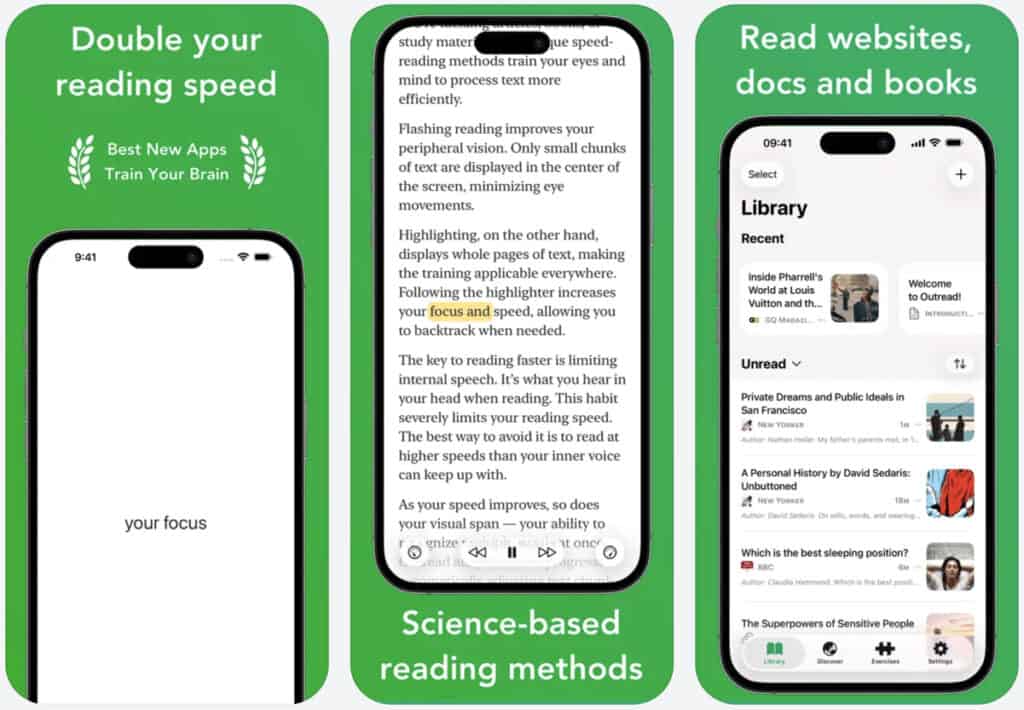
Outread is a speed reading app for iOS, iPadOS, and macOS. In general, it will guide your eyes to focus on smaller word chunks using a highlighting marker. This can be effective for quickly processing digital content and for increasing your overall pace.
It uses two core techniques. One is the just mentioned moving highlighter that guides your eyes through text. And Flash Mode. Flash Mode flashes individual words or short phrases at the center of your screen using Rapid Serial Visual Presentation (RSVP).
Arkadiusz Holko, an independent developer based in Warsaw, built it. He did so long before “intelligent” became a default feature claim.
Version 2.0 arrived in March 2023. Version 2.5 followed in September 2025, bringing Apple Intelligence integration and a Liquid Glass interface update. There is no Android version, no Windows app, and no web client. However, this is a dedicated Apple ecosystem tool, and it doesn’t pretend otherwise.
Outread in a nutshell
App Name: Outread
Developer: Arkadiusz Holko (Arek Holko)
Platforms: iOS, iPadOS, macOS
Current Version: 2.6
Android: Not available
Free Tier: Yes
Subscription: from $4.99/month
Subscription: Outread+ (monthly, annual, lifetime options)
AI Features: AI Summary, AI Key Points, AI Quiz, AI Tag Suggestions (Apple Intelligence, on-device)
Best For: Apple users with ADHD, dyslexia, heavy Pocket/Instapaper queues
Website: outreadapp.com
Who Gets the Most from This App
Primary audience
The primary audience is Apple users who struggle with focus while reading. That includes people with ADHD, ADD, dyslexia, or low vision. For them, controlled pacing and minimal visual clutter can genuinely help.
Furthermore, students and professionals with heavy reading loads, such as Pocket queues, ebooks, PDFs, and research documents, will find it well-suited too. The Pocket and Instapaper integrations make it a natural companion for any read-later workflow.
Secondary audience
A secondary fit exists for curious general readers who want to experiment with RSVP. Progress tracking built into the Outread app supports measurable habit-building over time.
Who should look elsewhere?
Android users have no version to consider. Readers who rely on DRM-protected Kindle or iBooks files will certainly hit a hard wall. And anyone expecting AI to deliver deep analytical insight should probably temper their expectations. Last but not least, free-tier users wanting full document import and sync will also find the walls closing in fast.
Reading tip: If you want AI to actually save reading time, start with a focused overview instead of scattered tips. The main AI speed reading guide walks you through my 3‑Step AI Speed Reading Method and shows where tools, AI summaries, and listening apps realistically help.
From there, you can dive into tutorials on AI‑supported reading workflows such as our ChatGPT for speed reading guide — and compare carefully selected AI speed reading apps and text-to-speech apps or AI summarization tools before committing to any subscription.
What the Outread Does (And Whether It Works)
1. The Two Reading Modes at the Core
The highlight-guided mode moves a colored bar across text at a set pace. It pulls your eyes forward and discourages regressive eye movements — the habit that slows most readers down.
Flash Mode goes a bit further. It removes the page entirely and presents words or short chunks centered at the focal point. Both approaches are grounded in legitimate reading science. And at lower speeds, I find them almost meditative.
If you push past 600–700 WPM, though, Flash Mode becomes a test of concentration rather than a reading aid. That’s worth knowing before you chase those 1,500 WPM for whatever reasons.
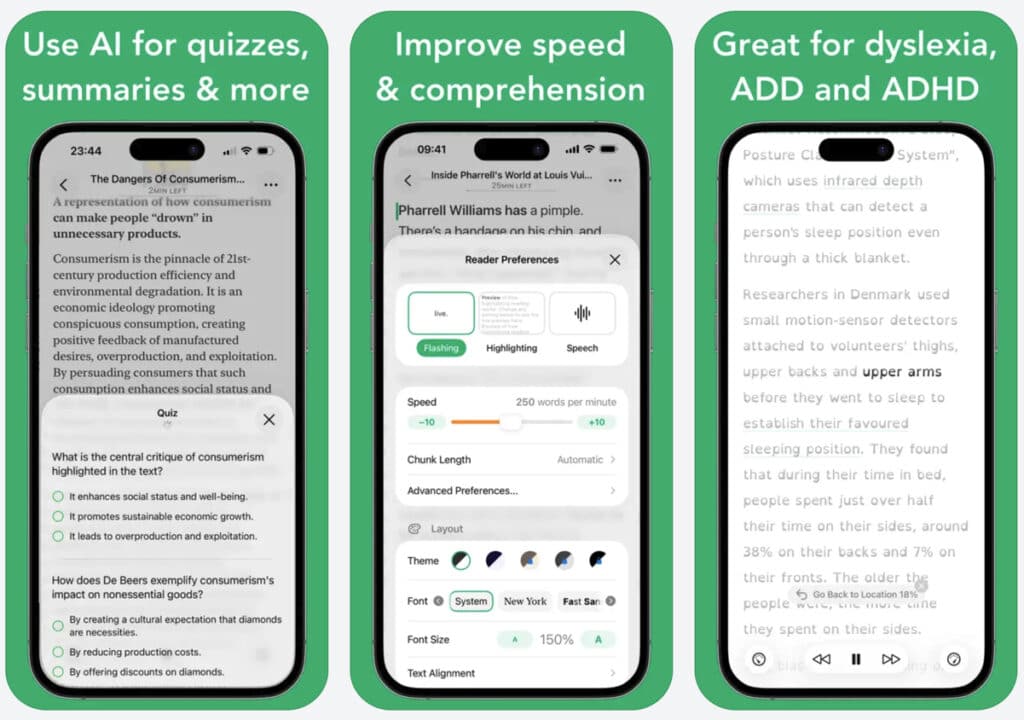
Speed and chunk size are both adjustable. Font family, size, color, and contrast can all be configured. Display themes — OLED Black & White, Sepia, Gray, night mode — are also available. For readers with visual sensitivities, I think this level of control is genuinely useful, and not just a simple checkbox feature.
2. What You Can Actually Read With Outread
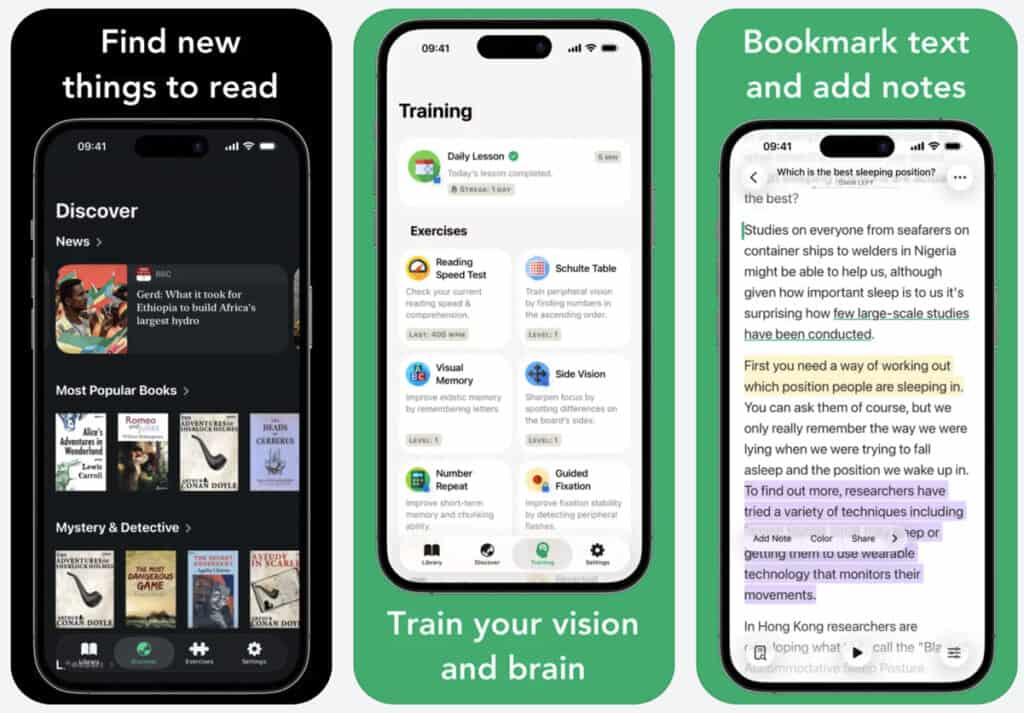
Outread’s content import tool is one of the app’s strongest practical arguments. Beyond pasting text or adding URLs, Outread+ supports DRM-free ePub, PDF, Microsoft Word, RTF, TXT, and Pages documents.
A built-in catalog of free classic novels rounds things out. Share extensions work from Safari and other apps, so sending an article to Outread takes two taps.
The Pocket, Instapaper, and Pinboard integrations also mean your existing reading queue feeds directly into the app. No manual curation required. It’s worth noting: the word “DRM-free” is doing real work in that feature list. If your ebook library lives in Kindle or Apple Books, those files stay locked out.
3. The AI Layer Added in Outread v2.5
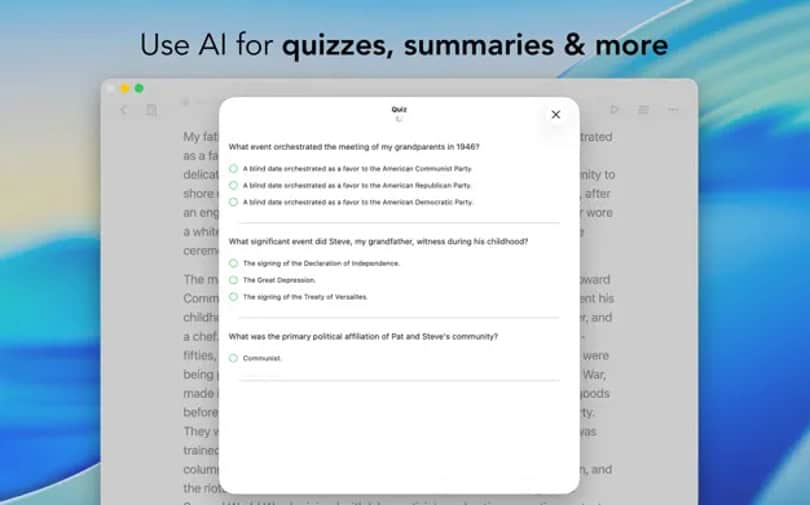
Four AI features arrived with Outread 2.5, all powered by Apple’s on-device Foundation Models.
- AI Summary generates a quick overview of any text.
- AI Key Points extracts important excerpts and saves them as bookmarks.
- An AI quiz creates a comprehension test after you finish reading.
- AI Tag Suggestions proposes organizational tags as you file content.
Importantly, these run on-device, which matters for privacy. They connect to nothing external — not ChatGPT, not Claude. For ADHD or dyslexia users specifically, the quiz and key points features address a real retention gap that RSVP reading can create.
However, whether they feel genuinely useful depends on the text. For a long-form article, I find the summary solid. For a nuanced argument, it will miss things. AI being AI here.
4. Outread Exercises, Stats, and the Habit Layer
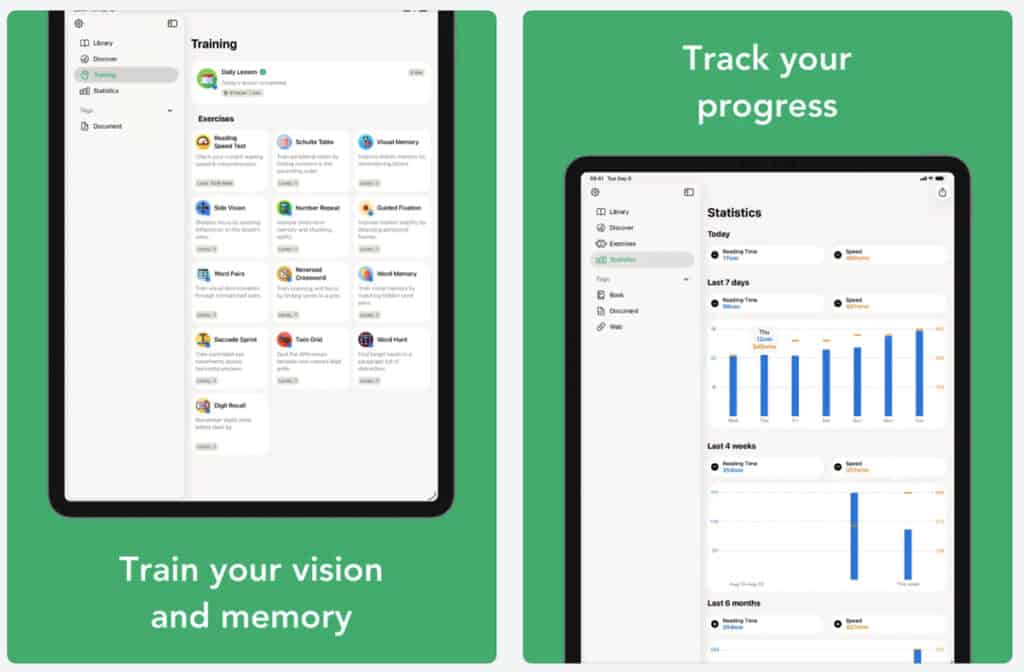
Reading exercises target peripheral vision, chunking ability, and short-term memory. Progress tracking logs words read, speed over time, and completed material. You can filter by service, tag, date, length, or title. For readers treating speed reading as a trainable skill — not a one-off experiment — these features provide real scaffolding.
Outread key features in a nutshell
- Flash Mode and highlighting work as described, but extreme speeds demand serious focus and discipline
- Content import breadth is a genuine strength; DRM restrictions are a genuine limit
- AI features are modest but purposeful, especially for accessibility use cases
- Stats and exercises support long-term habit building, not just one-session use
Reading tip: Tools and apps are useful, but most lasting gains come from a few solid tutorials you revisit. If you suspect habits, not software, are holding you back, do this. Start with a fundamentals guide on how to speed read, then move into practical lessons on skimming and scanning, and reading word chunks.
Where Outread Gets It Right – The Pros
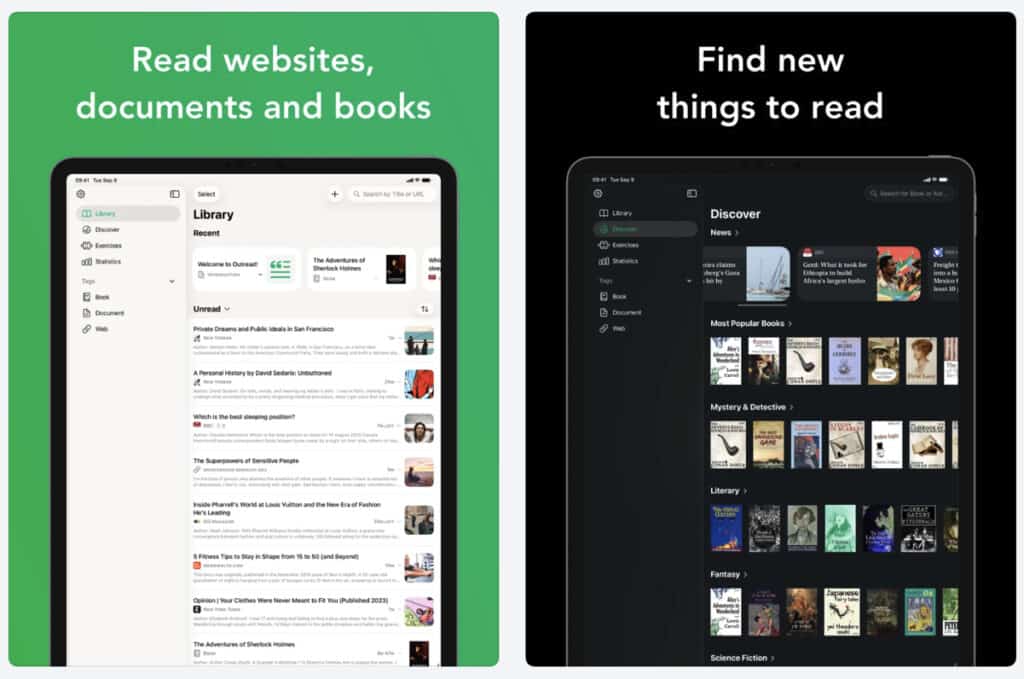
The app’s real strength is coherence. Every feature serves the same goal: remove distractions, control pace, and keep focus on the text. Nothing feels bolted on.
Apple ecosystem integration runs deep, think of AirDrop, share extensions, iCloud sync, and also now Apple Intelligence here. For someone already living in Safari, Pocket, and Apple Notes, I find Outread slots in without friction.
Developer responsiveness is also worth noting. When users in lower-income regions raised pricing concerns, Holko added purchasing power parity adjustments for annual subscriptions. That’s not nothing from an indie builder. The 2025 update signals active development. It is not a product coasting in maintenance mode.
Accessibility support deserves specific recognition. Customizable pacing, visual themes, TTS playback, and AI summaries together create a surprisingly complete toolkit. Readers who find standard interfaces overwhelming will feel that breadth.
Outread Pros:
- Deep Apple ecosystem integration makes adoption frictionless for existing Apple users
- The developer actively maintains and updates the app; not abandonware
- Accessibility feature depth goes beyond cosmetic customization
The Real Cost of Going All In
Here’s where it might get uncomfortable for some. Outread costs $4.99 a month or $29.99 annually. Just to remind you, everything seems to be on a subscription model these days. And so is Outread.
Now, the Outread app is certainly free at the base level, but a subscription layer locks nearly every feature worth having. Document import, Pocket sync, speeds above the basic cap, AI tools, unlimited bookmarks, text-to-speech, extra themes: all locked behind the paywall.
However, a lifetime purchase option is available for $199.99 or $149.99 for the family account, which is worth noting for readers frustrated by the subscription push. Free trial access is available for subscriptions, but not for the lifetime tier.
For heavy daily users, a subscription or lifetime purchase is defensible. For occasional readers, the free tier delivers a usable but deliberately limited experience. The shift from one-time purchase to recurring billing generated visible user frustration. That deserves to be named plainly, not softened.
Outread pricing in a nutshell
- Subscription model replaces the old one-time purchase structure
- Most meaningful features sit behind Outread+
- A lifetime option is available, but a free trial doesn’t apply to it
- US pricing requires verification before making a purchase decision
Alternatives to consider:
The Spreeder app offers competitive value at the premium tier. Iris Reading offers in-person speed reading courses. For a simpler entry point, ReadQuick is worth a look — our ReadQuick review covers where it fits.
How Outread Fits an AI Speed Reading Workflow
In the 3-Step AI Speed Reading Method, Outread fits most naturally into Step 1 and Step 2. Step 1 is the pre-read and intake stage, while Step 2 is the focused reading pass. The RSVP and highlight modes control your reading pace. The AI Summary and Key Points features help you process what you’ve absorbed.
What it doesn’t do is the deeper analytical work of Step 3. For synthesis, note organization, or connecting ideas across multiple documents, I’d pair Outread with a tool like ChatGPT or Claude.
Load an article into Outread for a focused first pass. Then bring the key points or summary into a separate AI tool for analysis. That hybrid workflow is clean and practical.
If you’re building a reading system from scratch, our AI speed reading guide explains how tools like Outread fit into a full workflow. For context on how it compares to other apps in the same space, our overview of apps to read faster is worth reading alongside this review.
Outread Review Verdict: Focused, Capable, Some Limits
Our Outread review rating is 8.5/10. I personally think Outread is a genuinely well-built app for what it sets out to do. The RSVP and highlight modes work. Apple ecosystem integration is deep and thoughtful. The AI update shows a developer who hasn’t walked away from the product.
Thus, for iOS and macOS users processing heavy reading loads, this earns a real recommendation.
But the score isn’t higher for two reasons. First, the subscription paywall captures too many core features — document import and sync among them — turning the free tier into more of a demo than a usable product.
Second, the AI features are modest in ambition. If you came hoping for deep AI reading assistance, you’ll probably want to supplement with external tools.
Download Outread if:
You’re an Apple ecosystem user, you read heavily from Pocket or Instapaper, you have ADHD or dyslexia, or you want an RSVP reading app with real longevity behind it.
Skip Outread if:
You’re on Android, you rely on DRM-protected ebooks, or you want AI that does more than summarize.
Outread App – Highlights + Tiers
| Feature | Free Tier | Outread+ |
|---|---|---|
| Flash Mode & Highlighting | ✓ | ✓ |
| Basic Speed & Chunk Settings | ✓ | ✓ |
| Stats & Progress Tracking | ✓ | ✓ |
| Offline / Distraction-Free Layout | ✓ | ✓ |
| Document Import (PDF, ePub, Word) | ✗ | ✓ |
| Pocket / Instapaper / Pinboard Sync | ✗ | ✓ |
| Speeds up to 1,500 WPM | ✗ | ✓ |
| AI Summary, Quiz, Key Points | ✗ | ✓ |
| Text-to-Speech | ✗ | ✓ |
| Unlimited Bookmarks & Notes | ✗ | ✓ |
| AirDrop & Extra Themes | ✗ | ✓ |
Bottom line – I like Outread and can definitely recommend the basic version. It is fun to use, and you can learn something. Although you wikt the ceiling very quickly. For the Plus edition, I’d like to suggest that you think about your goals beforehand and compare them with those of valuable competitors.
Are you using Outread? Which version? Please share your opinion and experiences in the comments below.
Interesting sources:
If you like to see what the evidence actually says about speed reading and reading tech, it’s worth dipping into original research rather than app marketing. These non‑commercial sources on RSVP reading, bionic reading, eye movements, regressions, comprehension, and retention are a solid starting point:
Curious what science says about RSVP, bionic reading, eye fixations, and regressions? These original studies and reviews are a good starting point:
- Modern Speed‑Reading Apps Do Not Foster Reading Comprehension (Rayner et al., 2016):
https://pubmed.ncbi.nlm.nih.gov/29461715/ - Perceptual Learning in an RSVP Reading Task (Chung, 2014):
https://pmc.ncbi.nlm.nih.gov/articles/PMC4274879/ - Guiding the Gaze: How Bionic Reading Influences Eye Movements (2025):
https://pmc.ncbi.nlm.nih.gov/articles/PMC12565662/ - Eye Movements and Fixation‑Related Potentials in Reading – Review (Schuster et al., 2020):
https://pmc.ncbi.nlm.nih.gov/articles/PMC7157570/ - A Cognitive Model of Regressive Eye Movements During Reading (von der Malsburg & Vasishth, 2020):
https://pmc.ncbi.nlm.nih.gov/articles/PMC7888242/
Disclosure: This post contains affiliate links to some partners. Speed Reading Lounge may receive a commission for purchases made through these links. It does not add any extra costs. All reviews, opinions, descriptions, and comparisons expressed here are our own.