
Reading Retention: How To Remember What You Read (with AI)
5 Reading retention strategies to retain information better (with AI)
Three weeks after finishing a book, someone asks what it was about. You pause. The cover comes to mind. A vague sense of the argument. Maybe one idea, blurring at the edges. Then silence. Welcome to reading retention, or the quiet collapse of it.
Speed readers hit this wall harder than most. The faster you move through material, the more you stand to lose if nothing sticks. Sure, you get better at reading faster, you feel productive, but then someone asks a question, and the shelf is empty.
Reading retention is the skill nobody talks about when they teach speed reading. Speed gets the spotlight because you can measure it and create a sales pitch around it. Reading retention is rather subtle and determines whether any of it was worth doing.
If you’ve already worked through our reading comprehension guide, you know how to follow an argument and extract meaning while reading. It covers the during-reading phase. This guide picks up exactly where it ends — at the moment you close the page and wonder how you’ll still remember what you read or know tomorrow.
Comprehension and reading retention are two separate skills, and the gap between them catches most readers off guard. You can follow an argument perfectly while reading it and remember almost none of it six days later. This guide covers the reading retention strategies that close that gap.
Why Your Brain Is Built to Forget
Hermann Ebbinghaus, a German psychologist in the 1880s, spent years memorizing nonsense syllables to study his own forgetting. The results were blunt. Without deliberate review, memory decays fast — steeply in the first hours, more gradually across the following days. He mapped this as the forgetting curve.
What it means in practice: reading something once, even attentively, doesn’t give your brain enough reason to keep it. Memory is economical. Your brain holds onto what it uses and quietly drops the rest.
Speed readers hit this harder than most. More material per session means more to lose. Review time rarely scales with reading volume. So the gap between what you’ve read and what you can actually remember what you read or can recall grows — quietly, session by session.
The forgetting curve isn’t a personal flaw. It’s simply the terrain. Every reading retention strategy in this guide is designed to work with that terrain rather than fight it.
The Three Phases of Reading Retention
Most people treat retention as something that happens after reading. Finish the chapter, then try to remember what you read. What actually works is a system across three phases: before, during, and after. The after phase carries most of the weight, but the other two do essential preparation.
Knowing this framework helps place each technique in context. Every method below belongs to one of these phases. When you know where it sits, you know when to use it.
Before: Set a Retrieval Intention
Most reading starts with a comprehension goal: understand this. Reasonable for the page you’re on right now. It does nothing for your future self.
A retrieval intention is different. Before opening anything worth reading, ask: what should I be able to explain to someone else when I’m done? Not “will I understand this?” but “what will I carry out of this?”
That small shift changes how your brain organizes incoming information. It creates a folder before the content arrives. And it is crucial to understand how to retain information from books, for example.
Without a folder, new ideas scatter. With one, they have somewhere to land.
AI Prompt (Before Reading)
“I’m about to read [title or topic]. Give me 3 specific questions I should be able to answer confidently when I finish. Make them testable, not vague.”
It’s ninety seconds of setup. The difference in how to improve reading retention is not subtle.
During: Collect Less, But With Intention
The during phase is not where retention is built. It’s where raw material gets gathered — and most readers gather too much of it.
Reading already places real demands on working memory. You’re decoding language, following structure, building meaning in real time. That’s a full cognitive load. Adding extensive highlighting or detailed notes on top of that load actively interferes with comprehension. See our guide on how to take notes.
The discipline that works: one key idea per major section. Not the most interesting sentence — the single idea you’d keep if you could only keep one. A brief marginal note: a question, a one-word summary, a connection to something you already know.
You’re not summarising for now. You’re leaving a trail for your future self to follow.
After: Where Most of the Work Happens
Close the book or tab, and the forgetting curve starts immediately. This is where almost every reader stops too early — and where every technique in the next section operates.
The reading comprehension guide builds your understanding of the text. What happens after the text determines whether that understanding becomes retrievable knowledge. The two phases work as a sequence. Get both right, and what you’ve read has somewhere durable to live.
5 Reading Retention Strategies
Each technique below is grounded in genuine cognitive science. Each comes paired with an AI integration — not as a shortcut, but as a practical way to make the technique easier to actually use on a normal day.
1. Active Recall Reading: The Uncomfortable Method That Works
Re-reading feels like studying. Cognitively, it produces something closer to familiarity than memory. Your eyes pass over familiar words, your brain signals quiet recognition, and nothing has been retrieved. Recognition and recall are entirely different operations.
Active recall reading means closing the material and reconstructing what you read from nothing — no notes, no glancing back. The struggle that follows is not a warning sign. It’s the mechanism itself. Your brain strengthens what it has to work to recover.
Retrieval practice produces significantly more durable reading retention than re-reading, and the gap shows up days and weeks later, not just immediately after a session.
However, it is worth naming the difficulty honestly, too. Active recall reveals how little you’ve retained and does so fast. Re-reading is more comfortable precisely because it generates familiarity without exposing gaps. And that comfort is exactly why it doesn’t work.
AI Prompt (Active Recall Reading)
“I just finished reading about [topic]. Give me 5 retrieval questions based on the core ideas. Make them hard enough that I genuinely have to remember the answer, not just recognise it.”
Tip: Attempt your answers before opening your notes. Struggle first. Check afterwards. That ordering matters.
2. Spaced Repetition: Reviewing at the Right Moment
A review session immediately after reading yields little for long-term reading recall. What works is spacing: review the next day, then three days later, then a week, then a month.
Each review catches the memory just as it starts to fade. That precise moment — not earlier, not later — is when reviewing does the most work.
This is the spacing effect, one of the most replicated findings in memory research. Well-timed review consistently outperforms cramming, across subjects, age groups, and content types. Ebbinghaus identified it first. Generations of studies have confirmed the benefits of spaced repetition (guide).
If this sounds too manual, Readwise automates this for reading highlights. Connect it to Kindle, Instapaper, or Pocket, and it resurfaces past highlights at calculated review intervals.
Readwise is genuinely useful here, but keep this in mind. It’s a paid tool, and the value depends on actually engaging with what it sends. If the daily review emails pile up unread, the subscription is doing nothing.
Anki gives more control at no cost. You build your own flashcard decks from notes. But the interface isn’t intuitive, and building a good deck takes longer than it initially looks.
For material, you need to learn how to better retain information long-term, professional knowledge, and technical skills — that time investment probably compounds. For lighter reading, Anki is likely more friction than the content warrants.
AI Prompt (Spaced Repetition Cards)
“Turn these notes into 5 Anki-style flashcards: [paste notes]. Format each as Question / Answer. Keep each answer to one or two sentences.”
Keep this clear: spaced repetition handles when to review. Active recall reading handles how to review. They’re not alternatives — they work together.
3. The Feynman Technique: Explain Until the Gaps Show
Richard Feynman tested his own understanding by trying to explain concepts in plain language, as if to someone with no background in the subject.
When the explanation broke down, he’d found exactly what he hadn’t truly understood — rather than what he’d memorized in borrowed technical terms.
The distinction matters. Specialist vocabulary can mask comprehension gaps. You can repeat a definition fluently and have no idea what it actually describes. Forcing yourself into plain language cuts straight through that.
Feynman Technique Reading: After reading, close the material and explain the core idea aloud or in writing — no jargon, no borrowed phrasing from the text. Where the explanation stalls, that’s the gap. Return to exactly that section, not the whole piece.
For anyone reading alone who finds “explain aloud to yourself” slightly awkward, AI handles this cleanly:
AI Prompt (Feynman Check)
“I’m going to explain a concept I just read about. Act as a curious, non-expert listener. Ask follow-up questions wherever my explanation is vague, circular, or uses undefined jargon.”
Then explain. Let it probe. The gaps surface faster and more honestly than re-reading would reveal.
There is one limitation: the Feynman technique works best with ideas that translate into plain language. Highly mathematical or notation-dependent content will hit a wall at some point.
Therefore, use the Feynman approach for conceptual frameworks, and accept that some technical material won’t simplify without losing something important.
4. Mind Mapping: Build the Structure, Not Just the List
Your brain stores information as networks of relationships, not as linear sequences. Mind mapping for reading works with that. Place the central concept at the center of a page, draw branches for the major ideas, and add sub-branches for supporting detail.
Building the map is a retrieval exercise — you’re reconstructing relationships from memory, not copying from the page.
Research on mind mapping shows consistent improvements in reading recall, particularly for material with multiple components or hierarchy.
The visual layout also reveals gaps, of course. If you can’t connect two ideas you assumed were related, you haven’t understood their relationship yet.
NotebookLM (Google’s AI research tool) generates a structured knowledge map from any uploaded document. Useful as a scaffold for dense papers or long reports.
The more effective habit: use that AI-generated structure as a starting reference, then rebuild the map yourself from memory. Rebuilding is where retention happens, not in reading the generated version.
AI Prompt (Mind Map)
“Based on this text, build a hierarchical mind map. One central concept, 4–5 main branches, 2–3 sub-points per branch. Keep every node to 5 words or fewer: [paste text].”
5. Interleaving: The Schedule That Feels Wrong but Works
Three focused hours on one subject feels like tough discipline. Research on learning suggests it’s less effective than it feels. (I always knew.)
Interleaving — deliberately mixing related topics across a session rather than completing one before starting another — produces more durable learning than blocked study, even though it feels slower and harder in the moment.
The reason comes back to what switching topics forces your brain to do. Each shift requires actively identifying which concepts apply to the new material. That discrimination process strengthens retrieval pathways in ways that repetitive, blocked reading doesn’t.
In practical words: if you’re reading a book on strategy and another on cognitive psychology, alternate chapters across the week rather than finishing one entirely before starting the other. The connections you notice between subjects aren’t a distraction — that’s the mechanism doing its work.
Research confirms one important boundary: interleaving works best when topics are sufficiently related to form connections yet distinct enough to require effort to discriminate. Jumping between completely unrelated subjects reduces the benefit.
AI Prompt (Interleaved Practice)
“I’ve been reading about [topic A] and [topic B] this week. Give me 6 review questions alternating between the two topics. Don’t label which question belongs to which topic.”
Let’s look at how we can put everything together.
Your 15-Minute Post-Reading Routine
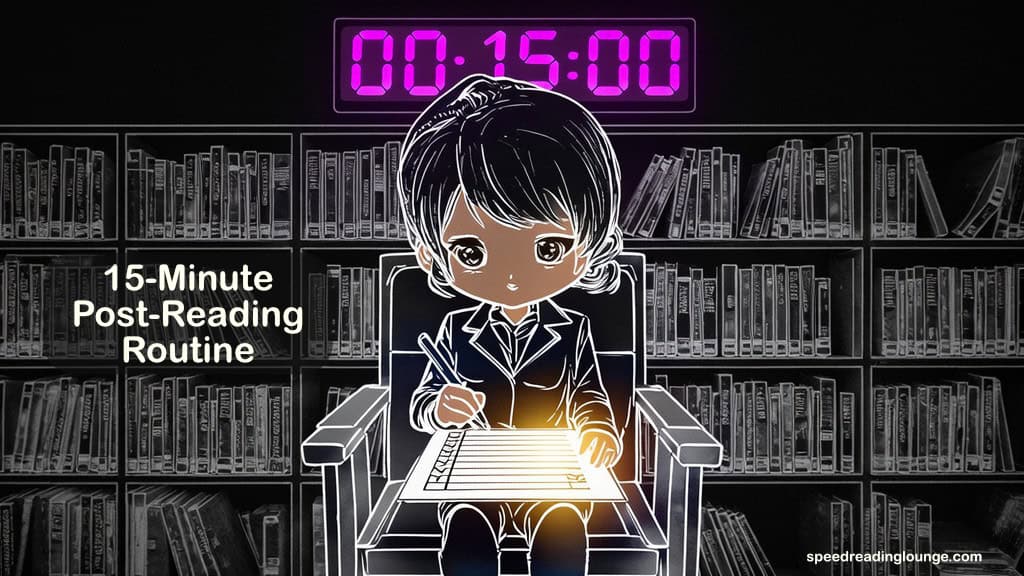
Reading retention techniques stay theoretical until they become a habit. This reading retention routine runs immediately after finishing any session worth retaining. The ordering of the steps is deliberate — each one builds on the last.
Step 1 — Memory dump (3 minutes).
Without notes or the text, write a 3-sentence summary in your own words. Your first active recall pass. It will feel incomplete. That feeling tells you exactly where the gaps are before you check.
Step 2 — Capture two or three highlights (2 minutes).
Return to your notes or text and pull out the ideas that matter most. Two or three, not ten. Add them to Readwise, Anki, or any notes app tagged for review.
Step 3 — One AI retrieval question (5 minutes).
Use the active recall prompt from the technique section. Answer without looking at your notes first. Check afterwards.
Step 4 — Schedule two reviews (2 minutes).
One reminder for tomorrow. One for seven days from now. Two entries. That’s your spacing system started without any app required.
Step 5 — One connection sentence (3 minutes).
Write one sentence connecting today’s reading to something you already knew before this session. Not a summary, but a bridge to existing knowledge.
New information encodes more deeply when anchored to something already established in long-term memory. This step is the most underused of the five, and consistently one of the most effective.
AI Prompt (Post-Reading Review)
“I just read [title/topic]. Here’s my 3-sentence summary: [paste]. Give me 3 retrieval questions to answer tomorrow. They should require genuine recall — not recognition from a quick skim.”
When the routine breaks: You’ll miss days. The 24-hour review will be extended to 48 hours. The memory dump will happen three days late. Do it anyway. Late retrieval practice still outperforms no practice. The forgetting curve (speed reading) is steep, but recovery is faster than starting from scratch. Return without drama and continue.
Reading tip: Tools and apps are useful, but most lasting gains come from a few solid tutorials or classes you revisit. If you suspect knowledge gaps are holding you back, consider an online speed reading course or in-person class. this. Or start with our guide on how to speed read.
Matching the Reading Retention Strategy to What You’re Reading
Part of building a sustainable reading retention practice is scaling effort to what the material actually deserves. Not everything needs the full system.
The table below maps content types to reading retention techniques. Treat it as a starting point — your own reading habits will refine it over time.
| Content Type | Best Technique | AI Integration |
|---|---|---|
| Non-fiction / self-help | Feynman + AI quiz | Use AI as a probing listener after each chapter |
| Academic papers | NotebookLM mind map + structured summary | Upload PDF; generate map; rebuild from memory |
| News and articles | 3-sentence memory dump + Readwise tag | Quick capture; spaced review handles re-exposure |
| Technical content | Interleaving + Anki cards | AI generates cards across sessions |
| Business books | Active recall + connection sentence | One retrieval question per chapter; one connection at the end. |
Speed and reading retention decisions often arrive together. The speed reading by content type guide covers how reading pace maps to content — the same material that demands slower reading usually demands more deliberate retention practice too.
Tip: For skimming and scanning material — news, long reports, dense articles — retention works differently. You are not reading for depth, you are reading for signal.
Where Reading Retention Strategies Fail
Knowing the reading retention techniques is one layer. Knowing where the system typically fails is the other reason, because most reading retention strategies collapse at the same predictable points.
Re-reading instead of recalling.
The most common mistake and the hardest to break. Re-reading is comfortable because it generates familiarity. Familiarity is not memory. The active recall section earlier explains why the gap between the two reading retention strategies is so significant — and why it compounds over time.
Highlighting without selection.
A fully highlighted page means nothing was actually selected. The highlight becomes useful only during a spaced review pass, and only when you have to recall why you marked it rather than simply read it again. This connects directly back to the during-phase guidance: less annotation, more intention, produces more usable material later.
Skipping the review entirely.
Reading, feeling satisfied, moving on. The satisfaction is real — you understood what you read. The retention isn’t, at least not past the first few days. The 15-minute post-reading routine is designed specifically to interrupt this pattern at the lowest possible time cost.
Using AI to summarise instead of testing you.
Easy to miss. Asking AI to summarise what you just read feels efficient. Used after reading, though, it becomes another form of passive re-exposure — your brain reads the summary and produces the same comfortable recognition as re-reading.
The productive version: ask AI to quiz you, challenge your explanation, and expose what hasn’t been consolidated yet. A summary is a before-reading tool. A quiz is an after-reading tool.
Leaving the first review too late.
The forgetting curve drops most steeply in the first few hours. A short, same-day review is worth considerably more than a longer session a week later. Scheduling tomorrow’s review before you close your notes — Step 4 of the routine — exists for exactly this reason.
Reading Retention Strategies – Summary and Conclusion
Reading retention isn’t a talent. It’s a practice — and practices only work when you actually run them.
The reading retention techniques in this guide aren’t new inventions. Spaced repetition reading, active recall, the Feynman technique — researchers and educators have tested and refined these across decades.
What’s different now is the friction involved. AI tools for reading retention handle card creation, quiz generation, and review scheduling.
The 15-minute post-reading routine that once demanded serious discipline now fits inside an ordinary evening without much rearranging.
Retrieval is still yours to do. No tool can struggle through a memory dump on your behalf or sit with the discomfort of an active recall question when the answer won’t come. That discomfort is the mechanism. Outsource the scaffolding. Keep the effort.
Start smaller than feels necessary. Pick one technique from this guide and apply it to your next reading session.
- The memory dump after a chapter.
- One retrieval question before you close the tab.
- A single connection sentence that ties today’s reading to something you already knew.
- One genuinely practiced habit builds more than a complete system that never runs.
Speed reading gives you more pages per hour. These reading recall strategies give those pages somewhere to live.
FAQs Reading Retention
Does reading faster hurt reading retention?
Speed alone does not hurt retention. Reading faster without any post-reading review system is what causes the problem — more material disappears more quickly, because the volume increases without the recovery mechanisms to match it.
With a consistent review routine, fast reading, and strong retention, they work together. The AI speed reading guide covers how the 3-Step AI Method builds review directly into the reading workflow itself. Our guide to learn how to speed read covers all techniques.
How to remember what you read?
Forgetting what you read happens to most readers — memory consolidates through retrieval, not through reading itself. The moment you close a book, the forgetting curve starts working.
To remember what you read, act the same day: write three sentences summarising the key ideas from memory, add your two most important highlights to a spaced review app like Readwise or Anki, and ask an AI tool for one retrieval question to answer tomorrow.
For complex material, the Feynman technique cuts through fast. Explain what you just read in plain language, and wherever the explanation stalls, that is exactly what has not been retained yet.
How to retain information better?
Most people try to retain information better by reading more carefully or highlighting more. Neither works particularly well. What actually works is retrieval — closing the material and reconstructing what you read from memory before checking your notes.
Your brain consolidates what it has to work to recover. Spaced repetition extends that further: reviewing material the next day, then three days later, then a week out, catches memories just as they start to fade. Readwise automates this for reading highlights. Re-reading feels like studying. Retrieval is studying.
What is the best time to review material to improve reading retention?
Review as soon as possible after reading — ideally within the same day. The forgetting curve drops most steeply in the first few hours after initial exposure, so a same-day review session recovers more than a longer session delayed by several days.
A second review within three to seven days, then moves the material into much more durable storage. After that, monthly reviews are enough for most general reading. Readwise and Anki both manage this scheduling once your highlights or cards are loaded.
What is the difference between reading comprehension and reading retention?
Comprehension happens during reading. It answers the question: Did I follow the argument and understand what I read? Retention happens after reading. It answers: Can I access and use what I understood, days or weeks later?
The two skills diverge at the moment you close the material. Strong comprehension creates the raw material for retention — but without deliberate review practice, that material decays regardless of how well you understood it at the time. The reading comprehension strategies guide covers the during-reading phase. This guide handles everything after.
Can I improve reading retention without using AI tools?
Every technique in this guide works without AI. Spaced repetition has existed as a method since the 1880s. The Feynman technique predates large language models by decades. Active recall has been validated across generations of classroom and laboratory research.
ChatGPT, Readwise, and NotebookLM, on the other hand, make some of these reading retention techniques faster to set up and more varied in practice. They are useful accelerants — not prerequisites. A notes app and 15 minutes after reading is enough to start building a real system.
How do I choose the right retention strategy for different types of reading?
Match the technique to how deeply you need to retain the information and material, and for how long. Academic papers and technical content worth keeping long-term justify the full system — active recall reading, spaced repetition reading, and mind mapping.
News and casual articles suit a lighter approach: a 3-sentence memory dump and one tagged highlight. Business books and professional non-fiction sit in the middle — active recall per chapter, and one connection sentence at the end covers most of what you actually need to hold onto. The content type table earlier in this guide gives a practical starting point.
These reading retention techniques connect directly to the broader Speed Reading Lounge reading system. The AI speed reading guide shows how the 3-Step AI Reading Method integrates comprehension, speed, and retention into a single workflow.
Credits and Interesting Sources
- List of the best apps to read fast and retain more
- Replication and Analysis of the Ebbinghaus Forgetting Curve – National Institutes of Health / PMC
- Memory Retention and Forgetting Patterns – Journal of Experimental Psychology / Notre Dame Memory Lab
- Retrieval Practice and Long-Term Memory Enhancement – National Institutes of Health / PMC
- Active Recall and Science Learning Outcomes – Science Daily
- Retrieval Practice in Higher Education – University of California San Diego
- The Neuroscience of the Spacing Effect – BrainFacts / Society for Neuroscience
- Interleaved Practice and Memory in Learning – National Institutes of Health / PMC
- The Interleaving Effect on Skill Acquisition – Scientific American
- Mind Mapping to Retain Information – National Institutes of Health / PMC