
eReflect – What’s the company like?
eReflect company profile, customer reviews, and contact info

To be fair, you probably didn’t come here to read about a software company named eReflect. It is more likely you came here because you’re trying to read faster, type without looking at your hands, or actually remember the words you learn.
Well, eReflect makes tools for exactly those three things and skills: reading faster, typing accurately, and building vocabulary. Narrow goals, focused products. And before you hand over your money or your kid’s attention span, it’s worth knowing who they are.
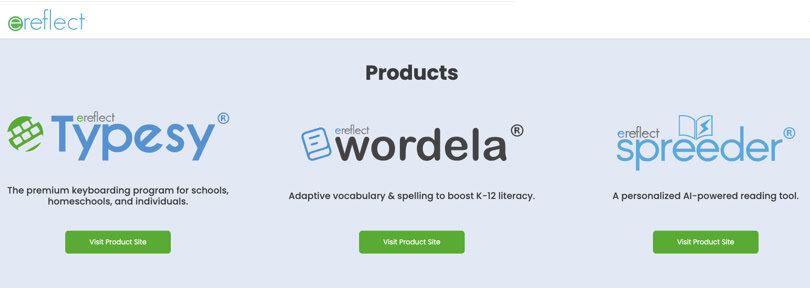
The short version: eReflect Pty. Ltd. has been building self-improvement software since 2006. They’re incorporated in Australia, have offices in Brisbane, Las Vegas, and the Philippines, and their products are currently used by over 1.5 million people across 182 countries. It’s a company with a long track record.
Three current products (all developed and published by eReflect): Spreeder for reading speed, Typesy for touch typing, and Wordela for vocabulary. If one of those is why you’re here, jump straight to the review or the products section below.
If you want to understand the company first — and whether they’re worth trusting — keep reading.
eReflect – How It Started
Marc Slater founded eReflect in 2006 with a single product — Ultimate Vocabulary — and a problem he kept running into: existing tools made you practice, but they didn’t adapt to how you were actually doing.
You’d drill the same words at the same pace whether you knew them cold or kept getting them wrong. Of course, that’s not how memory works. It’s simply how most developers built software back then.
His answer was to build around spaced repetition and active recall — two techniques with decades of research behind them. Spaced repetition spreads your review sessions based on how well you’re retaining the material.
The better you know it, the longer the gap before you see it again. Active recall means you retrieve information from memory rather than just reading it back. Both feel harder than passive study. Both work considerably better.
Two decades after Marc Slater dreamed of a better way to learn English vocabulary, the company’s goal remains the same: helping people achieve their own dreams of a better professional and personal life by improving their skills in fast reading, vocabulary building, spelling, and touch typing.
eReflect and Education
If you’re a parent or a teacher, this section is for you.
Mission – One of eReflect’s core missions is to help the growing Educational Technology movement by promoting literacy-supporting programs in classrooms to help prepare students for the future. Schools can start 9- and 10-year-old students on training that will make their later school years easier, and give them the foundation to build a career or go on to earn an advanced degree.
Indeed, eReflect doesn’t just sell to individuals. Two of their three products — Typesy and Wordela — have full school editions, actively used by K–12 districts. Matthew Strine, eReflect’s Chief Learning Officer, works directly with school districts to bring both into classrooms.
A school edition isn’t the same as a consumer app with a teacher tab slapped on. eReflect built Typesy for Schools and Wordela for Schools for district-scale use — with administrator dashboards, student progress reporting, and Clever integration.
Clever is the login platform thousands of school districts use. It means students sign in with their existing school credentials rather than yet another password. At scale, that’s the kind of detail that determines whether people actually use a tool or quietly dismiss it.
Homeschool families get their own separate editions. Typesy Homeschool and Wordela Homeschool aren’t cut-down school versions — eReflect designed them around the specific reality of one parent, multiple kids, different grade levels, one account. Each product section below covers what that looks like in practice.
eReflect Product Portfolio
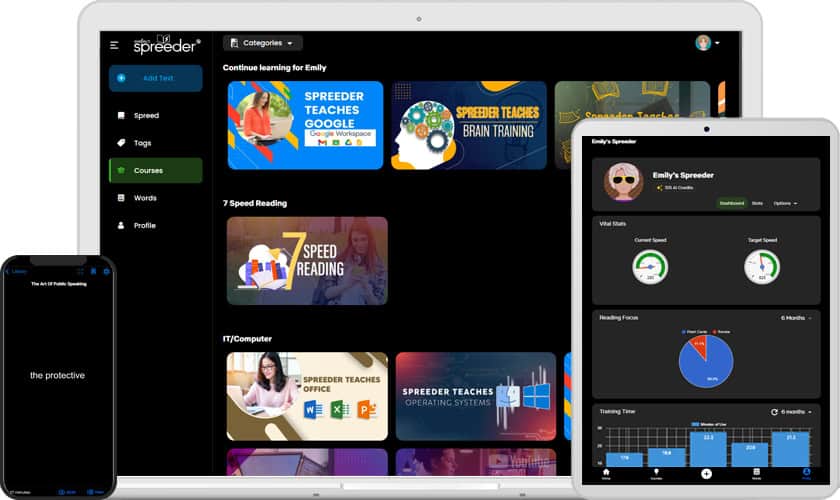
Spreeder is eReflect’s speed reading app, built around a method called Rapid Serial Visual Presentation. Words appear one at a time at a controlled speed, training your eyes to stop wandering and your reading pace to climb.
An AI-powered adaptive algorithm adjusts difficulty and pacing as you improve. Available on web, iOS, and Android.
Info: Visit official website.
Typesy is eReflect’s touch typing platform and its most widely used product. It teaches touch typing through drills, games, and video instruction — over 28,500 lessons in total, paced adaptively to where you actually are.
Available for individuals, homeschool families, and school districts. Typesy was previously sold as Ultimate Typing and rebranded in 2019.
Info: Visit official website.
Wordela is eReflect’s vocabulary and spelling platform, drawing on a database of roughly 150,000 words. Adaptive AI tracks what you know, identifies where your retention drops, and adjusts your review schedule accordingly.
It includes targeted word lists for SAT, GRE, and GMAT prep. Available for individuals, homeschool families, and schools.
Info: Visit official website.
Earlier Products
If you’ve found an old review of 7 Speed Reading or Ultimate Typing somewhere online and wondered whether any of that still applies, here’s the answer.
Ultimate Vocabulary was eReflect’s first product, launched in 2006. A desktop vocabulary builder that established the spaced repetition approach is now running through Wordela. It is no longer sold.
7 Speed Reading was the company’s flagship reading program for several years — a structured, course-style desktop product. It was merged with Spreeder to create a comprehensive app for digital reading. It is no longer sold as a standalone product.
Ultimate Typing became Typesy in 2019. It is the same product, new name, and all features carried forward.
7Spell, Vocab1, and PrepEd were standalone products from an earlier period. They are no longer available. Wordlea is the legitimate successor of 7Spell and Vocab1.
How eReflect Builds Learning Software
If you’ve used a lot of study apps and found most of them lose their effectiveness after the first week or two, there’s a reason for that — and it’s why the methodology here is worth understanding before you spend money.
Most practice software provides content and tracks whether you complete it. That’s a progress bar, not a learning system. What it doesn’t do is figure out where your memory is actually breaking down and send you back there at the right moment.
Spaced repetition is what makes the difference. Typesy tracks which keys you keep mistyping and keeps sending you back to them. Wordela monitors which words your retention drops on and increases how often they appear. Spreeder adjusts reading pace based on how you’re comprehending, not just how fast you’re going. Each product applies the same logic in a different domain.
The AI layer now built into all three platforms makes that process faster and more precise than the original desktop versions managed. For a self-directed learner without a teacher watching their progress, it’s the difference between software that notices when you’re struggling and software that doesn’t.
For a deeper look at how this applies specifically to reading, our guide to AI speed reading covers the full framework.
eReflect as a Platform Business
The company’s own website once described mobile apps and cross-platform delivery as coming soon. They arrived. Spreeder, Typesy, and Wordela all run on web, iOS, and Android with cross-device continuity.
Both Spreeder.com and Typesy.com maintain active blogs. Spreeder published content as recently as November 2025. Typesy pushed a product update in August 2025. These are products under active development.
All three products now use AI-driven adaptation rather than fixed difficulty settings — a practical difference for anyone learning without a teacher tracking their progress.
Pros and Cons
eReflect has been building learning software for nearly two decades. At that scale, patterns emerge. Think about things the company consistently gets right and areas where the products show their limits.
What eReflect gets right – Pros
The methodology is the strongest and most consistent asset. Spaced repetition and adaptive learning aren’t used as marketing language here. They run through every product in a measurable way.
Users who engage with their products regularly report genuine progress, and not just a sense of it. That consistency across three different skill domains points to a company that has built around a real learning framework rather than a feature list.
The school and homeschool infrastructure is genuinely well-built. Clever integration, district-scale administrative tools, and per-student progress reporting are the kinds of details that separate products used in actual classrooms from those that get trialed and abandoned.
Verified reviews from school accounts on Trustpilot reflect this — responsive support and functional rollout are recurring positives.
Where eReflect falls short – Cons
Engagement over time is the most consistent weakness across the product line. Typesy’s lessons can get repetitive. This also comes up on Trustpilot, the App Store, and homeschool review sites, independently and repeatedly.
Wordela, for example, has an interface friction point with the dictionary overlay that affects daily usability. For context, these aren’t isolated complaints. They simply point to a company that builds effective learning engines but seems to invest less in the day-to-day experience of using them.
Pricing transparency for eReflect’s products seems to be another pain point. Users across review platforms note that full pricing isn’t visible until late in the purchase or signup flow. For a company selling to schools and families evaluating on a budget, that creates unnecessary friction at the decision point.
eReflect’s products reward commitment. People who simply try a free trial and thus don’t build a practice habit certainly get less out of them than users who engage consistently over weeks and months. That’s just being honest, and it shapes who these products are actually right for.
eReflect – Frequently Asked Questions
Is eReflect a legitimate company?
Yes. Operating since 2006, incorporated as eReflect Pty. Ltd. in Brisbane, Australia, with a US office in Las Vegas. 1.5 million+ active users across 182 countries (2026). Typesy has verified Trustpilot reviews from schools and homeschool families. All three products were actively updated in 2025 and 2026.
What happened to Ultimate Typing?
Rebranded as Typesy in 2019. Features carried forward fully. Any review referencing Ultimate Typing is describing the same product under its old name.
Does Spreeder by eReflect use AI?
Yes. An AI-powered adaptive algorithm adjusts content difficulty and reading pace based on your performance.
What happened to 7 Speed Reading?
It was eReflect’s main desktop reading product for several years. No longer sold. Spreeder is the current platform.
Is eReflect good for schools?
Typesy and Wordela both have dedicated K–12 school editions with Clever integration, teacher administration tools, and district-scale reporting. Typesy is specifically designed around computer-based state test preparation. Wordela’s word lists align with grade-level curriculum by subject.
Which eReflect product is right for me?
Reading speed: Spreeder. Typing: Typesy. Vocabulary — especially for standardized exams: Wordela. All three have free trials.
eReflect contact
If you seek technical information, browse their knowledge base or contact their helpdesk.
- Email: helpdesk@ereflect.com
- US phone: 1-800-706-5904
- Brisbane: +61 7 2103 8430
- Address: 292/26 Felix Street, Brisbane City, QLD 4000, Australia
Blog
- AI Speed Reading: The Complete Guide
- Spreeder Pro Review
- Typesy Review
- Wordela Review
- Best Speed Reading Apps
Feedback
What is your experience with eReflect? Do you use any of their services? Do you have questions? Opinions? Please share them in the comments. I have tried all their versions and editions and am familiar with most of the iterations released over the last five years. Based on my experience, customer support is the aspect most customers mention positively.
Sources
- Spaced repetition and memory retention — National Institutes of Health (PMC)
- Active recall and retrieval practice — Washington University in St. Louis, Center for Teaching & Learning
- The spacing effect — over 200 studies summarised — UC San Diego Psychology Department
- Adaptive learning in K–12 education — ERIC / Education Resources Information Center
- Keyboarding skills and academic performance — Learning.com Research
Disclosure: This post contains affiliate links to some partners. Speed Reading Lounge may receive a commission for purchases made through these links. It does not add any extra costs. All reviews, opinions, descriptions, and comparisons expressed here are our own.