
What Are The Best Speed Reading Books?
12 best speed reading books to become an efficient learner.
Learning to read fast is no small feat. It takes time, patience, and steady practice to build real skill. But with the right techniques, you don’t just get faster. You will stay focused, motivated, confident, and on track.
There are many ways to pursue those goals, like apps or courses. Yet one path often goes unnoticed: using speed reading books. A lost opportunity. Because a good book slows things down before it speeds them up. It walks you through eye movement, attention, and pacing in ways no flashy progress bar ever could.
Those books show how to handle long chapters when your phone keeps buzzing. They also explain how to skim an online article without losing its argument. And if it gets academic, careful reading is the only sensible option. Interestingly, no one has yet discussed how to effectively add AI to this equation. But I’ll do.
So in this guide, you’ll find 12 of the best speed reading books. Some are pure classics or have survived past trends. Others are modern titles written for students, researchers, and professionals who live inside browser tabs and PDF readers.
Each one was chosen for clear methods and realistic promises. But also how well it fits within today’s mix of print, digital, and AI‑supported reading habits.
What Makes a Speed Reading Book Valuable?
A useful speed reading book does more than promise big numbers on a stopwatch. It needs to help with real reading loads. That includes exam chapters, project reports, research articles, and the novels that keep slipping to “later.”
When deciding which speed reading books to include in our list, a few questions did most of the work.
When reviewing and selecting speed reading books for our list, several questions guided our decision-making.
- Does it protect comprehension, or quietly sacrifice it for speed?
- Is the structure clear enough to follow and engaging?
- Does the book help in a world of screens, PDFs, and AI summaries?
- Is the author rooted in real teaching, education, or long practice?
This list, therefore, includes books that help both beginners and professionals read faster while remaining engaged with their material.
Best Speed Reading Books 2026
| Speed Reading Faster | Breakthrough Rapid Reading | Speed Reading for Dummies | Speed Reading |
|---|---|---|---|
 |  |  |  |
| Jan Cisek | Peter Kump | Richard Sutz | Kam Knight |
| ★★★★★ | ★★★★☆ | ★★★★☆ | ★★★☆☆ |
| View on Amazon | View on Amazon | View on Amazon | View on Amazon |
*Disclosure: This post contains affiliate links. Read the full disclosure below.
1. Speed Reading Faster: Maximize Your Success in Business & Study
Speed Reading Faster (view on Amazon) was written for the moment when your reading list quietly takes over your week. The authors bring serious credentials. Jan Cisek taught speed reading in London workshops for over twenty years, while Susan Norman specialized in accelerated learning and language instruction.
What makes this book unusual is how deliberately it slows you down before speeding you up. Early drills train your eyes to stop rereading the same sentence three times when your attention drifts.
The book then introduces chunking, which sounds technical. But it really just means learning to read in word chunks rather than stumbling over each word separately. That shift reduces the mental effort per page and makes long documents feel less exhausting.
The authors also teach you when to skim and when to slow down, which can matter more than reading faster. For example, when reading contracts, academic papers, or dense project reports, missing a detail could cost you time later.
After each technique, you get quizzes that check whether comprehension survived the pace increase or just blurred into vague familiarity.
The layout feels more like a serious workbook than a motivational read. Some readers find that dry. But you may also appreciate that it treats speed reading as a skill you build through practice, not a trick you learn once and forget by Monday.
Overall, this structured approach makes sense in 2026‘s mix of print books, PDFs, and AI‑assisted workflows. It is one of the best speed reading books for reading faster and holding up under real pressure.
Authors: Jan Cise, Susan Norman
Review Rating: ★★★★★
Book Info: View on Amazon.
2. Breakthrough Rapid Reading by Peter Kump
Breakthrough Rapid Reading (view on Amazon) has quietly multiplied reading speeds since 1998. Author Peter Kump ran Evelyn Wood Reading Dynamics for years before writing this.
Thus, he knew which speed techniques actually stuck after students left the classroom and which disappeared by the following week.
The book offers a six‑week program built around daily drills you can do with whatever reading material sits on your desk. Kump teaches hand pacing to guide your eyes steadily across the page and eliminate the constant backtracking that kills speed without you noticing.
He also separates reading from recall. This matters because many speed reading books confuse the two. They simply mix in memory techniques that have little to do with reading itself.
Readers who followed the program often report doubling or tripling their speed (600wpm) while maintaining comprehension. But be careful, the drills may feel repetitive if you rush them. Because that repetition is what builds the reflex.
Students, professionals handling lengthy reports, and anyone who reads for work will find this approach much more practical and straightforward. The book is aimed at print reading, but its core techniques transfer well to screens. Especially if you pair them with reading apps or AI tools for pre‑scanning long documents.
Author: Peter Kump
Review Rating: ★★★★☆
Book Info: View on Amazon.
3. The Speed Reading Book by Tony Buzan
Tony Buzan wrote The Speed Reading Book (view on Amazon) in the early 1970s. Back when most speed reading education treated the brain like a machine, one you could simply accelerate.
Buzan thought that was backward. Thus, he built his approach around how the brain actually processes visual information. This is why the book mixes eye-movement techniques, mind-mapping, and exercises meant to catch your attention before it drifts halfway down the page.
The book contains five main sections that build on each other. Early chapters explain why most people read slowly. They read with too many eye fixations, constant backtracking, and subvocalizing every word (narrating aloud in your head).
He then introduces guiding techniques in which you use your hand or a pen to lead your eyes across lines in sweeping motions. Sometimes forward, sometimes in an S‑pattern, reducing unnecessary eye movements that drain speed without improving comprehension.
What makes this book interesting is its emphasis on understanding over raw speed. Buzan pairs speed drills with mind mapping so you capture key ideas visually rather than trying to remember every sentence in order.
Students and professionals are likely to find it useful because it shifts the focus from passive reading to structure and meaning.
The exercises feel playful in places, almost experimental. Some readers appreciate that lightness, while others prefer a more strict, focused technique. The book assumes print material and does not address screens directly. Though the eye-movement principles still apply if you adjust for scrolling rather than turning pages.
Author: Tony Buzan
Rating: ★★★☆☆
Book info: View on Amazon.
4. The Complete Idiot’s Guide to Speed Reading
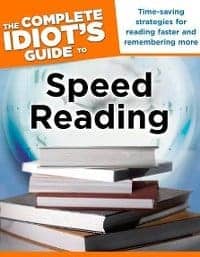
The Complete Idiot’s Guide to Speed Reading (view on Amazon) makes no apologies for its title. But that’s ok, because the book itself makes no apologies for being just useful rather than inspiring.
Abby Marks Beale spent twenty years teaching professionals and students how to clear their reading backlogs. And this book reads like a no‑nonsense manual drawn directly from those workshops.
Beale walks you through several hand pacing techniques, including the short‑smooth underline and the open‑hand wiggle. This sounds absurd until you try them and realize they keep your eyes from wandering or doubling back mid‑sentence.
She also introduces keyword reading. Here, you focus on the larger, meaning‑carrying words and skip over filler that slows you down without adding understanding. Dozens of timed exercises and comprehension checks let you track whether your speed gains come at the cost of comprehension or actually improve retention.
What makes this book particularly practical is its section on speed reading on screens. This was rare when the book came out in 2008 and remains useful now. Beale suggests scrolling paces and explains how digital reading demands different eye patterns than print reading.
Readers report doubling or tripling their speed within a few weeks. Often moving from 200 words per minute to 400 or more while comprehension holds steady or even improves.
The tone stays straightforward throughout, almost workbook‑like. It could be motivating or a bit dry, depending on your preferences. However, Abby’s guide remains among the best speed reading books. It offers proven expert tips suitable for doctors, lawyers, students, teachers, and busy professionals.
Author: Abby Marks Beale
Rating: ★★★★☆
Book Info: View on Amazon.
5. 10 Days To Faster Reading – Princeton Language Institute
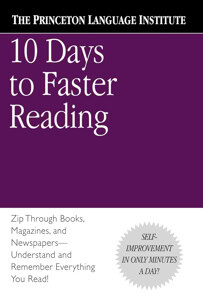
Ten days sounds like a gimmick until you realize this popular speed reading book (view on Amazon) means ten practice sessions, not ten calendar days stretched across busy weeks.
The Princeton Language Institute and Abby Marks Beale designed this as a short, structured program for people who want results quickly without committing to months of training.
The book starts by diagnosing your current reading speed and comprehension level through timed tests, then introduces one new technique per chapter. Hand pacers appear early and often, which is helpful but can feel repetitive or distracting.
Early chapters focus on breaking habits like regression and subvocalization, the two silent speed killers most people never notice. Later sections introduce previewing, skimming, and scanning techniques that help you decide what deserves careful reading and what you can process quickly without guilt.
Readers who followed the program report increases in speed from 200 to 400 wpm within a couple of weeks, often accompanied by gains in comprehension. This may sound a little. But the book assumes you read mostly non‑fiction material where extracting information matters more than savoring prose. Sounds quite useful for students, professionals, and anyone facing stacks of reports or articles, doesn’t it?
The tone stays practical and workbook‑like throughout, complete with exercises and multiple‑choice quizzes after each chapter. On the downside, the book feels dated in places, especially when it mentions digital reading. But the core techniques still apply to screens if you adapt them smartly.
Authors: The Princeton, Abby Marks Beale
Rating: ★★★★☆
Book info: View on Amazon.
Tip: Explore new language learning strategies to improve reading performance with our lists of AI vocabulary apps and best language learning apps.
6. Speed Reading with the Right Brain: Learn to Read Ideas Instead of Just Words
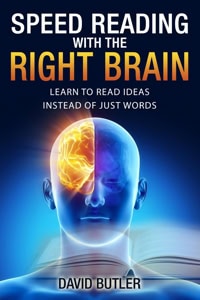
Many of the best speed reading books push you to move your eyes faster. That’s fine. Speed Reading with the Right Brain (view on Amazon) does the opposite. Author David Butler argues that reading speed only increases when comprehension speeds up first, which is why the book trains you to read phrases as complete ideas rather than stumbling through individual words.
Butler uses phrase‑highlighted exercises where text is color‑coded into meaningful chunks, forcing you to absorb clusters of words at once. The exercises draw on classic novels such as The Wonderful Wizard of Oz and The War of the Worlds.
But what is the goal? In a nutshell, it engages your right brain’s visual and conceptual processing. It’s effective because the right brain naturally handles patterns and larger meanings faster than the left brain’s word‑by‑word decoding.
Readers report that the method genuinely improves comprehension and retention, though visualizing every phrase feels exhausting at first. Students and professionals reading dense non‑fiction will most likely appreciate this focus on understanding over raw speed. Especially when they pair this approach with good AI summarizers that pre‑extract key concepts before diving into full chapters.
The method assumes you will practice slowly before reading quickly, which not everyone has patience for. Butler also includes access to a free online training site. There, you can upload your own text and practice phrase reading on material that actually matters to you. This feature alone makes the book more practical than most reading improvement classes that rely solely on generic practice passages.
Author: David Butler
Review Rating: ★★★★☆
Book Info: View on Amazon.
7. Speed Reading: Learn to Read a 200+ Page Book in 1 Hour – Kam Knight
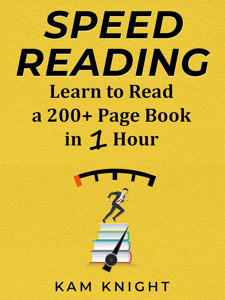
Ok, this book title (view on Amazon) sounds like marketing bait, and honestly, it is. Kam Knight spent years refining drills that genuinely help most readers double or triple their speed. But reading an entire book in an hour only works if it is light non‑fiction or you already read fast.
What makes this one of the best speed reading books on Amazon for years running, however, is how practical and drill‑heavy it is.
Knight teaches space reading, focusing on the space between words rather than on the words themselves. This lets your peripheral vision capture more text per glance. He also covers chunking, where you train your eyes to absorb three or four words at once instead of reading one at a time. Each method comes with timed exercises you can practice on any material.
Readers report moving from around 200 wpm to 400 or 600 wpm within a few weeks of consistent practice. Students, professionals facing heavy reading loads, and homeschooling parents often get this book. It is inexpensive, short, and focused on results rather than theory.
Weirdly, the book does not really address digital reading, though you can easily adapt its techniques to scrolling. Furthermore, pairing his manual drills with AI summarization tools helps you decide which sections of any book deserve your full attention. And which you can skim or skip entirely.
Author: Kam Knight
Review Rating: ★★★★☆
Book Info: View on Amazon.
8. Train Your Brain for Success: Read Smarter, Remember More, and Break Your Own Records
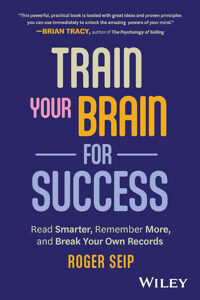
Author Roger Seip, co‑founder of Freedom Personal Development, spent years training executives, entrepreneurs, and students who feel stuck reading slowly or forgetting material the moment they close a book.
Train Your Brain for Success (view on Amazon) bundles memory techniques, speed-reading drills, and goal‑setting frameworks into a single system. This appears appealing if you want a broader approach rather than isolated tactics.
The book teaches instant recall using the Mental File Folder System, which converts abstract information into vivid mental images. You will store those visuals in imaginary locations you already know well. Think of the rooms in your home.
For reading, Seip introduces Smart Reading gears that adjust your reading speed based on material complexity while minimizing subvocalization, regression, and mind-wandering through structured exercises.
This speed reading book also includes interactive online videos that walk you through each technique, which readers find more engaging than text alone. Busy professionals, students, and entrepreneurs alike will love the practical, hands‑on approach that turns average reading speeds into remarkable gains in just weeks.
The downside is scope creep. If you only want speed reading techniques, the goal‑setting and mindset chapters may feel like filler. The book also assumes you have time for daily exercises, which some readers find difficult to maintain.
Author: Roger Seip
Review Rating: ★★★★☆
Book Info: View on Amazon.
9. How to Be a Super Reader by Ron Cole

Ron Cole taught speed reading in corporations and schools for fourteen years before writing How to Be a Super Reader (view on Amazon).
Thus, the book feels less like a theory and more like a workshop manual you can follow at home. He focuses on practical techniques for professionals and students who need to clear backlogs of emails, reports, and study material without losing comprehension.
Cole introduces Eye‑Hop, his signature technique, where you train your eyes to jump from word group to word group and absorb their meaning in a single glance rather than reading word by word.
He also teaches hand pacing, previewing, and parroting, a method in which you repeat key information aloud or on paper immediately after reading it to cement the material in memory. Each technique comes with exercises you can practice on whatever reading material sits in front of you.
The book assumes print reading and does not cover digital reading. Though the core techniques may adapt well to digital text, if you think outside the box. Pairing these methods with AI tools for pre‑scanning and summarizing long documents also helps you decide where to apply your focus.
Author: Ron Cole
Review Rating: ★★★★☆
Book Info: View on Amazon.
10. Speed Reading For Dummies – Richard Sutz
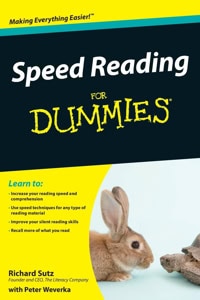
Most people don’t pick up Speed Reading For Dummies (view on Amazon) because they love the title. They pick it up because the stack of “I’ll read that soon” has turned into background noise.
Richard Sutz, founder of The Literacy Company and creator of The Reader’s Edge program, writes as if he has met that feeling hundreds of times in workshops and decided to design a calmer way through it.
Rather than chasing spectacular claims, the book starts by showing you what your current speed and comprehension look like on paper. From there, it nudges your habits:
- widening the amount of text you see at once,
- softening the inner voice that insists on pronouncing every word,
- and catching the quiet impulse to jump back a line whenever your attention slips.
The book’s practice pages and drills are deliberately plain. This makes them easier to use on whatever you actually read, like emails, reports, textbooks, or articles. And without feeling like you are stepping into a different world just to practice.
Where many speed reading books aim for drama, this one leans into steadiness. The Dummies tone can feel formulaic if you prefer literary prose. But for beginners who want a guide that explains things patiently and offers small, repeatable steps, it remains one of the best speed reading books to start with.
Author: Richard Sutz
Rating: ★★★★☆
Book info: View on Amazon.
11. Triple Your Reading Speed by Wade E. Cutler

Triple Your Reading Speed (view on Amazon) feels like a book for people who already know that quick tips are not enough. Wade E. Cutler treats speed reading as a physical skill, and his Acceleread method leans heavily on retraining your eye movement across the page.
Instead of glossing over effort, the book gives you timed self‑tests and drills. They push you to expand your visual span and reduce the small, restless eye stops that quietly slow most readers.
Short comprehension checks sit beside the speed work, so you see whether faster numbers still match real understanding. This approach may feel mechanical, yet that structure helps if you like seeing progress in clear steps rather than vague promises.
For students and professionals who have already worked through more beginner‑friendly speed reading books, Triple Your Reading Speed works well as a second‑stage manual. I recommend it in this order.
However, readers who want gentle encouragement may find it demanding and ruling. But anyone willing to live with the drills for a few weeks certainly gets a practical way to push beyond their first plateau.
Author: Wade E. Cutler
Rating: ★★★★☆
Book info: View on Amazon.
12. Seven-Day Speed Reading and Learning Program by Evelyn Wood
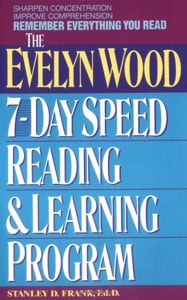
The Seven-Day Speed Reading Program (view on Amazon) reads like a time capsule from the height of the Evelyn Wood era. The promise of dramatic gains in a single week now feels bold. However, it also explains why this program shaped how many people first heard about speed reading.
Each day combines long practice blocks with eye‑movement drills, hand‑guided reading, and rapid previewing, followed by quick comprehension checks.
The schedule assumes you can give it serious, uninterrupted time. It also expects you to push your comfort zone, sometimes faster than feels reasonable. Take the big claims as inspiration, not guarantees. Even then, the structure shows how to face slow habits head‑on rather than circle around them.
In 2026, this book works best as a legacy companion rather than your main guide. Readers interested in where modern speed reading books came from can borrow a few exercises. It is then more effective to lean on newer titles for digital reading, AI‑supported workflows, and more modest expectations.
Seen that way, the program becomes a piece of context and a source of discipline, not the final word on how quickly you should learn to read.
Author: Evelyn Wood
Rating: ★★★★☆
Book info: View on Amazon.
How to Choose a Speed Reading Book?
Most readers now move between print, screens, and the occasional AI summary. Thus, the most useful question isn’t “Which is the best speed reading book?”, but “Which book fits the way I already read?”.
In my opinion, the right starting point feels like a quiet adjustment to your reading habits, not necessarily a complete overhaul.
Instead of trying to find a single perfect title, pick a first book that fits your situation, then treat the others as second steps rather than missed opportunities.
-> If you’re a complete beginner
Start with: The Complete Idiot’s Guide to Speed Reading or Speed Reading For Dummies.
Why: Both explain the basics in calm, straightforward language and rely on short drills that respect a crowded schedule. They are gentle places to meet ideas, like hand pacing and keyword reading, before you start mixing them with screen reading or AI support.
-> If you’re a student or academic
Start with: 10 Days to Faster Reading or Speed Reading Faster (Cisek & Norman).
Why: 10 Days gives you a compact, session‑based program that fits revision blocks. Speed Reading Faster is designed for long textbooks and research papers. Together, they help you decide what to skim, what to read slowly, and when an outline or summary—human or automated—can prepare you for the details.
-> If you’re a professional or knowledge worker
Start with: Speed Reading Faster or Breakthrough Rapid Reading.
Why: Both treat reading as part of the job, with clear drills and ways to measure progress. They make sense if your practice material is email, reports, slide decks, and contracts, and they sit naturally alongside whatever tools you already use to sort and preview long documents before committing deep focus.
-> If you’re advanced and want to push further
Start with: Breakthrough Rapid Reading or Triple Your Reading Speed.
Why: These two books on speed reading feel closer to training plans than introductions, with deliberately repetitive drills designed to push you past plateaus. They suit readers who like tracking numbers and experimenting with technique before bringing in extra systems for previewing or testing comprehension.
-> If you’re anxious about losing comprehension
Start with: Speed Reading with the Right Brain or Train Your Brain for Success.
Why: Butler focuses on reading ideas instead of isolated words. Seip links reading to memory, focus, and recall. Both keep understanding at the center. They also pair well with any summarization or quizzing tools you already use to check whether a chapter actually changed what you know.
-> If you mainly read for personal growth and general learning
Start with: The Speed Reading Book (Buzan) or How to Be a Super Reader.
Why: Buzan blends speed, mind maps, and learning strategies. Cole offers a calm, workshop‑style approach to everyday reading. They work well if you care about reading as a long‑term practice and see quick AI summaries as assistive helpers.
In a nutshell
A simple pattern is to choose one technique‑heavy book (Kump, Beale, Cisek, Knight) and one comprehension‑ or mindset‑focused book (Butler, Seip, Buzan).
Let the first teach your eyes and hands what to do, and the second shape how you think about information.
That way, when you later plug these skills into more AI‑supported reading workflows, you’ll be asking the tools to amplify a process you already understand, rather than to invent one for you. Let’s look into AI.
How to Use Speed Reading Books with AI?
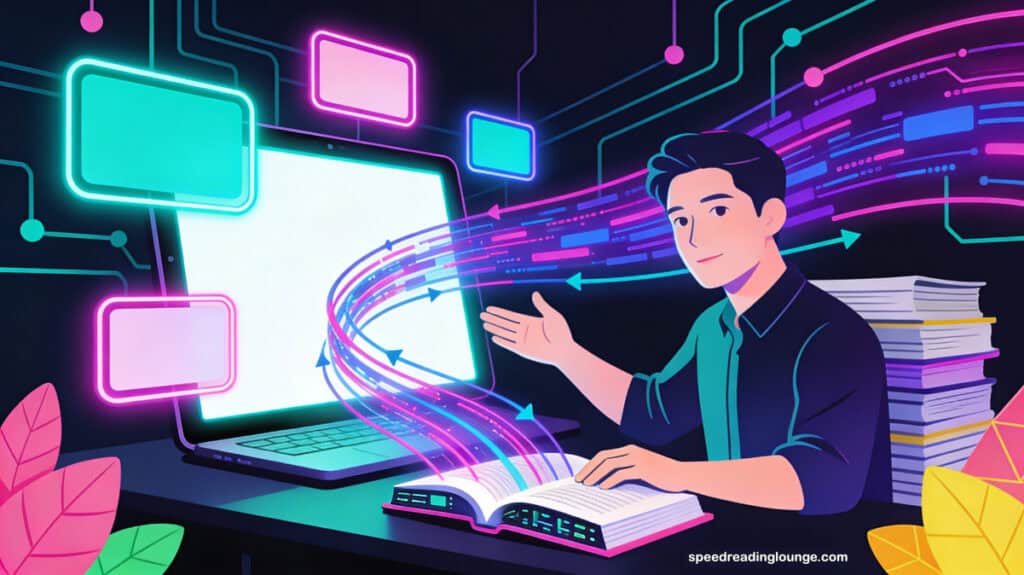
As seen above, a good speed reading book teaches you how to use your eyes and attention. AI, used well, changes what you do before and after that effort.
Don’t get me wrong here. The point is not to replace the work these speed-reading books ask of you. It’s more about ensuring that the manual and traditional skills you learn in books are effectively combined with digital technology and AI.
One useful way to implement AI into your reading workflow is the 3‑Step AI Speed Reading Method™. This is an applicable framework for any title on your shelf. It helps you decide which book or document pages actually deserve deliberate focus and concentration.
Imagine you’ve picked a current non‑fiction bestseller about decision‑making or deep work. Something you own in print but also have as a Kindle sample or PDF.
Here is how the 3‑Step Method can wrap around that one book.
Step 1: Let AI sketch the landscape before you dive in
Before you open the book properly, you ask AI for a short briefing tailored to you:
“Give me a concise overview of [Book Title], focusing on what’s most useful for a consultant who reads long client reports.”
In a few paragraphs, you now know the central themes, rough structure, and why this book might matter for your work or studies.
Then you put the summary aside and turn to the actual pages, using the techniques from, e.g., Speed Reading Faster or Butler’s phrase‑based method on sections you already know are likely to be important.
Step 2: Use AI to further narrow where you apply your techniques
While working through the book on paper, Kindle, or PDF, you occasionally pause to ask AI more pointed questions:
“Which chapter(s) in [Book Title] deal most directly with handling information overload?”
“List the key concepts in chapter 4 that I should focus on.”
The answers help you decide which chapters deserve your full speed and comprehension efforts and which can be read more lightly.
On print pages, your hand pacing, chunking, or right‑brain phrase reading can then concentrate on those core sections.
On digital text, the same techniques follow your scrolling only through parts you’ve chosen deliberately, instead of spreading your effort thinly across the whole book.
Step 3: Turn AI into a quiet review partner
After a reading session, instead of closing the book and hoping the ideas linger, you treat AI as someone to check your understanding with:
“Here are my notes from chapter 3 of [Book Title]. What seems missing or confused?”
“Ask me five questions that test whether I really understood the main argument in chapter 5.”
For readers using Speed Reading Faster, this makes it easier to see if fast reading of dense business or study material has actually led to useful recall.
For readers working with Speed Reading with the Right Brain, you can ask for alternative metaphors or real‑world examples and then read those new passages in phrases as extra training material on screen.
This kind of synergy works best with non‑fiction books, reports, or white papers. It’s beneficial for long online essays that explain how something works or how to act differently. Fiction asks for a different kind of attention, and speeding through a novel with summaries and drills usually takes away more than it gives.
For serious non‑fiction, though, the balance is different. AI can handle the briefing and the debriefing. You reserve your manual speed reading techniques for the short stretches of text where nuance and detail genuinely change what you will think or do next.
Seen like this, AI doesn’t replace the effort these best speed reading books ask of you. It just helps you spend that effort more wisely. On the right chapters, in the right format, at the right moment, and understanding why a topic deserves full attention.
Speed Reading Books – Summary & Verdict
Each of these best speed reading books offers a slightly different way to move through demanding text without feeling hurried. In my opinion, the desired shift comes less from which title you choose. But more from letting one of them stay open on your desk long enough to change your habits. It’s all about habits.
A workable approach is to select one foundational book and work through its drills for a few weeks.
- The Complete Idiot’s Guide to Speed Reading
- Breakthrough Rapid Reading
- How to Be a Super Reader.
Later, you can add a second title that focuses on comprehension, professional reading, or memory, so your practice grows in layers rather than starting over.
AI sits just outside this circle, acting as a quiet assistant. It can sketch the shape of a non‑fiction book, highlight what deserves attention, and help you test your understanding afterward. The reading itself still needs you: your focus, your judgment, and your willingness to slow down when a paragraph feels important.
Books remain one of the most affordable ways to learn, and many can be borrowed from a library at no cost. If you prefer more guidance alongside them, you can also explore our review of online speed reading courses. Pair one course with one book, letting each support and steady the other.
Best Speed Reading Books 2026
- Speed Reading Faster: Business & Study – Jan Cisek & Susan Norman
- Breakthrough Rapid Reading – Peter Kump
- The Speed Reading Book – Tony Buzan
- The Complete Idiot’s Guide to Speed Reading – Abby Marks Beale
- 10 Days to Faster Reading – Princeton Language Institute
- Speed Reading with the Right Brain: Learn to Read Ideas – David Butler
- Speed Reading: Learn to Read a 200+ Page Book in 1 Hour – Kam Knight
- How to Be a Super Reader – Ron Cole
- Train Your Brain for Success: Read Smarter, Remember More – Roger Seip
- Speed Reading For Dummies – Richard Sutz
- Triple Your Reading Speed – Wade E. Cutler
- Seven-Day Speed Reading Program – Evelyn Wood
Tips for Using Speed Reading Books Effectively
Speed reading only becomes real when the book on your desk meets the way you already live and read. These small habits help you achieve that.
- Treat each book like a course. Choose one title, give it a clear time window, and move through the chapters in order instead of grazing.
- Practice on what already matters. Use your drills on reports, textbooks, and articles you must read anyway, not just on the examples printed in the margins.
- Keep a light log. Note date, material, rough speed, and one line on how much you remember; the trend over weeks matters more than today’s number.
- Favor short, regular sessions. Ten focused minutes most days will change your habits more than a single ambitious marathon on the weekend.
- Learn slowly, then test fast. First, get comfortable with the technique at normal speed; only then push it during timed drills or heavy-reading days.
- Match format to the moment. Use print when learning a new technique, then carry it over to PDFs, web articles, and e‑books once it feels natural.
- Let AI handle the scaffolding. Summaries, outlines, and quick question lists are useful, but the real practice still happens on the original text.
- Protect deep thinking. Slow down on complex arguments, data, or legal phrasing, even if your log for that day looks “slower” on paper.
- Revisit one chapter after a week. Coming back reveals which techniques stuck and which need another gentle pass.
Used together, these habits give the best speed reading books room to do their work. Not by turning you into a reading machine. By making it easier to sit with the right words, at the right speed, for the right reasons.
FAQs Speed Reading Books

Do speed reading books really work?
They work when you treat them like training plans rather than shortcuts. A solid speed reading book offers techniques, structure, and practice. Consistent use on real non‑fiction—books, PDFs, and long articles you already need—usually matters more than which title you pick. If you combine them with AI reading workflows, you will further optimize your skills and techniques.
Which speed reading books are best for students?
Students need help with dense non‑fiction, textbooks, and research papers. 10 Days to Faster Reading and Speed Reading Faster focus on study skills, skimming, and realistic techniques for long chapters, PDFs, and exam deadlines, without demanding hours you don’t have.
Can speed reading books improve comprehension, not just speed?
The best speed-reading books prioritize comprehension. Speed Reading with the Right Brain and Train Your Brain for Success stress understanding ideas, building memory, and critical thinking. They show how to increase speed only where comprehension stays stable or improves.
How long does it take to get results from a book on speed reading?
Most structured books ask for a few weeks of steady practice. You can expect noticeable gains after two to four weeks of short daily sessions. Deeper, more automatic changes usually emerge over several months of honest, realistic use.
Should I choose an online course or a book?
Books are cheaper, self‑paced, and easy to revisit whenever life changes. Courses add guidance, accountability, and sometimes diagnostics. Many readers start with one strong book, then add a course later when they want feedback, tracking, or more structured support.
Can I just use AI instead of books on speed reading?
AI can summarise, outline, and quiz, but it does not retrain your eyes or attention. Speed reading books will teach the physical and cognitive skills of reading faster while maintaining comprehension. AI works best as a helper around that practice, not necessarily as an alternative for it.
Do speed reading books work for fiction as well as non‑fiction?
Most speed reading books are designed for non‑fiction, where information and argument matter most. The same techniques often feel wrong in literary fiction, where style and pacing are part of the experience. It’s usually wiser to speed up essays and reports, and let novels breathe.
What are the best speed reading books in your opinion?
Research Sources:
- Spaced Repetition and Memory – National Institutes of Health
- Reading Speed and Theory – National Institutes of Health
- Speed Reading Promises Review – Association for Psychological Science
- Reading Speed and Brain Activity – National Institutes of Health
- Paper vs Digital Reading Comprehension – National Institutes of Health
Disclosure: This post contains affiliate links to Amazon or other partners. Speed Reading Lounge may receive a commission for purchases made through these links. It does not add any extra costs. All reviews, opinions, descriptions, and comparisons expressed here are our own.