
AceReader Review – Classic & Personal
Learn to read efficiently with AceReader Classic + Personal

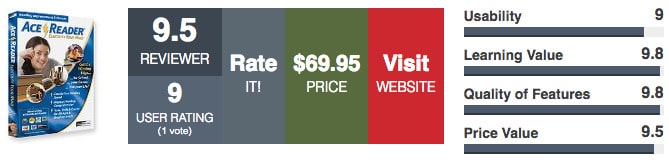
AceReader is an award-winning tutor that focuses on increasing a reader’s speed and comprehension. It combines scientifically proven exercises targeted to students, teachers, professionals, and individuals alike.
Our AceReader review explains the features and looks at the different versions for individual learners and schools. The Classic Edition is a desktop install available for Windows PC.
AceReader Personal, Family, and Education editions are cloud-based speed reading software and do not require installation. You access them directly in your browser on any device.
AceReader – Overview
AceReader is a popular software course that has satisfied users worldwide. Stepware, the developer behind it, has continuously improved its software over more than 25 years, receiving more than 50 educational awards and honors.
Clients include individuals, universities and schools, and government institutions, such as the US Air Force Academy and the Naval Academy. Stepware strongly believes that fast reading can benefit anyone who has to read large amounts of material and regularly recall the content.
Think about it: if you’re a student wading through three textbook chapters a night, or a professional who needs to process reports, research, and emails before lunch, the ability to read with focus and speed isn’t a nice-to-have. It’s a genuine edge.
Alternatives: Good alternatives to improve reading skills are Spreeder and Iris Reading. There are multiple options available for mobile devices and tablets.
There are currently four AceReader editions: Classic (Elite), Personal, Family, and Education.
1. AceReader Classic (Elite) – Overview
If you are looking for the original AceReader Elite version that you can install directly on your Windows laptop or PC, this edition is the one for you. AceReader Classic starts from $69.95 as a one-time payment — no subscription, no renewals, lifetime access.
Important note on platform: The Classic Desktop edition is for Windows only (Windows 10, 8, 7, Vista, and XP). It is not a Mac-native desktop application. If you use a Mac or prefer device flexibility, the Personal Edition Cloud edition is the better fit as it runs in any browser on any device.
1. AceReader Classic Features
- Three ways to learn: Course, Menu, and Reading Mode
- 200+ activities to help increase reading speed
- 6 themes to choose from, each with 13 levels (78 lessons total)
- 600+ preloaded books — plus access to thousands more via Project Gutenberg and other online resources
- Graphs represent your comprehension test results
- Email your results to teachers or parents
- Read your own texts, PDFs, and documents in Reading Mode
- Unlimited user accounts, up to 3 system installs
- Admin section to manage all users and monitor progress
- One-time payment, lifelong access
- Text-to-speech available in Reading Mode
- 30-day money-back guarantee


2. AceReader Classic – Structure
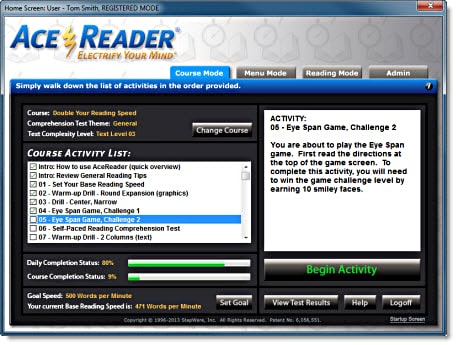
When you log onto AceReader Classic, you see three different ways you can learn:
Course mode, Menu mode, and Reading mode.
Course mode* is the easiest learning mode because the computer does everything for you. It will assign you tasks, games, speed reading tests, and readings each day. All you have to do is start the program, then follow along with the suggested activities.
If you can’t complete all the activities, you can leave them and return to them later. This is the mode most beginners should start with — it removes all decision-making and just tells you what to do next.
Menu mode* gives you more control over what to read and over activities and drills. You open this mode, and it shows you all of the same activities available in the Course mode, and you can pick and choose what you want to do.
If you already know your weak spots — say, you tend to re-read sentences or your eye fixation is poor — this mode lets you drill down into exactly those areas.
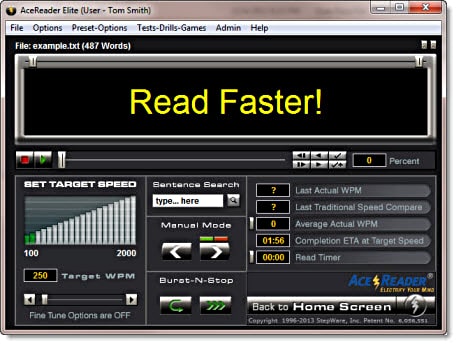
Reading mode* allows you to import your own texts, documents, and PDF files, and you can then use a reader to help you read a document at a speed you set. I thought this was really handy because I could read books or papers I might have to read anyway and use them to improve my reading skills.
Plus, I would be reading them faster than I usually do! Practically speaking, imagine loading in a chapter you need to finish for tomorrow’s seminar — you’re not doing “practice reading” anymore. You’re getting real work done while training.
3. Training Activities in Classic
Regression (Re-Reading)
AceReader directly targets regression — the habit of letting your eyes drift back to re-read text you’ve already covered. The program either flashes words in RSVP mode (so previous text simply isn’t visible) or highlights forward movement so your eyes have nowhere to go but ahead.
Subvocalization
AceReader also addresses subvocalization challenges. It is the inner voice that reads every word as if speaking it aloud. At high pacing speeds, it becomes physically impossible to subvocalize. The program literally pushes you past the speed at which your inner voice can keep up.
Chunking / Eye Fixation Expansion
AceReader includes drills specifically to expand your eye fixation zone — how much text your eyes can absorb in a single stop. Standard readers fixate on one word at a time. Trained readers can take in chunks of words or a full line per fixation. The Eye-Span Game is designed to practice exactly this.
200+ activities to do
AceReader Classic includes over 200 games, activities, and drills. The speed of the activities is based on the speed demonstrated in the first assessment test.
I noticed that the activities seem to start a little faster than my assessed speed, which is intentional. The program pushes you just beyond your comfort zone, which is exactly how you improve.
6 themes to choose
There are 6 themed, 13-level speed reading courses. The themes are General, American History, Earth and Space Science, Famous People, Fun Facts, and SAT/ACT Review. Within each theme are 13 levels, for a total of 78 lessons.
The SAT/ACT Review theme is particularly useful if you’re a student preparing for standardized exams — you’re building reading speed while absorbing test-relevant vocabulary and content at the same time.
600+ preloaded books and resources for more
AceReader Classic includes 600+ preloaded books. The lessons and Reader mode both incorporate them. In addition, they provide online resources such as Project Gutenberg for downloading texts and using them within the program.
Thousands of additional eBooks are also available for download from their website and can be imported directly into the software.
Graphed results
The program captures your test and game results and displays them as graphs. This picture is a quick snapshot of how you are doing in the software; this kind of instant feedback is very motivating.
You can see your words-per-minute trend over time and watch comprehension scores rise alongside — a useful reality check when it feels like you’re not making progress.
Ability to email work and progress
You can email your work and progress to teachers and parents — especially useful for educational institutions and homeschoolers.
Administrator’s section
The Administrator’s mode is very helpful for teachers and parents. This allows them to monitor students’ progress and to see what they are working on. It also allows them to assign texts, lessons, quizzes, and activities.
2. AceReader Personal Edition – Overview
AceReader suits most individuals, particularly students at any level. It is especially useful for those in university, pursuing a Master’s or doctoral degree. Or really, anyone who reads professionally and wants to do it faster without sacrificing comprehension.
AceReader Personal includes all the features listed above but adds a cleaner, more modern interface and various cloud features. Those interested in using Personal can access it for an annual subscription of $39/year — that’s less than the cost of a single academic textbook.
If you prefer learning online, the AceReader Personal edition might be the right tool. You can access it across desktops, tablets, and smartphones with an internet connection, though the browser-based setup may not suit everyone.
Notably, this means no software installation at all — you log in, and you’re working within minutes, on any device.
Personal Edition – Main Features
- Same as Classic, but with cloud support
- Automated self-adjusting courses that adapt to your reading level
- Reading assessment and improvement activities
- 1,000+ themed and leveled reading comprehension tests (compared to ~830 in Classic)
- Browser access, no installation required
- Windows, Mac, iPads, Android tablets, Amazon Kindle Fire
- Subscription-based: $39/year to access the software and features
- 30-day money-back guarantee
3. AceReader Family Edition – Overview
If you’re a parent, homeschooler, or simply have multiple people in your household who want to improve their reading, the AceReader Family Edition is worth knowing about.
It’s built on the same platform used by the Education Edition — the one trusted by schools — but adapted for home use, with a parent admin account that lets you manage and monitor each child’s progress individually.
Each person signs in with their own account, and the program adapts to their individual reading level. You’re not locked into a single speed or difficulty level for the whole family.
Family Edition pricing:
- 2 users: $59/year
- 4 users: $79/year
- 8 users: $99/year
It includes the same 1,000+ comprehension tests, 13 levels of text complexity, eye-pacing drills, and eye-exercise games as in the Personal and Education editions.
It was also named in the “Best Homeschool Curriculum, Products & Resources of 2024–25” by HowToHomeSchool.com — a recognition that matters if you’re making this decision for your kids.
4. AceReader Education – Overview
AceReader Education serves schools, universities, and educators working directly with students. Educators will guide students on their journey to read faster, expand their vocabulary, and deepen their comprehension. Features include:
- Ability for teachers to monitor their students’ progress and learning
- Fun and engaging eye exercises and games
- Classroom-level applications that allow for individual or group work
- Subscription-based
Educational institutions interested in purchasing the Educational Edition must contact customer service for ordering and pricing information. You may also contact me to get a competitive quote.
Any AI Features in AceReader?
Here’s something worth addressing directly, because it comes up more and more: Does AceReader use AI?
The short answer is: not in the way most modern tools do. As of mid-2026, AceReader does not offer AI-generated summaries, AI-driven comprehension analysis, or integration with tools like ChatGPT or NotebookLM.
To be fair, it is not even trying to be that. AceReader’s strength is different — and understanding that difference actually matters when you’re choosing the right tool for your goals.
What AceReader uses is a proprietary, patented blend of pacing and vision training techniques. This is built around two core methods:
- RSVP (Rapid Serial Visual Presentation): Words or phrases are flashed on screen one at a time at a controlled speed — anywhere from 100 to 2,000 words per minute. Your eyes don’t need to move. Your brain has to process what it sees, fast. It’s uncomfortable at first, but that discomfort is the point.
- Eye pacing drills: Rather than flashing words, these move a visual guide across the screen to train your eyes to cover lines with fewer fixation stops, increasing your natural reading speed over time.
These are not new ideas, but they are backed by decades of research into how the eye and brain process text. They are also not the same as bionic reading — a term you may have encountered recently.
What is bionic reading?
Imagine opening an article and noticing that the first few letters of each word are bolded — slightly darker, more prominent than the rest. Your eye naturally gravitates to those anchor points, and your brain fills in the rest of the word without consciously reading every letter.
That’s bionic reading — a typographic technique that guides your eye over text rather than training it through speed drills. Some people, particularly those with ADHD or reading fatigue, find it significantly easier to stay focused with bionic formatting.
Others notice little difference. The research is still mixed, but the concept is real and widely discussed in reading circles. AceReader does not currently offer bionic reading formatting — its approach is training-based rather than typographic.
So, where does AI reading fit if you use AceReader?
This is where you can take things into your own hands. AceReader’s Reading Mode lets you import your own text. That means you can:
- Run a dense research paper or report through an AI summarizer (like ChatGPT or Scholarcy) to extract the key sections
- Paste or import that condensed text into AceReader’s Reading Mode
- Use the pacing tool to read it at a trained, focused speed
You’re not relying on AceReader to be an AI tool — you’re stacking it alongside AI in a way that makes both more effective. Think of AceReader as the training ground and AI tools as your prep team. It’s a practical workflow. You can learn more about AI reading methods and workflows here.
AceReader Review – Pros and Cons
I once downloaded AceReader Classic/Elite and took it for a spin. Although some features are disabled in the free trial, you can still get a good grasp of what the program has to offer.
AceReader Pros
Actually, I was impressed by how intuitively I was able to start using the program. Within minutes, I had read the intro, taken the first assessment test, and started the first exercise.
There is a full help system, including online support and a toll-free phone number available, but I never had to use them. The three games I played were fun, and I found the drills to be challenging.
AceReader Cons
The cons were, to be honest, purely aesthetic. I found the graphics and sound to be a bit old-fashioned. I must admit I am used to a higher level of graphics and audio quality. But that was a personal preference; overall, the program is definitely excellent!
The cloud-based Personal and Family editions have a noticeably cleaner, more modern interface — so if the Classic design feels dated to you, the browser editions solve that immediately.
One practical limitation worth flagging is that the Classic Desktop edition requires a Windows PC. If you’re on a Mac and want the desktop experience, you’ll need to use the cloud-based editions instead.
That doesn’t have to be a dealbreaker, though. The cloud versions have more comprehension tests and work on every device. But it’s worth knowing upfront rather than finding out after purchase.
What Users Say
I always like to see how actual users rate things. I looked at several user reviews for this software and saw that most people give an excellent rating. There were hardly any cons listed, and people were happy to be using this program. However, the market is versatile, and it is worth comparing other tutors as well.
Cnet – I also looked over at Cnet.com. Their raters also awarded it almost 5 out of 5 stars; again, there were no cons listed, except that one rater said the games could be addictive! Cnet.com provides a download link to try a limited version of the software for free. This is also available on the software’s home site.
Support – Users generally seem very satisfied with AceReader’s customer support. There is telephone and email support, and you can drop your individual questions at any time. In case you run into installation issues, they are happy to help.
Help – A user provided this feedback after he had to re-install the software, combining with general praise: “Thank you very much for your kindness and a speedy reply. AceReader is the best, especially for those who have some difficulties with the eyes, such as ‘convergence insufficiency’, when the eyes tend not to work together. The exercises are varied, beneficial, and practical. John Bacevicius”
The program’s scientific background, combined with good customer service, seems to be key to the success they have experienced over the years.
It’s also worth noting that AceReader has a 30-day money-back guarantee across all editions — so the risk of trying it is genuinely low.
AceReader Review – The Verdict
Wrapping up our AceReader review.
General verdict
If you are looking to improve your own reading skills and comprehension or to help your students improve their skills, AceReader is one of the top speed reading apps and programs on the market.
It will give users proven, long-lasting results that help save time and improve physical and mental skills. Furthermore, in an increasingly crowded landscape of AI-powered reading apps, AceReader occupies a distinct position: it trains the reader, not the machine.
That’s a meaningful difference if your goal is to become genuinely faster — not just to consume pre-digested summaries.
Classic Edition
The learning modes in AceReader Classic, the variety of drills, and the games are the best parts of the desktop software. It absolutely does what it says it will: it helps you speed up your reading and increase comprehension.
If you prefer a one-time offline purchase with unlimited user accounts and lifelong access, Classic Elite is a strong choice — provided you’re on Windows.
For mobile access, the cloud-based Personal or Family edition is the better fit. It’s a one-time fee for the desktop tool.
Personal Edition
By choosing AceReader Personal, you will now get a cleaner, more polished interface and increased flexibility for mobile learning. You also get more comprehension tests — 1,000+ versus ~830 in Classic.
However, keep in mind that Personal is browser-based and requires an active internet connection. While Classic is a one-time fee, you will also need to pay a yearly fee of $39 to maintain access. It’s recommended for students who wish to accelerate their studies.
Family Edition
– If there are two or more people in your household who want to improve, the Family Edition offers genuine value. Starting at $59/year for two users, it delivers the same depth and admin tools used in schools at a price that makes sense for home use.
Support
As mentioned above, AceReader offers excellent support. In addition to email and phone options, you can browse their FAQs to learn more about common settings, techniques, and usage.
Final Review Verdict
Compared to the other programs I looked at, this was among the best in terms of quality and value. Choose this software if you want a proven, awarded concept trusted by educational and professional institutions.
Do you like this review? Please share our AceReader review!
Sources & Further Reading
The Science of Speed Reading
- How Do We Read, and Can Speed Reading Help? — PubMed / NCBI (peer-reviewed, 2016 — widely cited study on the speed/comprehension trade-off)
- Speed Reading Promises Are Too Good to Be True — Association for Psychological Science (comprehensive review of decades of reading science)
- Reading Speed Improvement in a Speed Reading Course — Electronic Journal of Foreign Language Teaching, NUS (academic study on measurable reading speed gains)
- Impact of Speed-Reading on Reading Speed, Stress and Anxiety — Ianna Journal of Interdisciplinary Studies (2025 peer-reviewed study)
- Does Reading Speed Matter? — UNESCO GEM Report SCOPE (correlation between reading speed and comprehension across languages)
Eye Movements & Reading Research
- Eye Movements During Reading and Their Relationship to Reading Ability — PMC / National Library of Medicine (2022 peer-reviewed study on eye tracking and reading assessment)
- Eye Movements in Skilled Readers — University of Massachusetts, Amherst (research lab video; Dr. Rayner’s eye movement studies)
- Speed Reading — Overview of Scientific Evidence — Wikipedia / Academic Citations (useful aggregation of scientific literature and references)