
Become A SuperLearner 2 – Review
Become A SuperLearner – Learn Speed Reading & Boost Memory
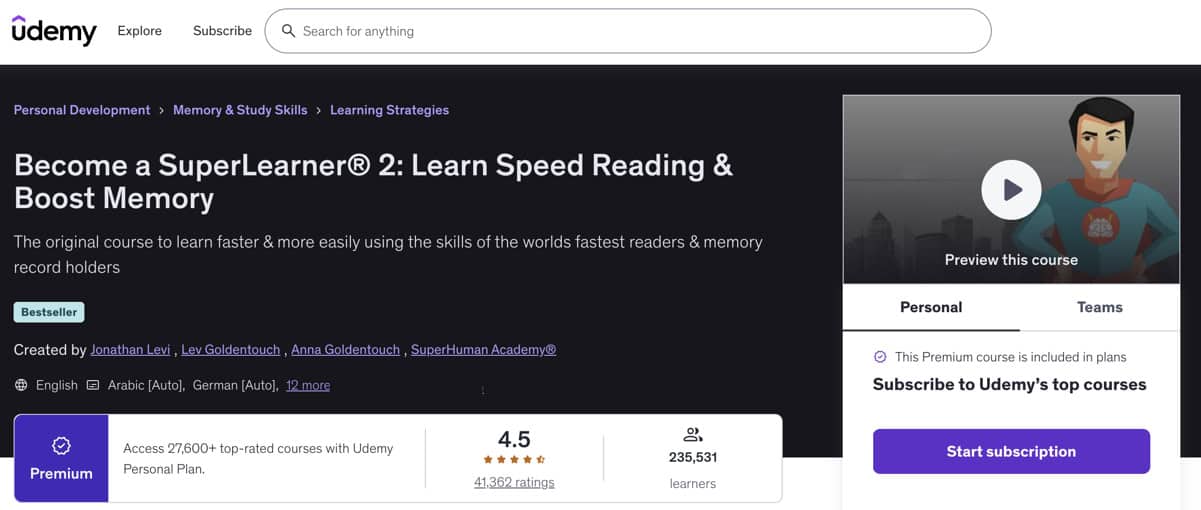
Let’s think about what school actually taught us. Dates, formulas, vocabulary lists. All good. What it rarely taught you was how to hold onto any of it. Well, at least effectively, and long-term. Not so good.
The mechanics of learning itself — encoding, retention, retrieval — were simply assumed. You were handed content and left to figure out the rest. Most people never do. Jonathan Levi noticed that gap and built the Become a SuperLearner course around it.
Become a SuperLearner arrived on Udemy (view course) over a decade ago, pairing speed reading with memory training in a single program. Nobody else was doing that combination at this price point.
It is a course for learning speed-reading and advanced memory techniques. The main goal of this course is to change how people learn, enabling them to read and record large amounts of content more quickly and effectively.
I bought the course 8 years ago, went through it carefully, and reviewed all its updates. What I found is a program that genuinely delivers on its core promise — and one that is showing its age in ways that matter for how you read in 2026.
Become a SuperLearner – Overview
Become a SuperLearner 2 (view course) is an online course on Udemy. It was co-created by Jonathan Levi, Dr. Lev Goldentouch, and Anna Goldentouch. The Goldentouch team brings research depth from the SuperHuman Academy.
Together, they cover two skill sets in one program: speed reading and advanced memory technique. Version 2.5 expanded the original with new video demonstrations and revised practical exercises.
The course contains 60 lectures across roughly 5 hours of video, with lifetime access after purchase. Over 240,000 students have enrolled, making it one of Udemy’s most recognised courses in the personal development space.
It is designed for anyone who wants to learn and retain information more efficiently. We review this class in this post.
Learning goals
Become a SuperLearner (view course) aims to help students learn three main skills:
- Speed reading – up to at least 3 times that of an average college student
- Memory techniques – memorize and recall large amounts of information
- Building up brainpower – store large amounts of new information
Who would benefit?
- Any reader who not only wants to consume vast amounts of information but also remembers it.
- Education specialists who want to understand the processes behind learning so they can teach more effectively and help their students to learn better
Learning Material
All learning materials can be accessed and downloaded via Udemy:
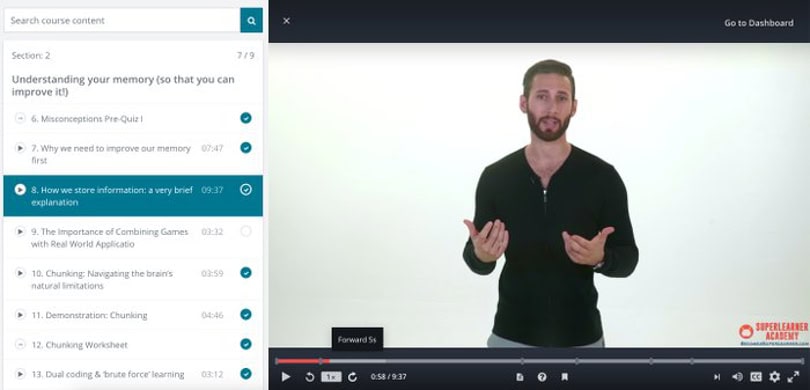
- 60+ video lectures with 5 hours of content
- Demonstrations on how to use the techniques taught
- Interactive and printable worksheets
- Homework assignments – often supplementary reading or video material
- Games – students are expected to keep practicing these every day
Duration or time to invest
- 6 – 9 weeks with about 3 hours of focused study per week.
- At 3 weeks, students should have gained some pretty cool memory tricks.
- At 5 weeks, one should be able to speed read with high comprehension.
After completing the SuperLearner class, one should be able to comfortably speed-read and record large amounts of information. This is true as long as you set a goal before starting and commit to daily training and practicing.
Good to know – Become a SuperLearner is not for those who want to lean back and just watch the videos. Expect some homework here to succeed.
Pricing: $149. Often $19.99. Use our exclusive coupon (view course) to claim up to an 80% discount.
Who Gets Real Results Here. Who Won’t?

Readers, students, knowledge workers
Reading more doesn’t automatically mean retaining more. Most people, including me, discover this the hard way. We finish a book, then realise two weeks later that little of it stayed.
Knowledge workers processing reports and research, students managing dense reading loads, autodidacts working through non-fiction across every field — all of them hit the same wall eventually. Volume without retention is just time spent.
If that gap or wall feels familiar, Become a SuperLearner will help address that frustration and overcome the challenge.
People with learning difficulties
An overlooked audience is also worth naming likley to benefit from the class. People with learning difficulties, including ADHD and dyslexia, have reported disproportionate gains here.
Memory techniques rely on vivid visual imagery rather than on linear text. That sidesteps several of the barriers that traditional study methods create. The course doesn’t oversell this — students simply report it.
Who should look elsewhere?
If you’ve already worked through Make It Stick, A Mind for Numbers, or Moonwalking with Einstein, most of this will feel familiar. You’ll recognise the techniques before Levi finishes explaining them.
Become a SuperLearner runs entirely in English with no subtitle alternatives. For non-native speakers navigating technical vocabulary, that’s not just an inconvenience. It’s a barrier to the precision the exercises require.
Mobile-first readers will also hit a wall. Several core drills are desktop-dependent. If your reading life happens primarily on a phone, the practice of architecture simply won’t fit your routine.
Become a SuperLearner – Teaching Methods
Brain retraining
Brain retraining is the underlying premise. Become a SuperLearner 2 isn’t built around reading faster as an isolated skill. It aims to change how the brain processes and stores incoming information. The goal is retention at speed — not just covering more pages, but keeping what you’ve read in long-term memory.
Brain chemistry
Brain chemistry gets its own space in the curriculum. Several lectures explain what’s happening neurologically during learning and how that knowledge can be applied practically. I find this section useful context rather than academic padding. Understanding why a technique works makes it easier to apply it consistently.
Pace and intensity
Pace and intensity are managed carefully throughout. Lectures and quizzes are pitched at or slightly below your comfort level, with subject matter varying in intensity to maintain focus. It’s a deliberate design. The variation keeps engagement alive across what is, realistically, a multi-week commitment.
Exercises and the Pomodoro method
Daily practice exercises run through specifically designed online tools, built to reinforce training efficiency. The course recommends structuring practice in 25-minute Pomodoro sessions with short breaks between them.
Those breaks aren’t filler — they’re when the brain consolidates what it’s just processed. I think this is one of the more underrated structural choices in the course.
Effort is non-negotiable
Most adults have been using the same learning habits for decades. Retraining them takes real work. The Become a SuperLearner course acknowledges this directly and offers tools for managing the frustration that comes with it. That honesty earns trust. You won’t feel blindsided when the exercises feel slow at first.
In a nutshell
- Brain retraining is the core premise, not just speed reading technique
- Neurological context is taught alongside practical application
- Pomodoro-based session structure supports memory consolidation
- Frustration is addressed directly — the course prepares you for the difficulty
Reading tip: If you want AI to actually save reading time, start with a focused overview instead of scattered tips. The main AI speed reading guide walks you through my 3‑Step AI Speed Reading Method and shows where tools, AI summaries, and listening apps realistically help.
From there, you can dive into tutorials on AI‑supported reading workflows such as our ChatGPT for speed reading guide — and compare carefully selected AI speed reading apps and text-to-speech apps or AI summarization tools before committing to any subscription.
The Become a Superlearner Curriculum: What You’re Actually Learning and Practicing

1. Reading with your eyes, not just your mind
Become a SuperLearner‘s first lesson opens with how the eye physically moves across text. People often read word by word, landing multiple fixation points per line. Levi teaches you to widen your perceptual span and reduce fixation frequency.
The technique draws on saccadic movement science. Your eyes jump rather than glide. Most readers never learn to use that to their advantage. I found the video demonstrations here more clarifying than any written explanation I’d previously encountered on this subject.
But expect some awkwardness before fluency. The eye training takes several weeks of daily practice before it consolidates.
2. Mental markers: Why the bizarre sticks
This is the strongest section of Become a SuperLearner. Mental markers are vivid, often absurd mental images attached to new information to anchor it in memory. The stranger and more emotionally charged the image, the more reliably it holds.
Levi and the Goldentouch team walk through the neuroscience: the brain encodes emotionally resonant imagery differently than plain text. They move quickly from theory into application.
I tried the marker technique mid-course on a dense non-fiction chapter. The retention difference was immediate. Noticeable enough that I’ve kept using the technique since finishing.
3. Building a memory palace
Unfortunately, people encounter the memory palace as a concept, get excited, but then never build one they use more than once. I agree it takes time, and it’s weird too.
Become a SuperLearner solves that specific problem. It walks through construction step by step: choose a familiar physical space, place vivid images at specific locations, and retrieve by mentally walking through.
The guided practice pushes you past the conceptual understanding that holds most learners back. This is where the course earns its reputation most clearly. The technique is ancient. The structured practice that makes it usable is what the SuperLearner class actually provides.
4. Spaced repetition and the practice of Architecture
Less prominent but worth understanding. The course integrates spaced repetition principles throughout its later sections. You review material at increasing intervals, exploiting how memory consolidates during rest.
Daily exercises and games are built into the assignments. And the course is explicit here too: passive watching produces no results. Your outcomes depend almost entirely on consistency across 6 to 9 weeks.
I found that honesty was genuinely useful. It prepares you for the frustration of unlearning reading habits built over decades. That acknowledgment isn’t reassurance — it’s preparation.
Become a SuperLearner: curriculum at a glance
- 60 video lectures, approximately 5 hours of on-demand video
- Lifetime access to all content after purchase
- Printable worksheets and interactive exercises included
- Daily games designed to reinforce memory encoding
- Suggested pace: approximately 3 hours of study per week
- Completion certificate available through Udemy
Reading tip: Tools and apps are useful, but most lasting gains come from a few solid tutorials you revisit. If you suspect habits, not software, are holding you back, do this. Start with a fundamentals guide on how to speed read, then move into practical lessons on skimming and scanning, and reading word chunks.
What the Become a Superlearner Course Gets Right
The combination is the differentiator.
Speed reading courses exist widely. Memory courses exist widely. A program that integrates both into a sequenced skill-building system is genuinely rare at this price. Well, given that you got it at a discount or as part of a subscription, which I recommend.
By the midpoint of watching Become a SuperLearner, the covered reading and memory techniques are practised together as a single system. I haven’t found another Udemy course at this price that does this as effectively.
Instructor accessibility
This is consistently cited as a strength by students, and I’d agree. Levi explains complex cognitive science without jargon overload. The Goldentouch team adds academic grounding without academic distance. That pairing makes the denser sections approachable rather than intimidating.
Become a SuperLearner also earns credit for honest expectation setting. It tells you how difficult the skill-building process will be. It doesn’t promise frictionless transformation. In a category full of inflated claims, that’s a meaningful design choice.
Pros at a glance
- Strong integration of speed reading and memory as one skill system
- Accessible delivery of complex cognitive science across all skill levels
- Realistic timeline with emotional friction acknowledged throughout
- Lifetime access to all content post-purchase
What Become a SuperLearner Gets Wrong
It hasn’t kept up with how people read now
This is the most significant issue for a 2026 learner. The course was built before AI reading tools even arrived. And before annotation apps and intelligent review systems became part of how people manage information.
There is no guidance on integrating these techniques with modern reading workflows. For anyone reading across multiple platforms and devices today, that’s a structural absence. It requires active supplementation, not just awareness.
The aggregated content question
Some students note that the techniques here aren’t original to Levi and the Goldentouch team. That’s partially accurate. Memory palaces, spaced repetition, and saccadic reading training all predate this course significantly.
What the Become a SuperLearner course provides is curation, structure, and demonstration in an accessible sequence. That synthesis actually has real value. But if you’ve already explored this territory through speed reading books or other courses, you may find you’re paying more for packaging than discovery. Fair enough.
Practical friction points
Desktop dependency. The eye training drills are designed for desktop screens and don’t translate to mobile. In a world where significant reading happens on phones and tablets, this limits when consistent practice is actually possible.
The book question. The companion book Become a SuperLearner (view on Amazon) covers nearly identical ground to the course. For readers who prefer text, it offers comparable value at a fraction of the price. Worth knowing before you enroll.
Cons in a nutshell
- No integration with modern AI tools or reading workflows
- Core techniques available in book form and elsewhere at a lower cost
- Desktop-dependent exercises limit mobile practice flexibility
- Companion book covers similar material for significantly less
Become a SuperLearner – What You’ll Actually Pay

Udemy’s discount model runs continuously. Become a SuperLearner 2 lists at a higher price but is consistently available for $14.99 to $19.99 during Udemy’s regular promotional periods.
That’s a fair price. And at that range, the value case is clear. At under $20 for 5 hours of structured content, lifetime access, and a completion certificate, it compares well against most alternatives. At full list price (above $100), the case weakens. Thus, wait for a sale. One typically appears within a few weeks, often days.
There is no free tier. Udemy’s 30-day refund policy functions as a practical risk-free trial. Alternatively, you can start a subscription and get access to all Udemy courses.
Pricing at a glance
- Regularly available for $14.99–$19.99 during Udemy promotions
- No free access tier; 30-day refund policy applies
- Lifetime access included after purchase
- Always verify current pricing directly on Udemy before enrolling
SuperLearner Alternatives?
As this is a video-based course, it would be interesting to explore alternatives as well. Iris Reading is probably the one that comes closest. They offer the same skills; however, you can choose whether to learn online or attend a seminar in person.
| Course | Core Focus | AI Integration | Price Range | Best For |
|---|---|---|---|---|
| Become a SuperLearner | Speed reading + memory | None | $15–$20 | Foundational learners |
| Iris Reading | Speed reading only | Minimal | $50–$100 | Reading speed focus |
| Learning How to Learn (Coursera) | Cognitive science of learning | None | Free audit | Theory-first learners |
Where This Fits in a Modern AI Reading Practice
Become a SuperLearner aims to build the cognitive foundation. It teaches you to read faster, encode information through markers, and retrieve it through structured memory systems.
That foundation doesn’t become less useful just because AI tools exist. What the SuperLearner class doesn’t cover is the layer above: using AI reading assistance tools, AI summarizers, and structured review systems to manage the volume modern readers actually face. But not to worry here.
Think of it in terms of layers. The course builds the engine. Our free 3-Step AI Speed Reading Method and modern reading tools provide the surrounding infrastructure.
A realistic combined workflow could look like this. Apply the course’s speed reading and marker techniques to active reading sessions. Use an AI summarizer for initial triage of longer material. Then, use spaced repetition software to review what you’ve marked.
These two concepts and approaches certainly operate at different layers. But they complement each other more than they compete. Also, for a broader view of where Become a SuperLearner sits among reading tools, the speed reading apps hub covers the full landscape.
Become a SuperLearner Review Verdict: Solid Foundation, Aging Frame
My review rating for the Become a SuperLearner course is 7.5/10.
This course works. That’s the honest starting point. The speed reading and memory techniques are real. The integration of both in a single program is rare at this price. Jonathan Levi and the Goldentouch team deliver complex cognitive science in a form that’s actually usable. For a foundational learner, the value is clear.
The reviews from those who have finished Become a SuperLearner (view course) have been overwhelmingly positive. And many have said the course has helped them remarkably in their reading speed and comprehension. The lessons are straightforward and explanatory, and the exercise demonstrations have shown clear examples for learners to follow.
What limits the score isn’t quality. It’s currency. The course doesn’t acknowledge the shift in the reading landscape. A 2026 learner will need to supplement it with current resources rather than treat it as a complete picture.
Enroll if:
You’re building foundational learning skills from scratch. You read primarily on a desktop or a laptop. You can commit 3 hours per week for 6 to 9 weeks. The price is under $20.
Skip it if:
You’ve already read widely on accelerated learning. You want an AI-integrated workflow from day one. You primarily read on mobile.
| Course Name | Become a SuperLearner 2 (view website) |
|---|---|
| Instructor(s) | Jonathan Levi, Dr. Lev Goldentouch, Anna Goldentouch |
| Platform | Udemy |
| Content | 60+ lectures, ~5 hours of video |
| Suggested Duration | 6–9 weeks (~3 hrs/week) |
| Typical Sale Price | $14.99–$19.99 |
| Refund Policy | 30-day money-back guarantee |
| Language | English |
| Certificate | Udemy completion certificate |
| Students Enrolled | 240,000+ |
| Udemy Rating | 4.5+ / 5 |
Looking for a ‘Become a SuperLearner 2’ Coupon Code?
Original Course Price: $145. Get up to 95% off here. Claim Your Coupon Code Deal by (viewing the course page) using the link. Please contact us for the latest coupons if the above doesn’t work. I might be able to help.
What “Become a SuperLearner” Actually Means Beyond the Course
The phrase “Become a SuperLearner” now carries a brand stamp. The concept underneath it is older and more useful than any course.
A superlearner is someone who has developed the ability to acquire and retain new information faster than the average person. Not through innate ability. Through deliberate, trainable technique. Research in cognitive science has consistently supported this. Learning is a skill. Its mechanisms are known and teachable.
The four skill pillars most supported by evidence
These aren’t productivity hacks. They’re properties of how the brain actually consolidates information.
Encoding transforms raw information into memorable form. Mental markers, imagery, and emotional anchors exploit the brain’s preference for vivid, resonant material over plain text. The more meaningful the brain treats incoming information, the more reliably it stores it.
Retrieval practice is the act of actively recalling information rather than passively reviewing it. Self-quizzing consistently outperforms re-reading in retention studies. The act of retrieving a memory strengthens that memory. Re-reading the same page gives the feeling of learning without much of the result.
Spaced repetition involves reviewing material at increasing intervals. The brain consolidates memories during rest and sleep. Spacing your reviews exploits that process. Cramming fights it.
Interleaving means mixing topics or problem types during study sessions rather than blocking one subject at a time. It feels harder. It produces better long-term retention and transfer. The difficulty is the mechanism.
SuperLearner Strategies That Accelerate the Process
1. The Feynman technique
Take a concept you’ve studied. Explain it as if teaching someone with no background in the subject. Where the explanation breaks down, a gap in understanding exists. Return to the source and close that gap. Repeat until the explanation holds without cracks.
I use this after any dense chapter or module. It reveals the places where familiarity has masqueraded as understanding. That happens more often than most readers would like to admit.
2. Multisensory learning
Engaging multiple senses deepens encoding. Reading alone activates one input channel. Combining text with audio, diagrams, or physical note-taking simultaneously activates different neural pathways. That redundancy creates more retrieval routes for the same information.
This is partly why handwritten notes tend to produce better retention than typed ones, even when typed notes are more complete. The physical act of writing slows processing enough to improve encoding.
3. Sleep as a cognitive tool
Sleep isn’t downtime for the superlearning brain. It’s consolidation time. Memory transfer from short-term to long-term storage happens primarily during deep sleep cycles. Reviewing material in the final hour before sleep consistently outperforms an equivalent review period mid-afternoon.
Most learners treat sleep as peripheral to their study routine. Cognitively, it belongs at the centre. I started treating pre-sleep review as non-negotiable and noticed the difference within a week. And superlearners will probably do so too.
4. The Protégé effect
Teaching material to someone else produces deeper learning than studying alone. Organising information for explanation forces you to identify logical gaps and build a coherent structure.
Study groups, peer tutoring, and explanatory writing all exploit this effect. You don’t need an actual student. Preparing a clear explanation for an imaginary reader achieves much of the same cognitive result. The preparation is the learning.
5. Pre-Learning and Context Priming
Before reading a dense chapter, scan the headings, summary, and conclusion first. This gives the brain a framework to organise incoming information rather than building a structure while simultaneously processing content.
Context priming reduces cognitive load during actual reading. You arrive at the detail already knowing roughly where it fits. The mechanism: schema already in place requires less working memory to process new information. I use this before any demanding non-fiction chapter. The retention difference is measurable.
6. Cognitive state: The precondition most learners ignore
State before the session matters more than most study guides acknowledge. Chronic stress impairs memory consolidation at a neurological level. Cortisol directly interferes with hippocampal function — the region most responsible for transferring short-term learning into long-term memory. It’s quite a biological constraint.
Physical exercise before study has strong research support. Even 20 minutes of moderate aerobic activity increases blood flow to the prefrontal cortex and raises BDNF levels, a protein that supports neural growth and learning.
The superlearning environment matters too. Consistent study spaces, reduced exposure to notifications, and adequate lighting all reduce the attentional friction that competes with encoding. Managing the state before a session produces more reliable results than any single technique applied within it.
SuperLearner Strategies
- Chronic stress measurably impairs memory consolidation
- Brief aerobic exercise before study enhances cognitive readiness
- Consistent environments reduce attentional friction during learning
- Pre-session state is a precondition, not an afterthought
Your SuperLearner Practice Stack in 2026
No course is required here. The tools and techniques exist independently of any program. Here is what a working, evidence-based become a superlearner practice looks like today.
1. The Reading Layer
Use reading sessions actively. Apply mental markers to key ideas as you encounter them. Build retrieval cues in real time rather than reviewing passively afterward.
The 3-Step AI Speed Reading Method provides a structured workflow for exactly this. Speed reading technique and comprehension reinforce each other when practised together, not in isolation.
2. The Memory Layer
Spaced repetition software handles review scheduling automatically. Anki is free and widely supported. Build a memory palace for material requiring long-term retention. Use mental markers for anything you want to anchor in the short term. The two techniques work at different time scales and complement each other naturally.
3. The AI Layer
AI tools change what superlearning looks like at volume. An AI summarizer can triage a long document before you read it in full. You arrive at the source text with context already in place.
Tools like Readwise capture highlights and resurface them on a spaced-out schedule automatically. These tools reduce friction around cognitive work and superlearning. They don’t replace it. The speed reading apps hub covers current tool recommendations across all categories.
The Full Become a Superlearner Practice Stack
| Layer | Technique or Tool | Frequency |
|---|---|---|
| Cognitive state | Exercise, environment setup, stress management | Pre-session |
| Speed reading | Saccade training, fixation reduction | Daily during skill-building phase |
| Memory encoding | Mental markers, memory palace construction | Every active reading session |
| Retention | Spaced repetition via Anki | 10–15 minutes daily |
| Comprehension | Feynman Technique, teaching back | After completing chapters or modules |
| Triage | AI summarizer | As needed for long or complex content |
| Review | Readwise or equivalent | Weekly |
The compounding matters. A faster reader who can’t retain is working at a fraction of their potential. A strong memory system without reading speed limits throughput.
Speed and memory together — which is what Become a SuperLearner actually teaches at its core — is where the gains begin. Everything in the stack builds on that foundation.
Become a SuperLearner – FAQs
How much time do I need to invest to become a superlearner?
There is no strict minimum number of hours you need to practice to see results. It is recommended to spend 2-5 hours a week on the exercises, plus the time you need to go through the course itself. Expect 6-8 weeks to complete ‘Become a SuperLearner’.
What online resources are available in SuperLearner?
There are myriad online tools to try out. You will be given access to websites that host those tools. Furthermore, there is supplemental content on TED or YouTube.
Who is Become a SuperLearner for?
It is beneficial for all who wish to up their reading and learning skills. Students, professionals, teachers, and autodidacts are among those who enroll. More than 60,000 people have taken the course by now.
Overview Curriculum
- Introduction, goal setting
- The power of memory and how to use it
- Understanding the benefits of visual memory
- Using mental markers
- Creating and maintaining long-term memories
- Reading improvement techniques
- Fine-tuning learning habits
- Ingrain what you learn
Who is Jonathan Levi?
Jonathan Levi is your teacher. He is an entrepreneur and angel investor, and one of Udemy’s most successful instructors with more than 400k students enrolled. He also runs various enterprises and academies that offer masterclasses on learning and productivity.
Keep reading: Best Udemy Courses | Wikipedia | How to Build a Memory Palace
What is your experience? Have you taken any of these courses? Let us know in the comments below. Please share our ‘Become a SuperLearner’ Review on your favorite network.
Interesting sources:
If you like to see what the evidence actually says about speed reading and reading tech, it’s worth dipping into original research rather than app marketing. These non‑commercial sources on RSVP reading, bionic reading, eye movements, regressions, comprehension, and retention are a solid starting point:
Curious what science says about RSVP, bionic reading, eye fixations, and regressions? These original studies and reviews are a good starting point:
- Modern Speed‑Reading Apps Do Not Foster Reading Comprehension (Rayner et al., 2016):
https://pubmed.ncbi.nlm.nih.gov/29461715/ - Perceptual Learning in an RSVP Reading Task (Chung, 2014):
https://pmc.ncbi.nlm.nih.gov/articles/PMC4274879/ - Guiding the Gaze: How Bionic Reading Influences Eye Movements (2025):
https://pmc.ncbi.nlm.nih.gov/articles/PMC12565662/ - Eye Movements and Fixation‑Related Potentials in Reading – Review (Schuster et al., 2020):
https://pmc.ncbi.nlm.nih.gov/articles/PMC7157570/ - A Cognitive Model of Regressive Eye Movements During Reading (von der Malsburg & Vasishth, 2020):
https://pmc.ncbi.nlm.nih.gov/articles/PMC7888242/
Disclosure: This post contains affiliate links to some partners. Speed Reading Lounge may receive a commission for purchases made through these links. It does not add any extra costs. All reviews, opinions, descriptions, and comparisons expressed here are our own.