
ReadSpeeder Review – Features, Pros, Cons
ReadSpeeder: a free tutor for beginners to develop comprehension
Somewhere between the AI reading tools that summarize your books for you and the RSVP apps that flash words until your eyes give up, there’s a quieter category of tool. Without adaptive algorithms. No premium tier promising to unlock your potential. And no app to download at all.
Just a structured course, running in a browser, asking you to rethink how you read from the ground up. ReadSpeeder.
ReadSpeeder belongs to that quieter category — and in 2026, that position is more interesting than it sounds. Most speed reading tools compete on speed metrics, word-per-minute claims, and feature counts.
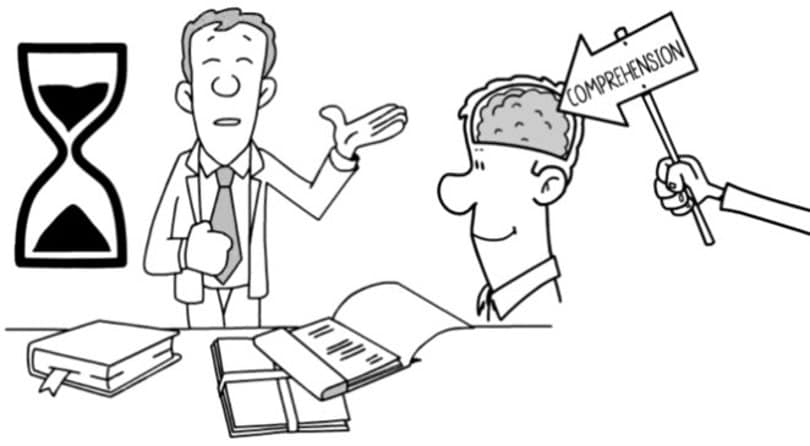
ReadSpeeder’s approach is almost contrarian. It argues that the real bottleneck isn’t your eye speed. It’s your comprehension, your focus, and your mental processing of language. Whether that argument holds up under scrutiny is what this review is for.
By the end, you’ll know what ReadSpeeder actually is, who it genuinely serves, and whether a free 12-day browser course has earned a place in a serious reading practice in 2026.
What’s ReadSpeeder? A Course and Software in a Browser
ReadSpeeder is a free, web-based speed reading course and training program developed by David Butler. It runs entirely in a browser — no download, no app, no installation.
The platform is desktop-only. There is no mobile version, no iOS app, and no Android app. Before you wonder, that is not a gap to be filled later. It is a deliberate design reality of a web-first product.
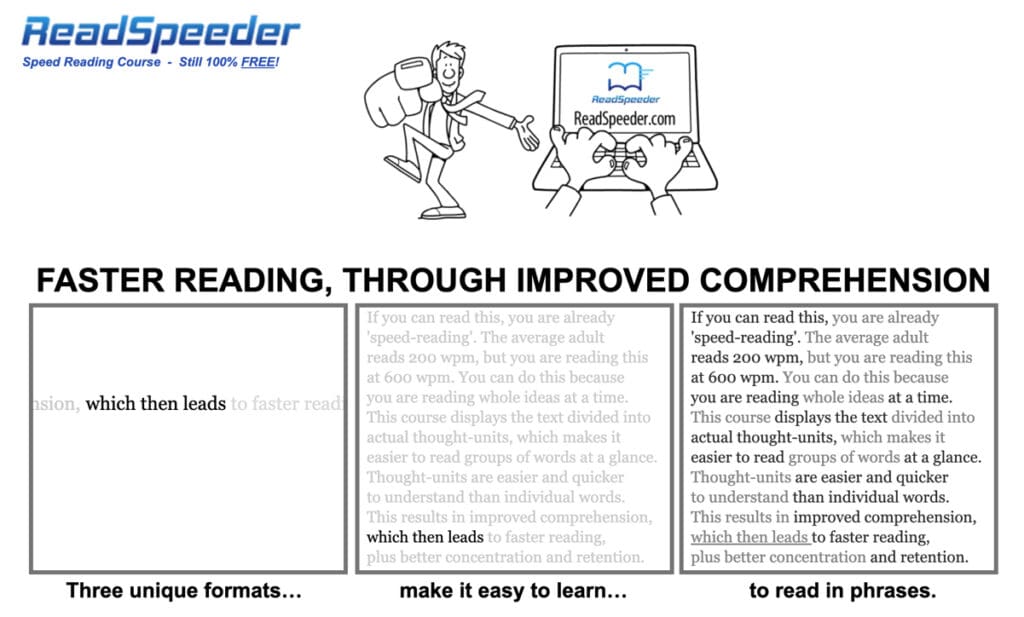
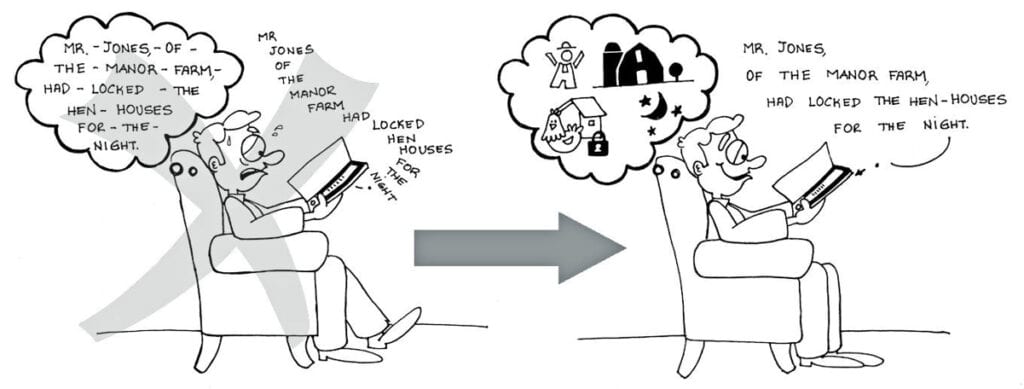
The method is phrase-based reading combined with active visualization — explicitly not RSVP. Rather than flashing individual words at increasing speeds, ReadSpeeder trains readers to process meaningful “idea chunks” and form mental images from text.
Over 90,000 users have registered since launch, and the core program remains entirely free, with no subscription and no premium tier of any kind.
ReadSpeeder – 4 Learning outcomes
- No rushing or skimming through the text. Learn to read words properly, only faster.
- Faster Comprehension. When you read a word in the correct context, you will understand it better and thus understand words or phrases more quickly.
- Better concentration. To comprehend better, you learn to concentrate correctly on the material in front of you, and even visualize it.
- Learn faster. It is inevitable: when you read better, you will understand better. You will then learn to work more effectively.
Alternatives: Browse our speed reading courses for premium options, such as Spreeder or Iris Reading.
Who Actually Gets Something From ReadSpeeder?
Beginners get the clearest return here. ReadSpeeder’s twelve-lesson structure offers a gentle path into the practice of reading with more awareness. Its focus on comprehension rather than raw speed reminds me that understanding is the real measure of progress.
What makes it even more inviting is how easy it is to begin—perfect for someone who has never examined their reading habits with intention. Students working through moderately demanding material such as textbooks, long articles, and structured nonfiction will find the phrase-training approach practical rather than gimmicky.
Teachers are a legitimate secondary audience. The ability to pre-select reading material and create multiple user profiles on a single account makes ReadSpeeder usable in classroom or tutoring contexts.
For younger learners or those with reading difficulties, the visualization and concentration focus is more thoughtfully constructed than most free alternatives.
Advanced readers looking for data-driven training or AI-assisted workflows, however, will quickly hit the ceiling here. And anyone expecting to read on a phone or tablet should stop reading here. The browser-only, desktop-only design is a hard constraint with no workaround.
Learn to visualize with ReadSpeeder
ReadSpeeder will help you develop your visualization skills.
- Learn how to read fast and with focus
- Read words in groups
- Create meaningful phrases from each group
- Create an image for the phrase
- Use the image to understand and remember the phrases
This concept is quite simple. Take the well-known sentence used for typing skills:
“The quick red fox jumps over the lazy brown dog.”
First, visualize the red fox. Got it? Now visualize the brown dog. Take the fox and visualize him jumping over the dog. There you have it. You read a sentence and visualized it. Now you will understand and remember the sentence better. ReadSpeeder will also focus on this topic.
Overall, ReadSpeeder is for:
- Best for: beginners and students deliberately building foundational reading habits.
- Secondary fit: teachers and tutors who need a free, structured classroom tool.
- Not for: mobile users, advanced readers, or anyone seeking AI-assisted workflows.
Reading tip: If you want AI to actually save reading time, start with a focused overview instead of scattered tips. The main AI speed reading guide walks you through my 3‑Step AI Speed Reading Method and shows where tools, AI summaries, and listening apps realistically help.
From there, you can dive into tutorials on AI‑supported reading workflows such as our ChatGPT for speed reading guide — and compare carefully selected AI speed reading apps and text-to-speech apps or AI summarization tools before committing to any subscription.
What Readspeeder Offers: Inside the 12-Day Program
1. Phrase-Based Reading and Visualization Training
The core technique.
Readspeeder teaches readers to process text in meaningful idea chunks rather than word by word. Lessons pair that phrase-reading approach with active visualization — training you to form mental images as you read, rather than subvocalizing passively.
The argument is that comprehension, not eye mechanics, is the primary speed constraint for most readers.
How ReadSpeeder’s lessons are structured.
The program comprises 12 lessons, designed to be completed over 12 consecutive days, with roughly 30 minutes of practice each session.
Early lessons establish phrase recognition and visual immersion. Mid-program lessons introduce horizontal scanning techniques. Later lessons push readers to process phrases without visual highlighting support — relying on internalized habits rather than on-screen cues.
- Phrase-based method targets comprehension, not just words-per-minute throughput.
- Visualization training builds mental engagement with text — not passive processing.
- 12-lesson structure provides a clear, time-bounded commitment of 30 min/day.
2. Content Library and Custom Text Input
500+ practice books included.
ReadSpeeder comes with a library of over 500 titles for practice reading. The range and quality are functional rather than exceptional and adequate for training purposes.
However, it is not a replacement for a proper reading library. I find the selection serviceable for anyone treating it as practice material rather than leisure reading.
Paste your own text.
Users can copy and paste any text into the system and run it through the training interface. That is genuinely useful. It means you can practice with the articles, reports, or chapters you were planning to read anyway.
For students working with specific course material, that flexibility matters considerably more than a built-in content library.
- 500+ practice books are available within the platform at no cost.
- Custom text input supported. Use your own reading material as training content.
- Library quality is adequate for training. It’s not a dedicated ebook platform.
3. Tracking, Progress Data, and Concentration Scoring
More tracking than you’d expect.
ReadSpeeder includes a daily WPM speed chart, a concentration score at the end of each reading segment, and exportable CSV data for users who want to analyze their progress independently.
For a free, browser-based course, that tracking depth is more considered than most comparable tools at this price point, which is zero.
The concentration score is the interesting one.
Rather than measuring only words per minute, it attempts to gauge actual focus during a session. It takes a few sessions to understand what the score reflects, and the methodology is never fully explained.
But, from my perspective, I find it a rough but useful signal. Better than no feedback at all, which is what most free tools offer.
- The daily WPM speed chart tracks reading pace across sessions.
- The concentration score provides focused feedback beyond raw speed metrics.
- Exportable CSV data available for independent progress analysis.
4. AI Features and Integrations
Well, No AI features in ReadSpeeder.
ReadSpeeder has no AI features. No summarization, no adaptive lesson pacing, no comprehension analysis, no integration with external reading tools.
In 2026, when platforms like Speechify and the tools covered in our speed reading apps guide have moved firmly toward AI-assisted comprehension, that absence is a clear ceiling. But we are talking about a free course here.
And to be fair about what that means: ReadSpeeder was also never designed as an AI product. Its value sits entirely in the structured course methodology.
Just for readers whose workflow really depends on AI summarization, note integration, or adaptive training, this is likely a hard stop. Less than a feature gap, and more of a product boundary.
- No AI summarization, adaptive pacing, or comprehension analysis.
- No integration with external tools, note-taking apps, or reading platforms.
- Browser-only product with no API or workflow bridge of any kind.
5. Other ReadSpeeder Tools
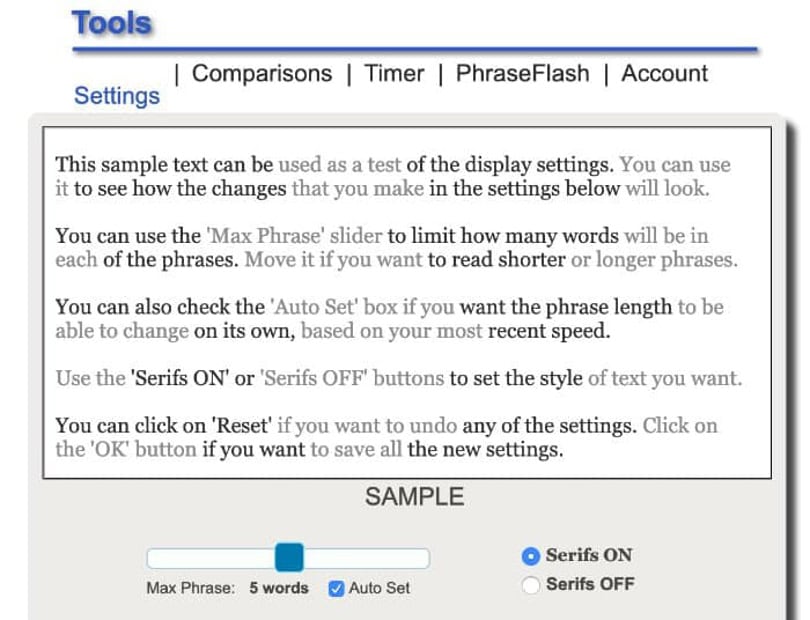
- You can adjust the settings to control the number of words per phrase. Or leave it on Auto Set for preloaded values.
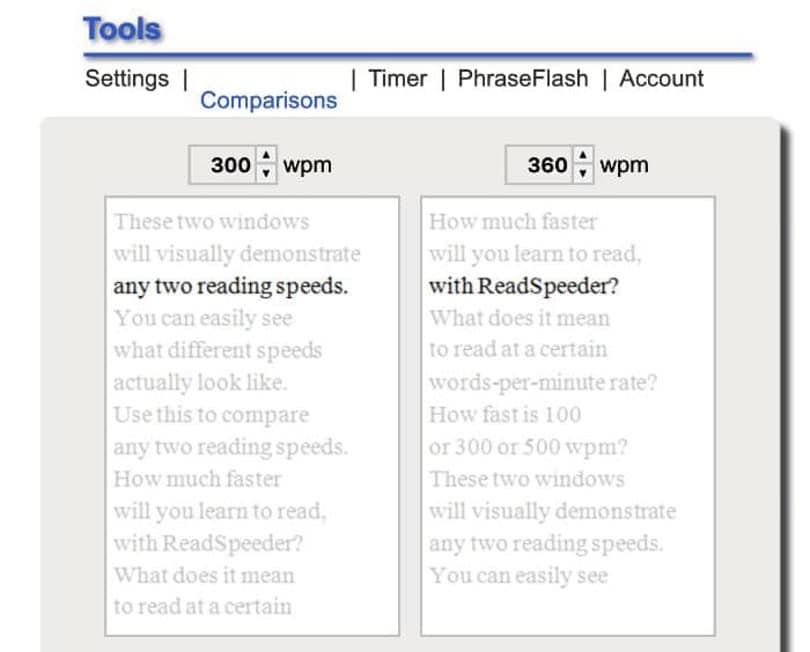
- Visual Comparison allows you to set your goals and compare them to your current progress. It is displayed as a left-side and right-side column.
- ReadSpeeder has a timer you can set to help with additional book reading. This function is very handy for tracking your overall progress.
- PhraseFlash is a fun activity to test your comprehension. The program displays a phrase and then replaces it with several images. You then choose the image that best describes the phrase.
- Your ReadSpeeder account saves all the information you input. Access the information anytime to view your progress. Reset the information to start over.
Reading tip: Tools and apps are useful, but most lasting gains come from a few solid tutorials you revisit. If you suspect habits, not software, are holding you back, do this. Start with a fundamentals guide on how to speed read, then move into practical lessons on skimming and scanning, and reading word chunks.
Where the Free ReadSpeeder Course Earns Its Keep
The Comprehension-First Argument Is Genuinely Different
A real methodological distinction.
Many speed reading tools treat comprehension as a side effect of pace training. Go fast enough, and retention will follow, somehow.
ReadSpeeder tries to invert that assumption. It treats comprehension as the primary variable and builds the speed improvement on top of it.
Thus, for beginners whose reading is genuinely slow due to poor focus or passive subvocalization, that distinction is certainly not marketing. It reflects a real learning gap that the course addresses directly.
Visualization as a retention tool.
The mental imagery training embedded throughout the lessons does something that raw RSVP practice cannot. It asks readers to actively engage with meaning rather than processing words mechanically.
I personally think this is where ReadSpeeder is most underrated. The approach is older than AI, less flashy than adaptive algorithms, and more effective for beginners than most free course alternatives I’ve reviewed.
Zero Cost, No Paywalls, No Friction at the Start
Genuinely free.
There is no premium tier, no trial period, and no subscription reveal after day three. The full 12-lesson program is accessible from the first session for every registered user.
In a market full of apps that bury features behind onboarding friction, that transparency is rarer than it should be. Registration, however, is required, but the process is straightforward. And the course starts immediately after.
For educators or students without a budget for reading improvement tools, ReadSpeeder’s complete accessibility is its most practical strength. And one that no amount of interface polish from competitors can replicate at this price point.
- Full 12-day course accessible immediately — no paywalls, no trial limits.
- Comprehension-first method addresses a gap that pure speed trainers miss.
- Visualization approach builds genuine retention, not just faster eye movement.
What ReadSpeeder Can’t Offer You
The Interface Is Dated — Noticeably So
Design from another era.
User feedback across multiple review sources consistently describes the ReadSpeeder interface as outdated. One widely cited phrase is “ReadSpeeder feels like a 2005 website.” I have known the course for more than a decade, and I agree it hasn’t changed much since then. Fair enough.
The visual design is still functional but ageing, and on modern monitors, it can feel incongruous alongside the tools it competes with. For some users, that aesthetic distance affects how seriously they engage with the content.
This matters more than it might sound. A dated interface signals stalled development. And for a tool that depends on daily habit-building over twelve consecutive sessions, first impressions of polish carry real weight.
They can determine whether users return on day two or quietly walk away after day one. The underlying method is sound. Unfortunately, the presentation works against it.
Desktop Only — No Mobile, No App
Browser-only is a hard constraint.
ReadSpeeder runs only in a desktop browser. No iOS app. No Android app. Not even a mobile-optimized interface.
For readers who do most of their reading on a phone or tablet—and I imagine there are many—the platform is effectively out of reach. What was ok several years ok is now just a hard boundary that quietly shuts out a large share of its potential audience.
Reading practice works best when it’s built into a daily routine. If your routine happens on a commute or a lunch break, ReadSpeeder cannot participate. That friction compounds quickly across a 12-day program that depends on consistent daily sessions.
Advanced Readers Hit the Ceiling Fast
Limited depth for experienced readers.
As mentioned, the 12-day program is specifically designed for beginner and intermediate readers. Thus, users who already read comfortably above 300 WPM, or who have completed dedicated speed-reading training, will likely exhaust what ReadSpeeder offers within the first few lessons.
The tracking data and concentration scoring are useful, but they don’t substitute for the adaptive difficulty and deeper analytical features that more developed platforms provide.
In a nutshell
- Interface is visibly dated — affects first impressions and daily return rates.
- Desktop browser-only; no mobile access of any kind.
- Limited depth for advanced readers; structured primarily for beginners.
- No community features, active support, or evidence of recent development updates.
ReadSpeeder Pricing: Free. One Upsell Option
It’s completely free.
The ReadSpeeder online course is 100% free. No subscription, no premium tier, no hidden upsells. Registration is required to access lessons, but the account is free, and the entire program is available immediately upon signing up. That model has been in place since launch and shows no signs of changing.
One optional purchase.
Developer David Butler offers a companion ebook — Speed Reading with the Right Brain — for $6.99 as a digital download or $19.99 in print. But don’t worry, it is not required to complete the course.
I’d consider ReadSpeeder worthwhile reading for anyone who wants to understand the methodology more deeply, but it is supplementary, not gated content.
- Full 12-day course: 100% free, no subscription, no premium tier.
- Optional companion ebook: $6.99 digital / $19.99 print — not required.
- No in-app purchases, no trial expiration, no paid unlock required.
How Readspeeder Compares
| Feature | Readspeeder | Spreeder | Speechify |
|---|---|---|---|
| Website | Visit website | Visit website | Visit website |
| Product Type | Free browser-based course | Cross-platform RSVP training app | AI text-to-speech platform |
| Platform | Desktop browser only | iOS, Android, Web, Desktop | iOS, Android, Web, Chrome |
| Core Method | Phrase reading + visualization | RSVP + guided training | Text-to-speech + AI |
| AI Features | None | Adaptive drills (limited) | AI summaries, voice AI |
| Comprehension Tools | Concentration score + visualization | Quizzes and speed drills | AI summaries assist retention |
| Progress Tracking | WPM chart, concentration score, CSV export | Detailed analytics dashboard | Limited |
| Structure | 12-day course, 30 min/day | Open-ended with guided programs | No structured training program |
| Pricing | 100% free | Lifetime access ~$67 | Free tier; Premium ~$139/yr |
| Best For | Beginners building comprehension habits | Structured cross-platform RSVP training | Audio-first AI reading workflow |
Where ReadSpeeder Fits in a Smarter Reading Workflow
Our 3-Step AI Speed Reading Method breaks reading into three deliberate phases: pre-reading with AI orientation, active reading with focused pace, and post-reading AI-assisted synthesis.
ReadSpeeder touches the foundational layer beneath all three — the habits and mental approach a reader brings to the table before any tool is involved. Used as a starting point rather than an ongoing tool, a structured comprehension course can reset how you engage with text.
Readers who complete the 12 lessons and internalize the phrase-reading approach often find that AI tools and RSVP trainers become more effective afterward — because the underlying reading habit is cleaner. Think of ReadSpeeder as free prep work, not a parallel system.
What ReadSpeeder cannot do is participate in a connected reading workflow.
As I mentioned, it doesn’t come with any AI integration, there’s no export to note-taking platforms, and no bridge to anything in your reading stack. Its role is front-loaded — it builds a foundation — then it steps back.
Pairing it with an AI text-to-speech app, such as Speechify, for content consumption, or using ChatGPT for pre-reading orientation, builds the layer on top that ReadSpeeder never claims to provide. Again, our full speed reading apps guide covers those combinations in more depth.
In a nutshell
- Best used as a foundational course before layering in AI or RSVP tools.
- No workflow integration; its contribution is to the reader’s habits, not their toolkit.
- Front-loaded value — most useful at the start of a reading improvement effort.
Is Readspeeder Worth Your Time? The Honest Case For and Against
Rating: 6 / 10. ReadSpeeder is a more considered product than its dated interface suggests. The phrase-based, comprehension-first methodology is genuinely different from the RSVP trainers and AI platforms it sits alongside.
And for beginning readers, that difference is meaningful. It’s free, structured, immediately accessible, and asks more of a reader’s attention than most free tools bother to. That is earned credit, not faint praise.
The limitations accumulate predictably. The interface is ageing and works against daily habit-building. The desktop-only constraint removes it from most modern reading routines entirely.
More advanced readers will also exhaust it quickly. And in 2026, the absence of any AI layer — even something as simple as a comprehension check — makes ReadSpeeder feel like a product that has reached a ceiling it isn’t trying or wanting to break through.
Overall, it’s a good starting point. But it is rarely the right long-term answer.
Thus, use it if you’re a beginner building reading habits from scratch, a teacher looking for a free structured classroom tool, or a reader who suspects comprehension — not speed — is the real bottleneck in your reading.
Skip ReadSpeeder if you read primarily on a phone or tablet, if you’ve already developed deliberate reading habits, or if you need a connected workflow that integrates with your existing reading and note-taking tools.
Better alternatives for different needs: Spreeder offers a more comprehensive cross-platform RSVP training environment with structured progression and detailed analytics. Speechify makes more sense if you want AI features and an audio-first reading workflow built for modern, mobile-first habits.
ReadSpeeder — Quick Reference
| Category | Detail |
|---|---|
| Product Name | Mobile users, advanced readers, and AI-integrated reading workflows |
| Category | Free browser-based speed reading course and software |
| Developer | David Butler |
| Platform | Desktop browser only — no mobile, no iOS, no Android app |
| Method | Phrase-based reading + visualization (not RSVP) |
| Program Structure | 12 lessons, ~30 min/day |
| Pricing | 100% free — no subscription, no premium tier |
| AI Features | None |
| Best For | Beginners and students building foundational reading habits |
| Not For | Mobile users, advanced readers, AI-integrated reading workflows |
| Verdict Score | 6 / 10 |
| Alternatives | Spreeder, Speechify |
| Official URL | readspeeder.com |
Bottom line – ReadSpeeder is a learning opportunity that often goes under the radar. It is popular among many people around the world, and, apart from the book offered, it costs you nothing.
Although it has been available for so long, it shows few signs of aging. However, expect some rather outdated styles and graphics here and there. ReadSpeeder is worth a try, and to try strategies that derive from a different point of view and focus.
Interesting sources:
If you like to see what the evidence actually says about speed reading and reading tech, it’s worth dipping into original research rather than app marketing. These non‑commercial sources on RSVP reading, bionic reading, eye movements, regressions, comprehension, and retention are a solid starting point:
Curious what science says about RSVP, bionic reading, eye fixations, and regressions? These original studies and reviews are a good starting point:
- Modern Speed‑Reading Apps Do Not Foster Reading Comprehension (Rayner et al., 2016):
https://pubmed.ncbi.nlm.nih.gov/29461715/ - Perceptual Learning in an RSVP Reading Task (Chung, 2014):
https://pmc.ncbi.nlm.nih.gov/articles/PMC4274879/ - Guiding the Gaze: How Bionic Reading Influences Eye Movements (2025):
https://pmc.ncbi.nlm.nih.gov/articles/PMC12565662/ - Eye Movements and Fixation‑Related Potentials in Reading – Review (Schuster et al., 2020):
https://pmc.ncbi.nlm.nih.gov/articles/PMC7157570/ - A Cognitive Model of Regressive Eye Movements During Reading (von der Malsburg & Vasishth, 2020):
https://pmc.ncbi.nlm.nih.gov/articles/PMC7888242/
Disclosure: This post contains affiliate links to some of our partners. Speed Reading Lounge may receive a commission for purchases made through these links. It does not add any extra costs. All reviews, opinions, descriptions, and comparisons expressed here are our own.