
The Reader’s Edge Review
Reader’s Edge review: solid reading trainer, uncertain future

Reader’s Edge is desktop speed reading software developed by the Literacy Company. It runs on Windows PCs or via a browser-based online version, with identical core content across both platforms.
The software targets slow readers who want a structured, exercise-driven path to faster processing and better comprehension. It sits firmly in a niche that values methodology over convenience, closer to a personal trainer than a fitness app.
The Literacy Company’s background is limited in available documentation, but its product focus is clear: reading improvement through repeatable, measurable drills. This is not a flashy tool. It was built with a specific pedagogical philosophy, and that philosophy runs through every feature.
Unfortunately, Reader’s Edge hasn’t seen a verifiable major update in several years. It hasn’t disappeared either, which says something about the audience it built. Whether that audience still includes you is what this review is here to answer.
Who Actually Benefits

The Primary Audience
Windows desktop users, students, professionals, and institutional learners who want a structured, self-paced program rather than a casual speed-reading experiment.
If your workflow involves processing long documents, research papers, or professional reports, Reader’s Edge was built with you in mind. Measurable progress, not approximate improvement, is the pitch here.
Institutions
Reader’s Edge includes a dedicated Network version, making it one of the few tools in this space designed for classroom or organizational deployment.
Its institutional pedigree is genuine: verified purchasers include the U.S. Army, NASA, numerous colleges, and the Boys and Girls Club. That list is not marketing copy. It is a track record.
Who Should Look Elsewhere
Mobile-first learners will find nothing on iOS or Android. The desktop version is Windows only, though Mac users can access the full feature set through the browser-based online version.
If you prefer gamified learning, free access tiers, or AI-assisted features, this software will feel like stepping into a different decade. Casual browsers wanting a commitment-free trial should move on.
Reader’s Edge Overview – Basic and Professional Version
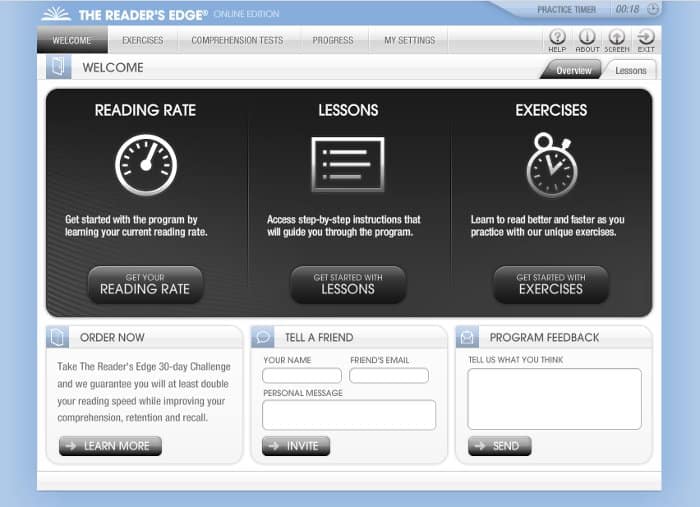
If you can get your hands on a license, this will include the following features and exercises.
- 8 exercises in the Basic version. 12 in the Pro version.
- 200+ comprehension tests
- Step-by-step lessons.
- Import your own material to read
- Word-Association Training
- Exercise Coach
- Assessment and progress reports.
- Personalized user settings.
- Free updates for life.
The exercises are the foundation of the Reader’s Edge software. They teach you the essential skills you need to boost your pace. They are:
- Motility training, which increases your ability to process information.
- Horizontal Span helps you decrease sub-vocalizing.
- Vertical Span enables you to process groups of words.
- Marquee Text scrolls text to simulate the movement of your eyes.
- Highlight Text reduces eye fixations by increasing the number of words read.
- Word Groups increase the number of words read in groups.
- Say It, which displays letters and sounds.
Now, let’s take a closer look at the features and exercise types in Reader’s Edge.
Reading tip: Tools and apps are useful, but most lasting gains come from a few solid tutorials you revisit. If you suspect habits, not software, are holding you back, do this. Start with a fundamentals guide on how to speed read, then move into practical lessons on skimming and scanning, and reading word chunks.
The Reader’s Edge Training Architecture
1. Eye Movement and Processing Speed
How the Sequence Works
I want to start where Reader’s Edge starts: with the mechanics of how your eye actually moves. Motility Training targets the root inefficiency, training the eye to process information more fluidly across a line.
Horizontal Span attacks subvocalization, the habit of silently pronouncing each word that anchors reading speed to speaking pace. Vertical Span conditions the eye to absorb groups of words rather than one word at a time.
Building Momentum
From there, the sequence builds logically outward. Marquee Text scrolls content at a controlled pace, simulating smooth eye movement and penalizing the urge to regress.
Highlight Text reduces fixations by progressively increasing the number of words highlighted per stop. Word Groups reinforces that same chunking behavior in a different format. Each drill addresses a specific reading weakness, not a randomly assembled toolkit.
What strikes me here is the design intent. Most speed reading apps give you one pacing tool and call it a curriculum. Reader’s Edge maps the failure chain, eye movement, fixation, sub-vocalization, and regression, and addresses each link in order.
- Motility Training targets poor eye movement at the root
- Horizontal and Vertical Span dismantle subvocalization and single-word fixation
- Marquee Text, Highlight Text, and Word Groups reinforce momentum through progressive exposure
2. Comprehension and Vocabulary
The Testing Infrastructure
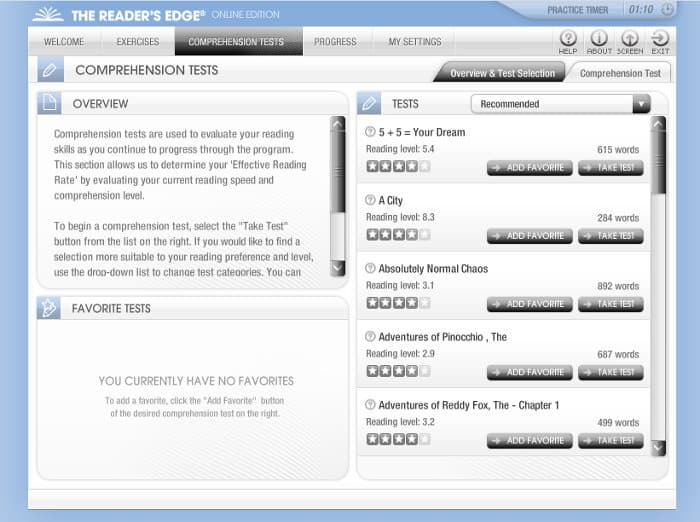
Speed without comprehension is skimming with extra steps. Reader’s Edge addresses this more honestly than most tools in its price range. 200+ comprehension tests sit alongside the speed drills, covering diverse subjects from various authors and content providers, including business topics.
That last detail matters. Most competitors in this space default to student-level reading material. Seeing business content in the test library signals that Reader’s Edge takes professional users seriously.
Vocabulary Tools
Word-Association Training builds contextual vocabulary through a built-in dictionary with voice-to-text support. Say It handles phonetic training, more useful for language learners or younger readers than fluent adults.
Neither feature is AI-powered. The dictionary is functional, not intelligent. But for a one-time purchase at this price point, the comprehension infrastructure is substantive.
- 200+ tests provide real accountability, spanning diverse subjects, including business content
- Word-Association training builds contextual understanding, not just decoding speed
- Say It is a secondary feature for most adult learners
3. The Exercise Coach and Progress Tracking
Why Direction Matters
Here is where Reader’s Edge earns genuine distinction. The Exercise Coach monitors progress and tells you specifically what to work on next. I find this feature deceptively important.
Because self-directed learning collapses most often not from lack of motivation but from lack of direction. Not knowing what to do after the first session is how programs get abandoned.
The Feedback Loop
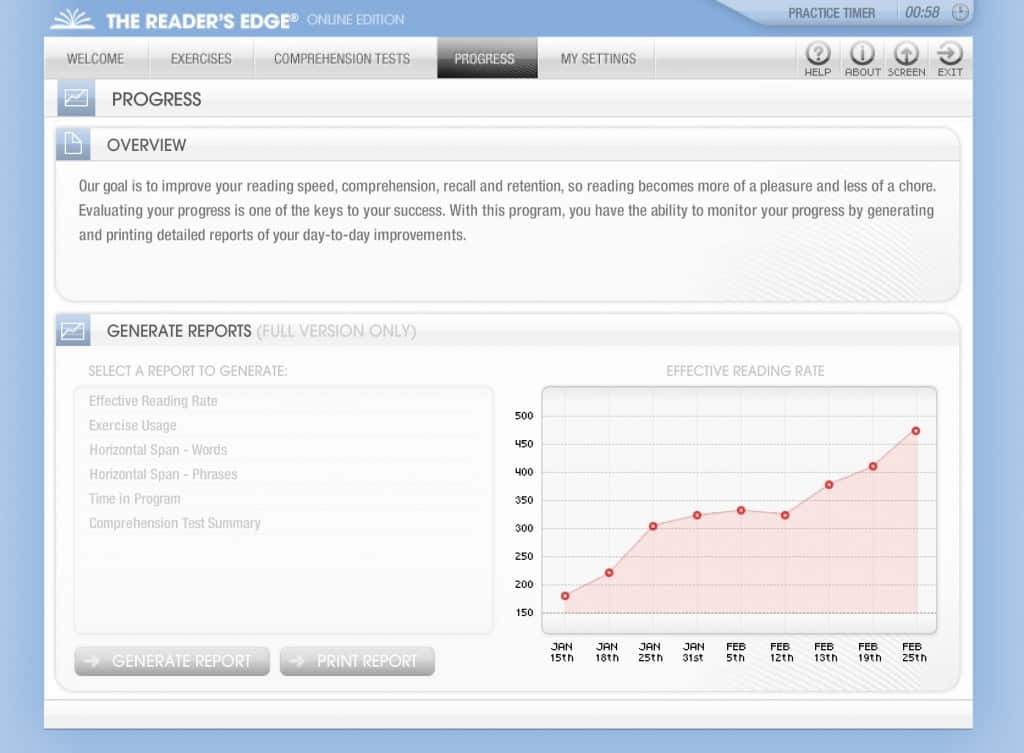
The Exercise Coach solves that problem directly. Combined with Assessment and Progress Reports, which can be printed or saved, it creates a functional feedback loop. You practice. You are tested.
The software tells you where to focus. Step-by-Step Lessons formalize this into a guided curriculum, so the experience resembles a speed reading course rather than a loosely organized set of tools.
- Exercise Coach provides personalized direction without requiring human instruction
- Progress reports make improvement visible, printable, and measurable
- Structured lessons reduce the dropout that comes from uncertainty
4. Import and Multi-Language Support
Your Own Material
The ability to import your own material is practically significant, and I think it is undervalued in most discussions of this software. Training on pre-loaded sample texts is one thing. Applying that speed to your own research papers, reports, or study materials is another entirely. Reader’s Edge supports clipboard, document, and network imports across all versions.
Language and Accessibility
That import capability extends to five languages: English, Spanish, French, Chinese, and Arabic. Multi-language import is rare at this price point. Most competitors in this space don’t offer it. For bilingual professionals or language learners working across reading systems, this feature alone justifies a serious look.
One more verified feature deserves attention. Reader’s Edge includes support for dyslexia and learning difficulties, allowing activities to be displayed in single- or multiple-word layouts, with font controls to minimize visual distraction. Most tools in this category ignore this entirely.
- Multi-language import covers English, Spanish, French, Chinese, and Arabic
- Dyslexia-friendly display modes and font controls serve learners with reading difficulties
- Import capability extends to the clipboard, document files, and network sources
What Reader’s Edge Gets Right – Pros
The software’s structural integrity is its clearest strength. Most speed-reading tools give you a pacing drill and call it training. Reader’s Edge builds a layered progression: eye-movement mechanics, word grouping, comprehension testing, vocabulary development, and personalized coaching, all in a deliberate sequence. I find that difference meaningful, not cosmetic.
The Exercise Coach is the feature I keep returning to. Personalized direction inside a self-paced product is genuinely useful. It changes the experience from a passive tool to an active program.
Multi-language support and dyslexia accommodation are both rare in this category. Professionals and students working across languages, or learners with reading difficulties, face almost no direct competition in this specific combination of features. That is a real gap Reader’s Edge fills.
Reader’s Edge Pros:
- Good variety of exercises
- Excellent subjects and variety for the comprehension tests.
- Guided lessons with an exercise coach
- Ability to import your own texts.
- Free future updates
Reader’s Edge vs Spreeder
| Feature | Reader’s Edge | Spreeder |
|---|---|---|
| Price | $79.95 / $149.95 | $79.95 lifetime |
| Platform | Windows, Web | Online, Mobile |
| Mac Desktop | No | Yes |
| Mobile | No | Yes |
| AI Features | None | None |
| Free Tier | No | Limited |
| Comprehension Tests | 200+ | Limited |
| Dyslexia Support | Yes | No |
Reader’s Edge Problems and Downsides
To be honest, Reader’s Edge is no longer actively maintained. And prices have dropped significantly. Thus, it doesn’t make sense to give you any pricing tables here. If you still fancy this software, you can get it on Amazon for less than $20, down from $149 or $79 before. Ok, it is still old.
A license includes exercises, Continuous Text, High-Speed practice, Paced Reading, and Timed Reading, plus Audio-Text readings and editable vocabulary lists. Paced Reading and Timed Reading are genuinely useful for serious practitioners.
Multi-Device Limitations
There is also the multi-device constraint. Pro authorizes two computer installations with unlimited desktop users or five accounts online. For a solo learner who works across multiple devices, this feels arbitrary in 2026.
Data sync between computers exists, but, as independent reviewers note, it is not a feature that justifies a premium when competitors include it as standard.
The Update Question
Underneath the pricing question sits a deeper concern. As mentioned, the desktop version has not received a verifiable major update in several years. Lifetime updates are promised at purchase.
That is a genuine commitment, but it is softer than it sounds when there is no evidence of recent development activity. The online version may receive updates more frequently. Whether it does is not confirmed.
No Mobile, No AI
There are no native apps for iOS, Android or Mac desktop. Reader’s edge doesn’t have any AI features either. I do not raise this as a checklist complaint. I raise it because the category is moving toward adaptive, AI-assisted learning, while Reader’s Edge stands still.
Reader’s Edge Cons:
- Outdated product without updates
- No mobile support, no native Mac desktop, browser access is the workaround
- Zero AI integration, as competitors and workflows increasingly depend on it
- The amount of preloaded material is less than that of other similar products.
- There are no games.
Reader’s Edge and the AI Reading Workflow
Where it fits into AI reading
I want to be specific here, because the framing matters. Reader’s Edge does not belong at Step 1 of the 3-Step AI Reading Method.
Step 1 is the AI Summary Scan, where tools like ChatGPT or Scholarcy extract the skeleton of a document before you commit to reading it. Reader’s Edge has no role there. It is a traditional skills-building tool, not an AI-integrated one.
Step 2: Where the skills apply
Where Reader’s Edge fits is Step 2: Selective Reading with Traditional Techniques. That step is where hand pacing, chunking, and focused visual attention come back, applied strategically to the sections that actually warrant your full effort.
The drills in Reader’s Edge build exactly those mechanics: reduced fixations, better chunking, faster eye movement, and improved comprehension retention. The skills trained here are those on which Step 2 depends.
Reader’s Edge limitation
Reader’s Edge builds those skills in isolation. It has no connection to AI tools, no integrations with summarizers, and no export of progress data to other systems. Once you close the software, it has no relationship with the rest of your workflow.
That makes it a foundation layer, valuable for developing the mechanics, but not a partner in the process. You assemble the combination yourself.
If you are comparing software options in this space, the speed reading apps overview provides useful market context.
Reader’s Edge Review Verdict
Review Rating: 6/10.
Reader’s Edge earns its score through genuine pedagogical structure. The layered exercise system, the Exercise Coach, 200+ comprehension tests, dyslexia support, and multi-language import are real differentiators.
Overall, Reader’s Edge is, or was, a good product with a wide variety of exercises and activities. It certainly helps you develop your pace and retention as long as you use the exercises. However, it is not as economical as other programs. And it is old and outdated.
The score stays at six because of what surrounds that core. Update recency is unverifiable. The Pro jump is hard to justify for solo learners. No mobile, no native Mac desktop, no AI features. The category is accelerating. Reader’s Edge is not.
Buy It If
You are a Windows user, a student or professional who wants structured training, or an institution needing a network-deployable program with comprehension tracking and no recurring licensing costs.
Skip It If
You work primarily on mobile, need a native Mac desktop client, want AI-enhanced features, or expect visible evidence that the software is still actively developed.
Consider Instead
For a free starting point, Spreeder gives immediate access to RSVP-style practice without a purchase commitment.
Reader’s Edge in a nutshell
| Software Name | Reader’s Edge |
| Developer | The Literacy Company |
| Category | Speed Reading Software |
| Platform | Windows (Desktop), Web (Browser) |
| Mobile Support | None |
| Mac Support | Online/browser version only; no native desktop |
| AI Features | None |
| Pricing Model | One-time purchase (Basic $79.95, Pro $149.95, Network) |
| Free Trial | Not confirmed |
| Languages Supported | English, Spanish, French, Chinese, Arabic |
| Best For | Windows users, students, professionals, institutions |
| Key Features | Exercise Coach, 200+ Comprehension Tests, Motility Training, Dyslexia Support, Multi-Language Import |
| Notable Clients | U.S. Army, NASA, colleges, Boys and Girls Club |
| SPL Rating | 6/10 |
About the Literacy Company (Education Administration Programs) – 1
Interesting sources:
If you like to see what the evidence actually says about speed reading and reading tech, it’s worth dipping into original research rather than app marketing. These non‑commercial sources on RSVP reading, bionic reading, eye movements, regressions, comprehension, and retention are a solid starting point:
Curious what science says about RSVP, bionic reading, eye fixations, and regressions? These original studies and reviews are a good starting point:
- Modern Speed‑Reading Apps Do Not Foster Reading Comprehension (Rayner et al., 2016):
https://pubmed.ncbi.nlm.nih.gov/29461715/ - Perceptual Learning in an RSVP Reading Task (Chung, 2014):
https://pmc.ncbi.nlm.nih.gov/articles/PMC4274879/ - Guiding the Gaze: How Bionic Reading Influences Eye Movements (2025):
https://pmc.ncbi.nlm.nih.gov/articles/PMC12565662/ - Eye Movements and Fixation‑Related Potentials in Reading – Review (Schuster et al., 2020):
https://pmc.ncbi.nlm.nih.gov/articles/PMC7157570/ - A Cognitive Model of Regressive Eye Movements During Reading (von der Malsburg & Vasishth, 2020):
https://pmc.ncbi.nlm.nih.gov/articles/PMC7888242/