
Acceleread App – Review
Acceleread: A Performance Reading Trainer for iPad and iPhone
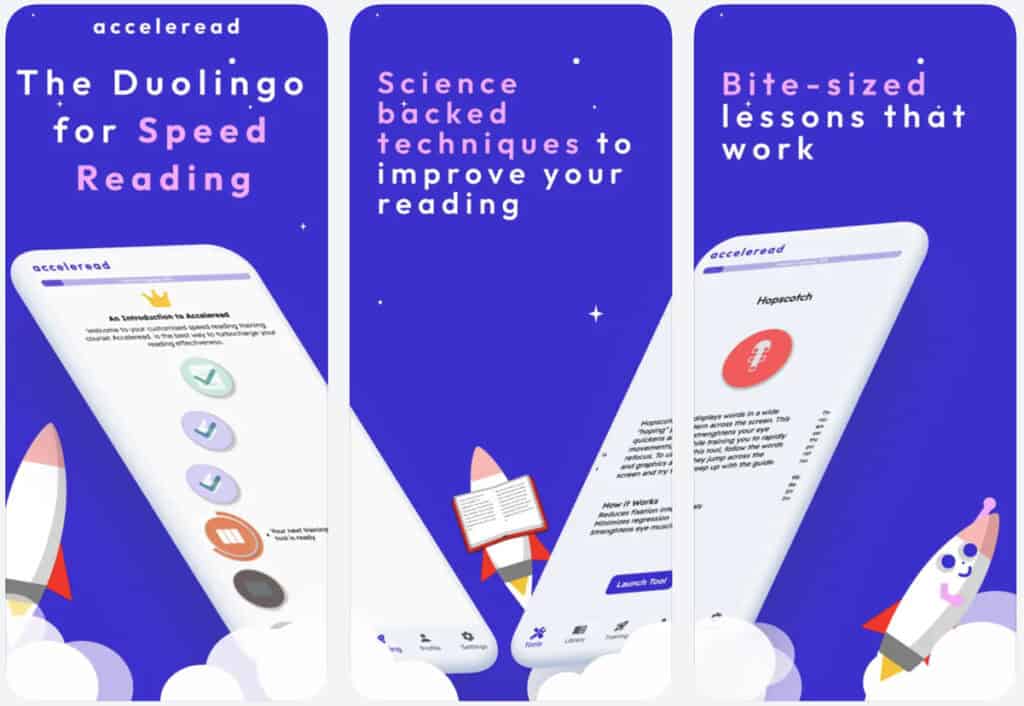
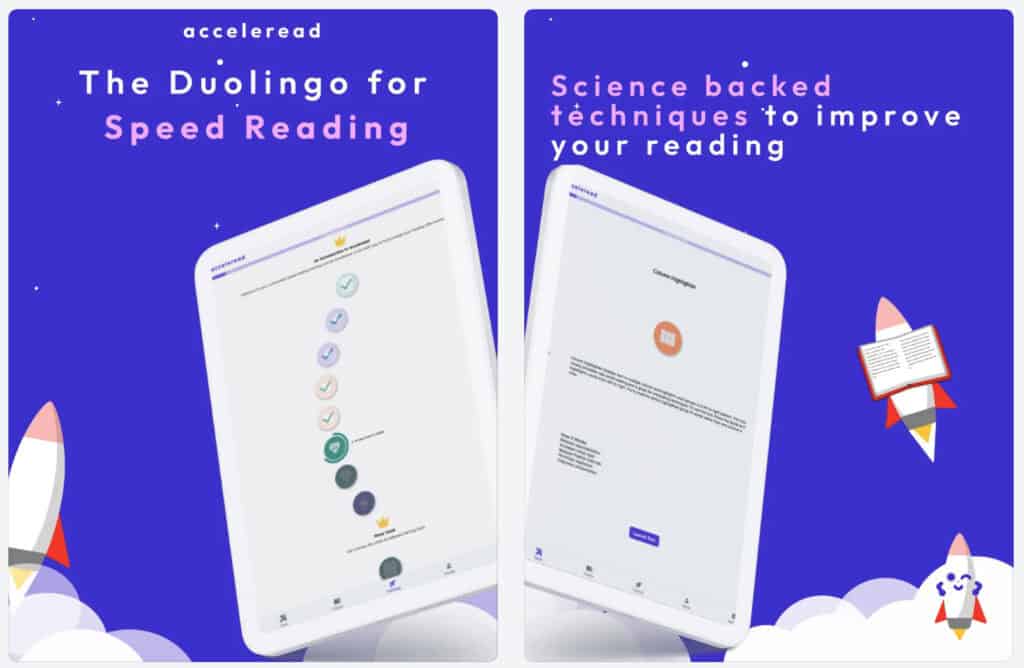
Acceleread positions itself as the Duolingo of speed reading, and that comparison does real work. It carries the same logic: short daily sessions, adaptive progression, visible milestones.
What makes the Acceleread app genuinely interesting isn’t the headline promise of reading three times faster. It’s the feature that allows comprehension and speed to be trained together, not traded off against each other. And I find that tension worth examining before recommending anything.
The Acceleread app is available on iOS, Android, Mac with Apple M1 or later, and Apple Vision Pro. It delivers personalized drills, guided courses, and WPM tracking, all calibrated to your starting level and advancing automatically as you improve.
Developer GBB Components Pty Ltd builds and maintains it, with active updates still being deployed. That’s a more reassuring picture than the app’s obscure listing suggests at first glance.
I recommend reading our overview of the best speed reading apps to learn about suitable alternatives and get the full picture. But here we go.
Who This Is Built For — And Who Should Look Elsewhere
The core audience is someone who wants a drill-based training program on their phone. Think of a medical student grinding through dense textbooks, a professional buried in weekly reports, or an ESL learner building reading fluency in a second language.
Acceleread fits commutes, lunch breaks, and focused short sessions. It doesn’t demand much from your calendar. It demands consistency from you.
Other use cases include language learners wanting vocabulary and reading speed built simultaneously, and self-improvement readers who respond to milestone tracking and visible WPM progress. Progress dashboards motivate some people deeply. For others, they’re noise. Acceleread assumes you belong to the first group.
Who should skip it:
Readers wanting AI-powered summarization or ChatGPT integration will be disappointed. If you need school-grade quizzing with library integration, Renaissance Accelerated Reader is the more appropriate tool.
And if long-term, completely free access is a hard requirement, the subscription structure creates a real problem, one worth understanding before you invest your first week.
How does it work?
- Upon startup, Acceleread measures your initial reading rate and then suggests ways to improve by placing you on a suitable course.
- There are three levels: beginner, intermediate, and advanced, each of which refines your skills gradually.
- Once the current level is achieved, it will gradually place you onto the next level by itself. No fiddling required!
Acceleread – Features and Highlights
Combined, these highlights provide you with one powerful package, of which the key features are demonstrated below:
- Informative, legible lessons that tell you where you are going wrong and where you are going right in your development of better reading.
- The ability to import your own book collection into Acceleread allows you to read and learn techniques in tandem.
- Easy to follow and fun statistics, showing everything from course completion to a number of words read and more!
Reading tip: Tools and apps are useful, but most lasting gains come from a few solid tutorials you revisit. If you suspect habits, not software, are holding you back, do this. Start with a fundamentals guide on how to speed read, then move into practical lessons on skimming and scanning, and reading word chunks.
Acceleread Training System, Explained Honestly
1. Adaptive Courses That Actually Advance
The most defensible thing about Acceleread is its training architecture. After an initial reading rate assessment, the app assigns a personalized plan based on your WPM, skill level, and goals.
It advances levels without requiring manual adjustment. For beginners, especially, that automatic progression removes a common source of friction: not knowing when you’re ready to move on. I think that matters more than it sounds, because most people abandon training tools at exactly that moment of uncertainty.
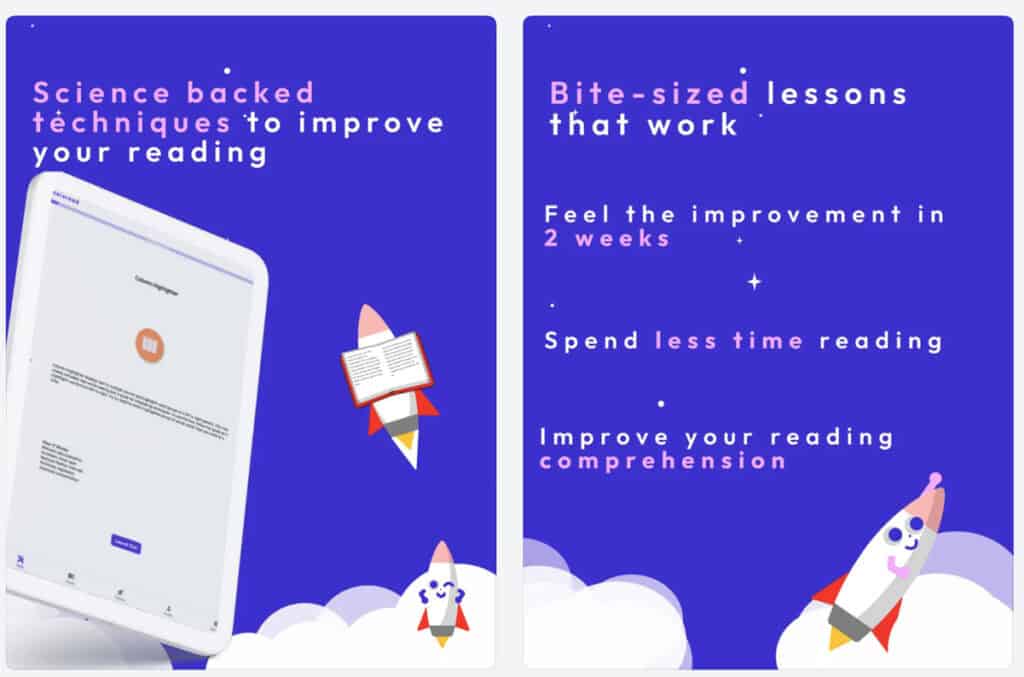
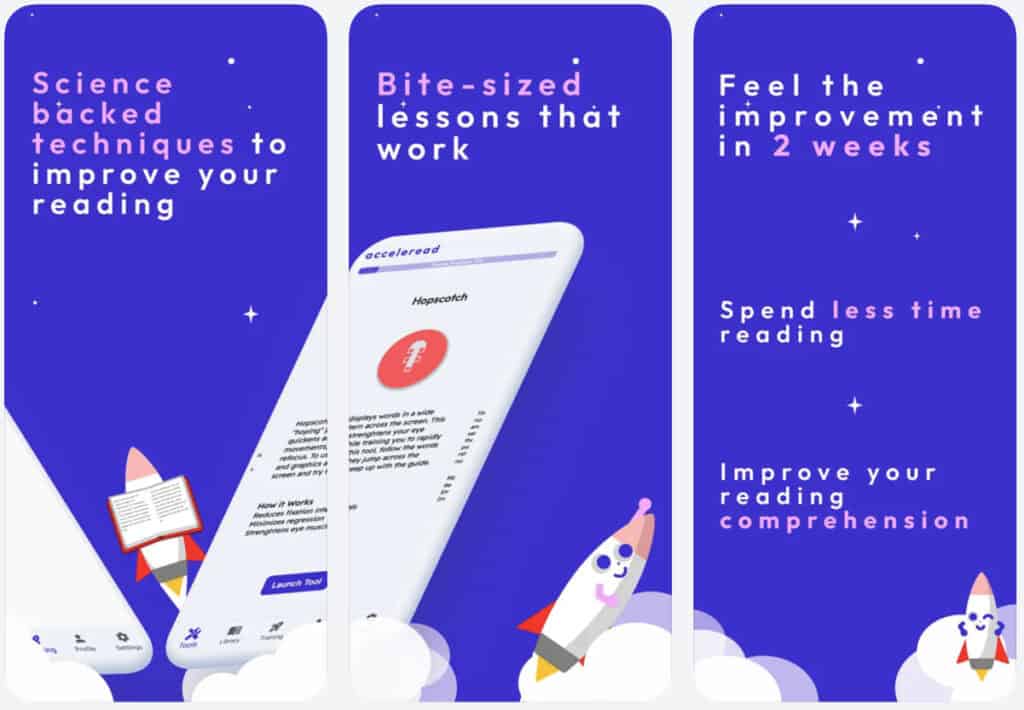
Training plans are designed to show results in as little as two weeks. That’s a concrete, honest timeline, and the structure gives the training real shape rather than leaving users wandering through isolated drills with no sense of forward movement.
In a nutshell
- Personalized plans calibrated to the initial WPM assessment
- Automatic level advancement without user input
- Two-week training plans with structured daily progression
- Compare alternative speed reading courses similar to Acceleread.
2. Vision Span and Regression Drills
Regression, the habit of re-reading words and phrases, is one of the primary reasons reading speed stalls. Most readers do it constantly and unconsciously. Acceleread uses dynamic pacers to discourage it, forcing the eye forward through text.
Vision span exercises train peripheral reading, helping users take in more words per fixation. These are established techniques found in most serious speed-reading methodologies. Thus, Acceleread’s implementation of them is quite functional rather than gimmicky.
The drills are not glamorous. They feel like practice, which is exactly what they are. That plainness is a feature, not a flaw.
In a nutshell
- Dynamic pacers discourage regression during reading
- Vision span drills build peripheral word recognition
- Techniques align with established speed reading methodology
3. Content Variety and Personal Imports
Practice doesn’t have to happen on generic passages. Users can import personal book collections and apply technique drills to their actual reading material. There’s also support for pairing audiobooks with reading practice to improve retention. Fiction, non-fiction, and articles are all in the mix.
This matters because transfer is the whole point. Reading faster on a random passage is easy. Reading faster on a textbook chapter or a work report is the actual goal, and the personal import feature keeps training anchored to that reality.
In a nutshell
- Import personal books for technique practice on real material
- Fiction, non-fiction, and article content supported
- Audiobook pairing available for comprehension and retention
4. Language Learning Applications
Acceleread includes specific tools for ESL learners and polyglots. Vocabulary building, fluency development, and comprehension work are framed as part of the reading speed training.
For a language learner wanting to build reading fluency alongside speed, this dual-purpose angle is genuinely useful. It’s not a full language learning platform. Don’t expect Duolingo-level vocabulary scaffolding. As a complement to other language studies, though, the overlap is real and practically valuable.
5. Progress Tracking and Analytics
WPM improvements, comprehension scores, focus metrics, course completion rates, total words read, and milestone tracking are all available. Users can share statistics.
For people motivated by data and visible progress, I’d call this a meaningful feature. But for someone who just wants to read faster without monitoring every metric, it’s easy enough to ignore. The dashboard doesn’t demand your attention. It simply waits.
Reading tip: If you want AI to actually save reading time, start with a focused overview instead of scattered tips. The main AI speed reading guide walks you through my 3‑Step AI Speed Reading Method and shows where tools, AI summaries, and listening apps realistically help.
From there, you can dive into tutorials on AI‑supported reading workflows such as our ChatGPT for speed reading guide — and compare carefully selected AI speed reading apps and text-to-speech apps or AI summarization tools before committing to any subscription.
Where Acceleread Gets It Right
I keep returning to the structural logic here, because it’s genuinely sound. Adaptive progression, regression-reduction drills, and vision span training are not marketing constructs.
These techniques have been documented as valuable in speed-reading research. The Acceleread app organizes them into a coherent daily practice framework, which is harder to execute well than it sounds.
The content import feature is a quiet differentiator. Practicing on material you actually care about increases engagement and real-world transfer. Bringing your own books into the training system is more useful than grinding through pre-loaded generic passages. It keeps the training honest.
For ESL learners, the dual focus on reading speed and comprehension fills a gap that most dedicated speed reading trainers ignore entirely. The availability across mobile, Mac, and Vision Pro significantly widens the audience.
Short daily sessions also fit the actual schedules of busy students and professionals, and the multi-platform access means the training follows you rather than waiting at a single device.
Know Acceleread’s Issues Before You Download
Pricing
The paywall structure is where I’d ask you to slow down. The app is free to download, but full access requires a paid subscription. Three tiers are available: one week at $8.99, one month at $12.99, or three months at $14.99.
There’s no confirmed free trial period in the current data. That means you’re being asked to commit money to a two-week training program without a guaranteed free window to evaluate it first.
The three-month plan is the most economical, but it’s also the most trust-dependent purchase of the three.
The copyright notice is unusual.
GBB Components Pty Ltd develops the app, but the listed copyright holder is Rendezvous Dating Inc. I’m not suggesting anything improper. I am suggesting that a speed reading trainer with a dating company in its legal paperwork is the kind of detail a careful buyer notices.
It doesn’t disqualify the product. It raises a reasonable question about corporate structure that the app does nothing to answer.
No AI features exist here.
Marketing language mentions “cutting-edge tools” and “adaptive technology,” but there’s no integration with any AI system. The personalization is algorithm-driven, not AI-driven.
That distinction matters. And it’s not automatically a weakness, but it is a real gap for readers who want to combine speed reading practice with AI-assisted comprehension tools. The marketing papers over that gap rather than acknowledging it honestly.
No Android-native desktop access.
Mac and Vision Pro users are covered. Android users on desktop workflows are not. If your heavy reading happens on a Windows or Linux machine, Acceleread won’t reach you there.
In a nutshell
- Subscription required for full access, with no confirmed free trial period
- Copyright held by an unrelated company, raising unanswered structural questions
- No AI integration despite “adaptive technology” marketing language
- No desktop access for Android or non-Apple platforms
Acceleread Pricing
Acceleread is free to download on iOS, Android, Mac, and Vision Pro, with in-app purchases required for full access. Current verified pricing tiers are:
- 1 Week Premium: $8.99
- 1 Month Premium: $12.99
- 3 Months Premium: $14.99
Subscriptions auto-renew unless canceled 24 hours before the renewal date. That detail deserves plain-language prominence, because it’s the kind of thing people miss and then resent.
The three-month plan works out to roughly $5 per month, which is reasonable for a structured training program. The one-week plan, at $8.99 for seven days, is harder to justify unless you’re testing before committing to a longer tier.
I’d always recommend verifying current pricing directly on the App Store or Google Play listing before downloading, since pricing structures can change without notice.
In a nutshell
- Weekly plan costs more per day than monthly or quarterly options
- The three-month plan offers the best per-month value at roughly $5
- Auto-renewal cancellation window is 24 hours before the renewal date
- Verify current pricing on official store listings before purchasing
Acceleread and AI Reading Workflows
Acceleread sits squarely in Step 1 of the 3-Step AI Speed Reading Method, the preparation and speed-building phase, where the goal is to increase raw reading rate before layering in comprehension and retention strategies.
That’s a specific, bounded role. I think it’s worth naming clearly, because the app is best understood as a training tool rather than a reading tool. The distinction matters when you’re deciding what else you need alongside it.
Used in isolation, it trains the mechanical side of fast reading: reducing regression, expanding vision span, and building WPM. That’s valuable. What it doesn’t do is help you extract meaning from complex material, generate summaries, or connect ideas across sources. That’s where AI tools come into play.
A practical workflow pairs Acceleread’s drill-based training with AI-assisted reading strategies for actual study or research sessions. The physical reading speed you build here becomes more useful when you also know how to use a tool like ChatGPT to pre-process complex texts before reading them at pace.
For a complete picture of how speed reading tools fit together, the AI Speed Reading Guide maps the full methodology. Comparing Acceleread against other mobile options? The speed reading apps overview covers the broader landscape.
Acceleread’s role is clear: it’s a training gym for your reading mechanics. The rest of the workflow, comprehension, synthesis, and retention, happens elsewhere.
Acceleread Review Verdict: Solid Foundation, Real Uncertainty
Our review rating is: 6.5/10.
For those actually looking to learn accelerated reading techniques, both in terms of words per minute and rate of comprehension, Acceleread is still a decent app.
Acceleread’s training methodology is legitimate. The adaptive course structure, vision-span drills, regression-reduction techniques, and content import feature form a coherent speed-reading training program.
For a student building study skills or a professional wanting to work through dense reports faster, the core system delivers what it promises. I believe that, straightforwardly.
The score holds below 7 because real questions remain. The copyright situation is unusual and unexplained. No confirmed free trial period means the purchase requires trust before proof.
There are also no AI features despite marketing language suggesting otherwise. The product works. The surrounding context gives a careful buyer pause.
Download Acceleread if
Try it if you want structured, drill-based WPM training across mobile and Mac, you’re an ESL learner wanting speed and fluency in one app, or you prefer guided courses with clear progression over self-directed practice.
Skip Acceleread if
Avoid the Acceleread app if you want genuine AI integration, need Windows or Android desktop access, or require a transparent developer story before committing your practice time and subscription budget.
Alternatives worth considering: Outread offers a cleaner reading tool with broader content integration. Spreeder is a powerful RSP reader and training program. Or Iris reading can offer in-person or online speed reading classes if you want to focus on the techniques.
Acceleread App: Quick Reference
| Feature | Detail |
|---|---|
| Platform | iOS, Android, Mac (Apple M1+), Apple Vision Pro |
| Free Tier | Yes — WPM assessment, basic courses, drills, tracking |
| Paid Access | Weekly $8.99 / Monthly $12.99 / 3-Month $14.99 |
| AI Features | None confirmed |
| Best For | Students, professionals, ESL learners wanting structured WPM training |
| Not For | Windows/Android desktop users, AI workflow seekers, fully free long-term use |
| App Store Rating | Not verified in current data |
| Developer | GBB Components Pty Ltd |
| Copyright | Rendezvous Dating Inc. |
| Official Site | accelereadapp.com |
| iOS Download | App Store |
| Android Download | Google Play |
Interesting sources:
If you like to see what the evidence actually says about speed reading and reading tech, it’s worth dipping into original research rather than app marketing. These non‑commercial sources on RSVP reading, bionic reading, eye movements, regressions, comprehension, and retention are a solid starting point:
Curious what science says about RSVP, bionic reading, eye fixations, and regressions? These original studies and reviews are a good starting point:
- Modern Speed‑Reading Apps Do Not Foster Reading Comprehension (Rayner et al., 2016):
https://pubmed.ncbi.nlm.nih.gov/29461715/ - Perceptual Learning in an RSVP Reading Task (Chung, 2014):
https://pmc.ncbi.nlm.nih.gov/articles/PMC4274879/ - Guiding the Gaze: How Bionic Reading Influences Eye Movements (2025):
https://pmc.ncbi.nlm.nih.gov/articles/PMC12565662/ - Eye Movements and Fixation‑Related Potentials in Reading – Review (Schuster et al., 2020):
https://pmc.ncbi.nlm.nih.gov/articles/PMC7157570/ - A Cognitive Model of Regressive Eye Movements During Reading (von der Malsburg & Vasishth, 2020):
https://pmc.ncbi.nlm.nih.gov/articles/PMC7888242/